
 https://doi.org/10.4081/reumatismo.2025.2220
PO:37:260 | Mepolizumab in the treatment of patients with eosinophilic granulomatosis with polyangiitis: real-life experience from a single-center cohort
Eleonora Bruschi1, Fabrizio Angeli1, Alessandro Belotti Masserini1, Stefania Bertocchi1, Silvia Breda1, Elide Lupi1, Valeria Rossi1, Tania Ubiali1, Massimiliano Limonta1 | 1ASST Papa Giovanni XXIII Bergamo Italy
All claims expressed in this article are solely those of the authors and do not necessarily represent those of their affiliated organizations, or those of the publisher, the editors and the reviewers. Any product that may be evaluated in this article or claim that may be made by its manufacturer is not guaranteed or endorsed by the publisher.
Background. Mepolizumab is an anti-interleukin-5 (IL-5) monoclonal antibody approved for the treatment of eosinophilic granulomatosis with polyangiitis (EGPA) at a dose of 300 mg every 4 weeks, with the goal of both achieving and maintaining disease remission besides reducing the dose of glucocorticoids (GCs). The objective of this study is to evaluate the characteristics of patients with EGPA treated with mepolizumab at our center, their response to treatment, and the steroid-sparing effect.
Materials and methods. Twenty-one patients (12 men) were enrolled, mean age 64.5 ± 9 years, median disease duration 4 years (IQR 1.6-7.25). Nine patients (43%) were positive for MPO (myeloperoxidase) antibodies, 2 (10%) for PR3 (proteinase 3). The mean duration of treatment with mepolizumab was 2.3 ± 1.7 years. In 6 patients (29%) mepolizumab was used as first-line, one patient had previously been treated with rituximab, 5 patients with cyclophosphamide, 9 patients with methotrexate/azathioprine or both.
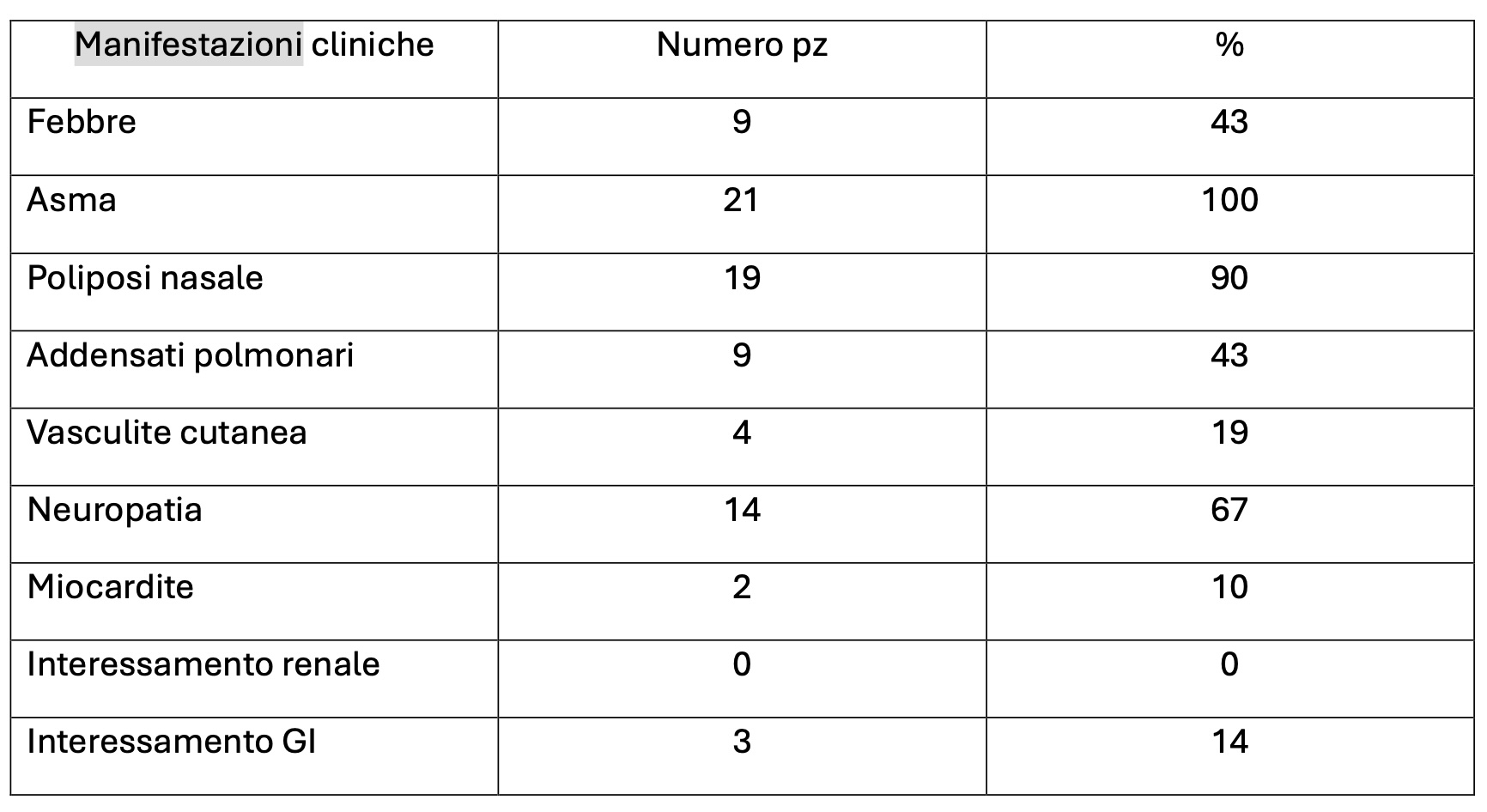
Results. The clinical description of patients with disease manifestations before starting mepolizumab therapy is reported in Table 1. All patients had an excellent response, with a reduction in the number of asthma flares, normalization of eosinophil counts, resolution of cutaneous vasculitis, improvement in nasal polyps, neuropathy, gastrointestinal and myocardial involvement. During follow-up, 13 patients (62%) were able to discontinue GCs, and in the remaining 8 cases, a dose of ≤5 mg/day was achieved. No adverse events leading to drug discontinuation occurred.
Conclusions. In our cohort of patients with EGPA, mepolizumab confirmed its efficacy in reducing disease activity, its excellent safety profile and its steroid-sparing effect, allowing us to interrupt GCs in more than 60% of patients, and to reduce the daily dosage below 5 mg in the rest of the case series.
Downloads
How to Cite

This work is licensed under a Creative Commons Attribution-NonCommercial 4.0 International License.
PAGEPress has chosen to apply the Creative Commons Attribution NonCommercial 4.0 International License (CC BY-NC 4.0) to all manuscripts to be published.