
 https://doi.org/10.4081/reumatismo.2025.2053
PO:22:029 | Impact of mepolizumab on idiopathic hypereosinophilic syndromes: analysis of a monocentric retrospective cohort
Jacopo Mora1, Francesca Regola1, Paola Toniati2, Ilaria Cavazzana1, Franco Franceschini1. | 1ASST Spedali Civili e Università degli Studi di Brescia, Brescia, Italy; 2ASST Spedali Civili di Brescia, Brescia, Italy.
All claims expressed in this article are solely those of the authors and do not necessarily represent those of their affiliated organizations, or those of the publisher, the editors and the reviewers. Any product that may be evaluated in this article or claim that may be made by its manufacturer is not guaranteed or endorsed by the publisher.
Background. Idiopathic hypereosinophilic syndromes (iHES) are characterized by persistent eosinophilia and eosinophil-mediated organ damage. Mepolizumab, an anti-interleukin-5 monoclonal antibody, has proven effective in reducing eosinophilic burden, controlling clinical manifestations, and decreasing the reliance on glucocorticoids (GCs). This study aims to evaluate the clinical and steroid-sparing efficacy of mepolizumab in a monocentric retrospective cohort of patients with iHES.
Methods We enrolled patients with iHES, diagnosed at our Center according to the 2023 diagnostic criteria for HES (1), and treated with mepolizumab. Variables were analyzed immediately before mepolizumab initiation (t0) and at 1 (t1), 3 (t3), 6 (t6), 12 (t12), 18 (t18), and 24 (t24) months after treatment, using Wilcoxon test for paired data (significance: p < 0.05).
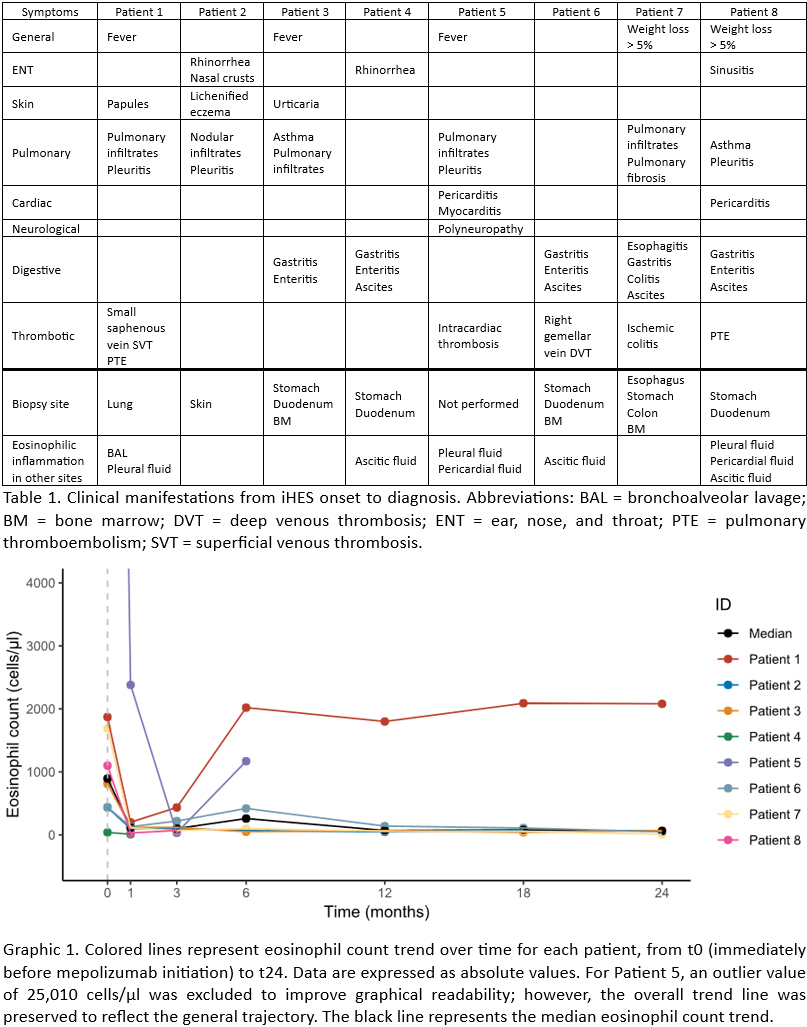
Results. Eight patients were enrolled [M 50%, F 50%; median diagnostic delay: 6 (2-18) months]. Clinical features at onset are reported in Figure 1, Table 1. At iHES onset, median eosinophil count (EC) was 6,375 (4,570-12,282) cells/µl, 1 patient showed eosinophilia and 7 patients hypereosinophilia. The median time from diagnosis to mepolizumab initiation was 3 (0-14) months, with a median follow-up of 21 (5-24) months. Seven patients had received GCs before mepolizumab and were still on steroid therapy at the time of initiation. Furthermore, patient 2 had been treated with cyclosporine A for lichenified trunk eczema. At t0, 2 patients showed eosinophilia and 3 hypereosinophilia. A marked decrease in EC was observed as early as t1 [median t0: 980 (895-439) cells/µl; median t1: 116 (82-147) cells/µl; p: 0.0078], which was maintained at the last available follow-up [median at last follow-up: 70 (40-352) cells/µl; p: 0.0234]. At t6, 2 patients showed a significant rebound in ECs. In patient 1, hypereosinophilia persisted from t6 onward, and both GCs and dupilumab were introduced at t18. Patient 6 was hospitalized at t6 and later died from septic shock (notably, with a history of substance abuse) (Figure 1, Graphic 1). Overall, the median percentage reduction in EC was 90 (80-93) % (p: 0.0006). During follow-up, GCs were discontinued in 5 patients and later reintroduced in 3 cases due to iHES relapses. The comparison of GC daily dose at t0 and at the last available follow-up showed a significant reduction [median at t0: 50 (3-50) mg/day; median at last follow-up: 0 (0-5) mg/day; p: 0.0234]. The median number of iHES relapses before [1 (1-2)] and after [0 (0-1)] mepolizumab initiation showed a trend toward statistical significance, although not reaching it (p: 0.0655).
Conclusions. Preliminary findings from our cohort suggest that mepolizumab may be effective in achieving clinical control and reducing GC dependence in patients with iHES.
 References: (1) Valent P, et al. Proposed refined diagnostic criteria and classification of eosinophil disorders and related syndromes. Allergy. 2023 Jan;78(1):47-59
Downloads
How to Cite

This work is licensed under a Creative Commons Attribution-NonCommercial 4.0 International License.
PAGEPress has chosen to apply the Creative Commons Attribution NonCommercial 4.0 International License (CC BY-NC 4.0) to all manuscripts to be published.