

 https://doi.org/10.4081/reumatismo.2025.1971
CO:05:2 | An OMERACT study for the development of an algorithm for automatic identification of calcium pyrophosphate deposition by ultrasound: the Crystal Artificial Intelligence Monitoring Study
Daniele Cirillo1, Tito Bassani2, Silvia Sirotti1|2, Greta Pellegrino1|2, Alessandro Lucia1, Rodolfo Fabbri1, Laura Pezzoni1, Piercarlo Sarzi Puttini1|2, Georgios Filippou1|2. | 1Università degli Studi di Milano; 2IRCCS Ospedale Galeazzi - Sant'Ambrogio, Milano, Italy
All claims expressed in this article are solely those of the authors and do not necessarily represent those of their affiliated organizations, or those of the publisher, the editors and the reviewers. Any product that may be evaluated in this article or claim that may be made by its manufacturer is not guaranteed or endorsed by the publisher.
Background. Calcium pyrophosphate deposition (CPPD) is one of the most frequent causes of chronic arthropathy in individuals over 60. Ultrasound (US) has recently become central in the diagnostic process, with the OMERACT group defining elementary US lesions and a standardized scoring system. Despite its increasing use, US remains operator-dependent and requires specialized expertise to reduce diagnostic variability. This study aims to develop an Artificial Intelligence (AI) tool capable of automatically identifying and grading CPPD in knee menisci using US images.
Materials and Methods. This project is part of an international initiative to develop AI algorithms for detecting and scoring elementary US lesions in CPPD and gout. Nineteen rheumatologists from ten countries contributed a total of 446 high-quality US images of CPPD in the knee menisci, previously classified by expert consensus into four grades (0 to 3). Each image was manually annotated to isolate the meniscal region using 3DSlicer software. A deep learning approach based on transfer learning was employed, utilizing convolutional neural networks (CNNs) pretrained on the ImageNet dataset. The models were fine-tuned on the collected dataset and trained using standard techniques including early stopping, data augmentation (rotation, shift, zoom, flipping), and class weighting to handle data imbalance. The dataset was split into training (80%) and validation (20%) subsets while preserving grade distribution. Model performance was evaluated using standard classification metrics: accuracy, precision, recall, and F1-score. All processes were implemented using Python, OpenCV, and TensorFlow-Keras frameworks.
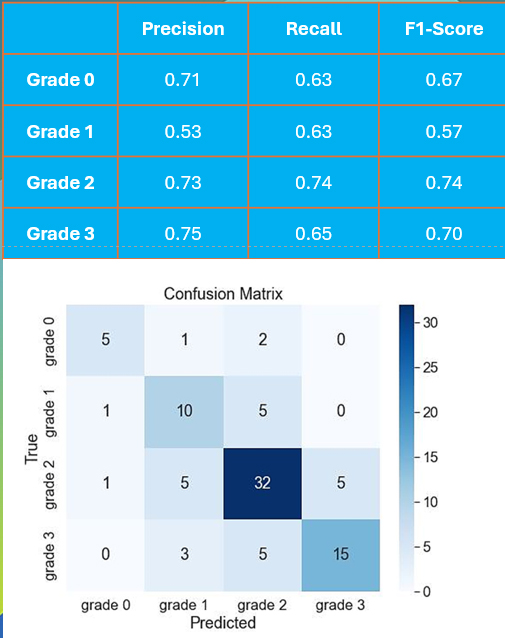
Results. The image dataset showed an unbalanced distribution: 9% grade 0, 18% grade 1, 48% grade 2, and 25% grade 3. The highest accuracy obtained for binary classification (CPPD presence vs. absence) was 0.69. The model showed acceptable performance in identifying grades 0, 2, and 3, while classification of grade 1 was less reliable. Precision and recall values were generally consistent across the grades, with the exception of grade 1, which showed lower precision. These results reflect both the potential and the limitations of the current model in handling the CPPD grading task with a relatively small and imbalanced dataset.
Conclusions. Although the model demonstrates initial potential, its current performance is below the threshold required for clinical application. The limited dataset size and imbalance across grades likely constrained the deep learning model’s accuracy. Future development will focus on expanding the dataset, achieving better grade distribution, applying cross-validation techniques, and exploring advanced approaches such as semantic segmentation. These steps are essential to improve model reliability and enable its use in real-world diagnostic workflows (see Table below).. 
Downloads
How to Cite

This work is licensed under a Creative Commons Attribution-NonCommercial 4.0 International License.
PAGEPress has chosen to apply the Creative Commons Attribution NonCommercial 4.0 International License (CC BY-NC 4.0) to all manuscripts to be published.