
62nd National Congress of the Italian Society of Rheumatology
Vol. 77 No. s1 (2025): Abstract book of the 62th Conference of the Italian Society for...
 https://doi.org/10.4081/reumatismo.2025.2385
PO:35:226 | Red flags raising suspicion of Eosinophilic Granulomatosis with Polyangiitis (EGPA): results from the European EGPAware Delphi study
Gabriele Brembilla1, Bernhard Hellmich2|3, Apostolos Bossios4|5, Chistian Domingo-Ribas6|7, Giacomo Emmi8, Cristina Ponte9|10, Maria Roser Solans-Laque11, Íñigo Jesus Rúa-Figueroa12, Augusto Vaglio13, Dimitrios Vassilopoulos14, Konstantina Kallinikou15, Benjamin Terrier16 | 1GSK Verona, Italy; 2Medius Klinik Kirchheim Kirchheim unter Teck Germany; 3Teaching Hospital of the University of Tübingen Tübingen Germany; 4Karolinska University Hospital Stockholm, Sweden; 5Karolinska Institutet Solna, Sweden; 6Parc Taulí University Hospital. Parc Taulí Research and Innovation Institute I3PT-CERCA Barcelona Spain; 7Department of Medicine, Universitat Autònoma de Barcelona UAB Barcelona Spain; 8University of Trieste, UNITS, Trieste, Italy; 9Santa Maria Hospital Lisbon, Portugal; 10Lisbon Academic Medical Center Lisbon, Portugal; 11Vall d'Hebron University Hospital Barcelona Spain; 12Gran Canaria Doctor Negrín Hospital Las Palmas de Gran Canaria Spain; 13University of Florence Florence, Italy; 14National and Kapodistrian University of Athens School of Medicine Athens, Greece; 15GSK Athens, Greece; 16Cochin Hospital Paris, France
Publisher's note
All claims expressed in this article are solely those of the authors and do not necessarily represent those of their affiliated organizations, or those of the publisher, the editors and the reviewers. Any product that may be evaluated in this article or claim that may be made by its manufacturer is not guaranteed or endorsed by the publisher.
All claims expressed in this article are solely those of the authors and do not necessarily represent those of their affiliated organizations, or those of the publisher, the editors and the reviewers. Any product that may be evaluated in this article or claim that may be made by its manufacturer is not guaranteed or endorsed by the publisher.
145
Views
Methods. EGPAware is led by a panel of European EGPA experts (4 rheumatologists, 2 internal medicine specialists, 2 pulmonologists, a nephrologist and an immunologist). The Delphi questionnaire covered panellists’ profile, current clinical management and red flags for EGPA suspicion in adult patients with asthma and blood eosinophilia (>1000 cells/mcL or >500 cells/mcL, if previously treated with any medication that may have altered the blood eosinophil count). The committee defined profiling questions and proposed red flags. Consensus was determined with =/>70% agreement. In round two, statements with <70% consensus were revisited, and the 10 most pertinent signs based on clinical relevance and frequency of observation were ranked (based on panellists’ experience). Data was analysed with descriptive statistics.
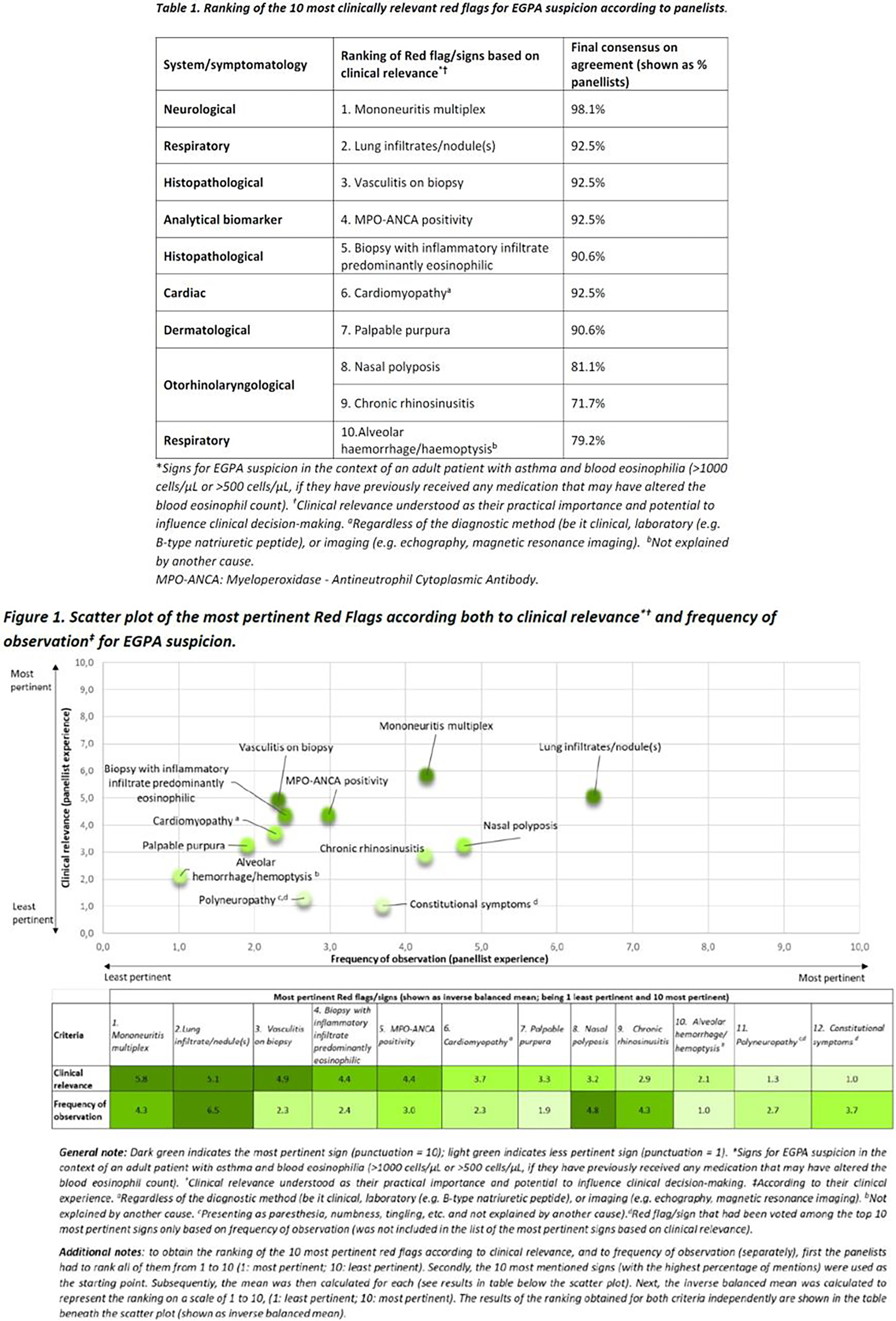
Results. 53 EGPA-treating physicians from 15 countries completed the two Delphi survey rounds. The panel included rheumatologists (35.8%), pulmonologists (30.2%), internal medicine physicians (11.3%), immunologists (9.4%), nephrologists (5.7%), allergologists (5.7%) and a dermatologist (1.9%). Half had over 15 years of experience managing EGPA, all using a multidisciplinary approach. Consensus was reached on 25 out of 47 red flags for EGPA suspicion, including mononeuritis multiplex (98.1%), lung infiltrate/nodule(s) (92.5%), alveolar haemorrhage (79.2%), retinal vasculitis (73.6%) and episcleritis/scleritis (71.7%). General signs like constitutional symptoms (weight loss, fever, fatigue etc.) (79.2%) and digital ischaemia (73.6%) also achieved consensus. Alveolar haemorrhage and digital ischemia reached consensus despite their rarity, while frequent non-specific findings like proteinuria did not. Proteinuria (67.9%) and elevated creatinine with or without active urine sediment (66.0%) failed consensus despite glomerulonephritis achieving high consensus (89.4%). Cardiomegaly (60.4%), chronic diarrhoea (18.9%) and venous thrombosis (54.7%) also failed to reach consensus. However, in the context of asthma and blood eosinophilia, these signs could warn of other conditions. The most important red flags ranked by clinical relevance included mononeuritis multiplex, lung infiltrates/nodules, vasculitis on biopsy and MPO-ANCA positivity (Table 1), while the most frequently observed red flags were lung infiltrates/nodules, nasal polyposis and mononeuritis multiplex (combined prioritisation in Figure 1).
Conclusions. EGPAware is the first European study to provide a checklist of red flags, developed with inputs from a multidisciplinary panel, for identifying potential EGPA cases, improving referral and treatment timelines. The study reveals variability in how physicians prioritise red flags, emphasising the need for unified training and a multidisciplinary approach to EGPA management.
Downloads
Download data is not yet available.
How to Cite
1.
PO:35:226 | Red flags raising suspicion of Eosinophilic Granulomatosis with Polyangiitis (EGPA): results from the European EGPAware Delphi study: Gabriele Brembilla1, Bernhard Hellmich2|3, Apostolos Bossios4|5, Chistian Domingo-Ribas6|7, Giacomo Emmi8, Cristina Ponte9|10, Maria Roser Solans-Laque11, Íñigo Jesus Rúa-Figueroa12, Augusto Vaglio13, Dimitrios Vassilopoulos14, Konstantina Kallinikou15, Benjamin Terrier16 | 1GSK Verona, Italy; 2Medius Klinik Kirchheim Kirchheim unter Teck Germany; 3Teaching Hospital of the University of Tübingen Tübingen Germany; 4Karolinska University Hospital Stockholm, Sweden; 5Karolinska Institutet Solna, Sweden; 6Parc Taulí University Hospital. Parc Taulí Research and Innovation Institute I3PT-CERCA Barcelona Spain; 7Department of Medicine, Universitat Autònoma de Barcelona UAB Barcelona Spain; 8University of Trieste, UNITS, Trieste, Italy; 9Santa Maria Hospital Lisbon, Portugal; 10Lisbon Academic Medical Center Lisbon, Portugal; 11Vall d’Hebron University Hospital Barcelona Spain; 12Gran Canaria Doctor Negrín Hospital Las Palmas de Gran Canaria Spain; 13University of Florence Florence, Italy; 14National and Kapodistrian University of Athens School of Medicine Athens, Greece; 15GSK Athens, Greece; 16Cochin Hospital Paris, France. Reumatismo [Internet]. 2026 Mar. 18 [cited 2026 Oct. 21];77(s1). Available from: https://www.reumatismo.org/reuma/article/view/2385
Copyright (c) 2026 The Author(s)


This work is licensed under a Creative Commons Attribution-NonCommercial 4.0 International License.
PAGEPress has chosen to apply the Creative Commons Attribution NonCommercial 4.0 International License (CC BY-NC 4.0) to all manuscripts to be published.