
62nd National Congress of the Italian Society of Rheumatology
Vol. 77 No. s1 (2025): Abstract book of the 62th Conference of the Italian Society for...
 https://doi.org/10.4081/reumatismo.2025.2381
PO:35:218 | Switching the dose of mepolizumab in patients with Eosinophilic Granulomatosis with Polyangiitis (EGPA): a European retrospective multicentre real-world study
Edoardo Biancalana1, Irene Mattioli1, Emanuele Chiara2, Danilo Malandrino1, Maria Canfora1, Palmerini Miki1, Maria Paola Lisi1, Michela Gasparotto3, Paola Tomietto3, Maria Letizia Urban1, Giacomo Bagni1, Elena Silvestri1, Alessandra Bettiol3, Augusto Vaglio3, Giacomo Emmi2 | 1Department of Experimental and Clinical Medicine, University of Florence Firenze, Italy; 2Department of Medical, Surgery and Health Sciences, University of Trieste Trieste, Italy; 3Clinical Medicine and Rheumatology Unit, Cattinara University Hospital, Trieste, Trieste, Italy; 4Department of Biomedical, Experimental and Clinical Sciences Mario Serio, University of Florence Firenze, Italy
Publisher's note
All claims expressed in this article are solely those of the authors and do not necessarily represent those of their affiliated organizations, or those of the publisher, the editors and the reviewers. Any product that may be evaluated in this article or claim that may be made by its manufacturer is not guaranteed or endorsed by the publisher.
All claims expressed in this article are solely those of the authors and do not necessarily represent those of their affiliated organizations, or those of the publisher, the editors and the reviewers. Any product that may be evaluated in this article or claim that may be made by its manufacturer is not guaranteed or endorsed by the publisher.
152
Views
Methods. We included patients with EGPA, classified according to ACR and/or MIRRA trial criteria, treated with mepolizumab and followed at 50 European referral centres. Patients required at least three months of follow-up and a documented dose switch. Reasons for switching, clinical outcomes, and oral corticosteroid (OCS) use after the switch were assessed. Complete response (CR) was defined as BVAS = 0 with prednisone < 4 mg/day; partial response (PR) as BVAS = 0 with prednisone > 4 mg/day.
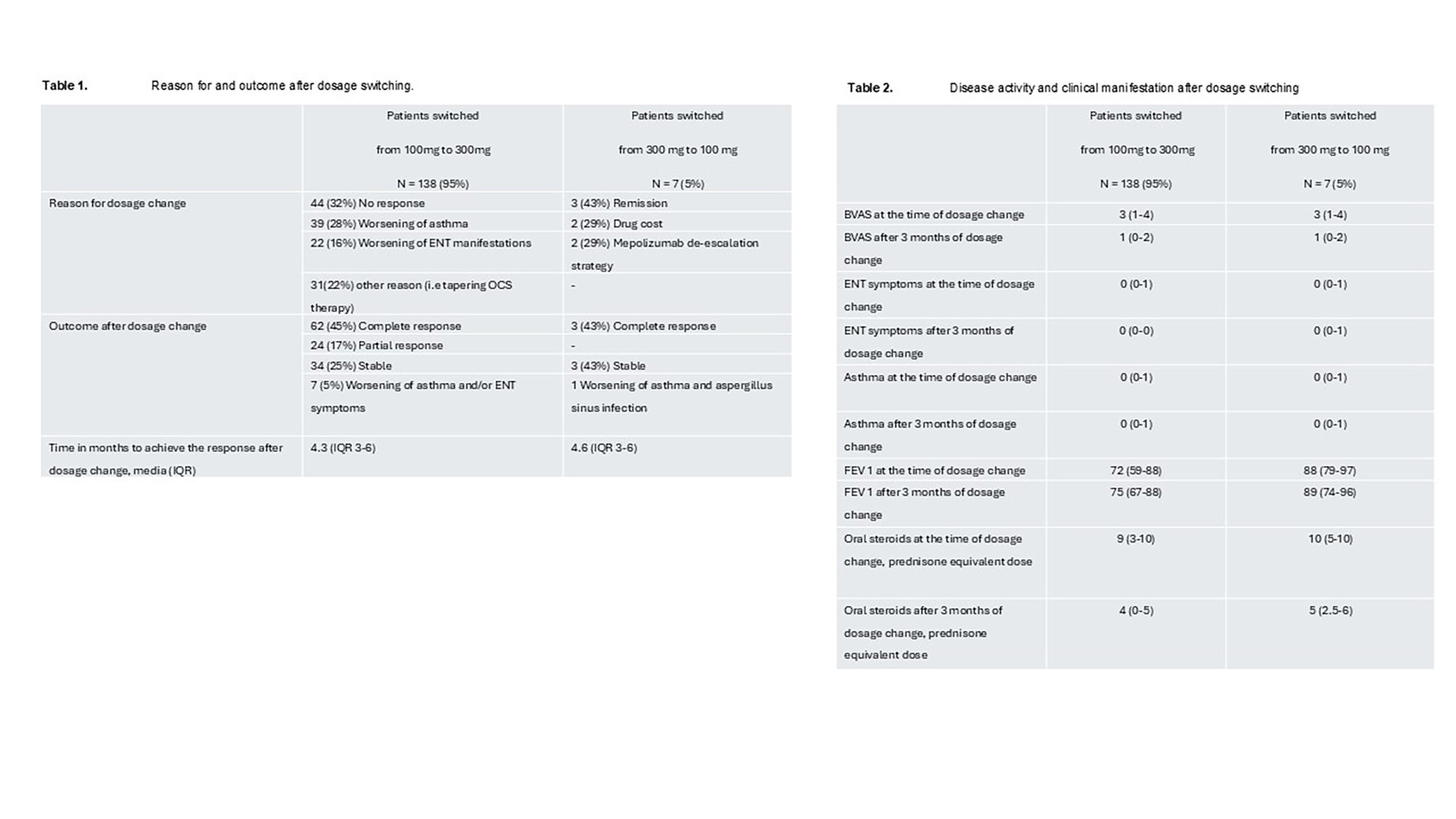
Results. The final cohort included 145 patients with EGPA, of whom 138 (95%) switched mepolizumab dosage from 100 mg to 300 mg every four weeks, while 7 patients (5%) switched from 300 mg to 100 mg (Table 1). The main reasons for escalation were suboptimal disease control (32%), worsening asthma (28%), ENT symptom deterioration (16%), and facilitating OCS tapering (22%). De-escalation was mainly due to remission (43%), planned strategy (29%), or cost concerns (29%). Among those escalating to 300 mg, 62 (45%) achieved CR, 24 (17%) PR, and 34 (25%) remained stable. Clinical improvement was observed after a median of 4.3 months (IQR 3–6). Only 5% worsened. In the de-escalation group, 3 patients (43%) reached CR, 3 remained stable, and 1 worsened due to an infectious complication. Median time to response was 4.6 months (IQR 3–6). OCS dose decreased in both groups: from 9 to 4 mg/day after escalation, and from 10 to 5 mg/day after de-escalation. BVAS scores also improved in both subgroups (Table 2).
Conclusions. In real-world clinical practice , switching mepolizumab dose from 100 to 300 mg every four weeks enhances disease control and remission rates in patients with EGPA who respond inadequately to 100 mg. Although based on a limited cohort, dose de-escalation from 300 to 100 mg does not seem to compromise clinical control and may be considered as a strategy following sustained remission.
Downloads
Download data is not yet available.
How to Cite
1.
di Reumatologia SI. PO:35:218 | Switching the dose of mepolizumab in patients with Eosinophilic Granulomatosis with Polyangiitis (EGPA): a European retrospective multicentre real-world study: Edoardo Biancalana1, Irene Mattioli1, Emanuele Chiara2, Danilo Malandrino1, Maria Canfora1, Palmerini Miki1, Maria Paola Lisi1, Michela Gasparotto3, Paola Tomietto3, Maria Letizia Urban1, Giacomo Bagni1, Elena Silvestri1, Alessandra Bettiol3, Augusto Vaglio3, Giacomo Emmi2 | 1Department of Experimental and Clinical Medicine, University of Florence Firenze, Italy; 2Department of Medical, Surgery and Health Sciences, University of Trieste Trieste, Italy; 3Clinical Medicine and Rheumatology Unit, Cattinara University Hospital, Trieste, Trieste, Italy; 4Department of Biomedical, Experimental and Clinical Sciences Mario Serio, University of Florence Firenze, Italy. Reumatismo [Internet]. 2026 Mar. 18 [cited 2026 Oct. 25];77(s1). Available from: https://www.reumatismo.org/reuma/article/view/2381
Copyright (c) 2026 The Author(s)


This work is licensed under a Creative Commons Attribution-NonCommercial 4.0 International License.
PAGEPress has chosen to apply the Creative Commons Attribution NonCommercial 4.0 International License (CC BY-NC 4.0) to all manuscripts to be published.