
62nd National Congress of the Italian Society of Rheumatology
Vol. 77 No. s1 (2025): Abstract book of the 62th Conference of the Italian Society for...
 https://doi.org/10.4081/reumatismo.2025.2325
PO:15:209 | Attainment of remission or lupus low disease activity state in single center Lupus Clinic
Paola Tedoldi1|2, Silvia Ebe Lucia Della Pina1|2, Claudia Barison1|2, Chiara Orlandi1|2, Cecilia Nalli1, Micaela Fredi2, Ilaria Cavazzana1|2, Franco Franceschini1|2 | 1Rheumatology and Clinical Immunology Unit- ERN ReCONNET, ASST Spedali Civili of Brescia Brescia, Italy; 2Department of Clinical and Experimental Sciences, University of Brescia Brescia, Italy
Publisher's note
All claims expressed in this article are solely those of the authors and do not necessarily represent those of their affiliated organizations, or those of the publisher, the editors and the reviewers. Any product that may be evaluated in this article or claim that may be made by its manufacturer is not guaranteed or endorsed by the publisher.
All claims expressed in this article are solely those of the authors and do not necessarily represent those of their affiliated organizations, or those of the publisher, the editors and the reviewers. Any product that may be evaluated in this article or claim that may be made by its manufacturer is not guaranteed or endorsed by the publisher.
153
Views
Materials and Methods. We examined 401 medical charts of patients affected by SLE, who reached our Lupus Clinic from January 2023 to May 2025. Disease activity, cumulative organ damage and remission were recorded according to validated indices such as SLEDAI-2K, SLICC Damage Index, LLDAS and DORIS at the last available visit. GC, HCQ, DMARDS, biological therapies were also evaluated at the same time point. Categorical variables were reported as number/percentage, continuous variables were expressed as mean (±standard deviation) values.
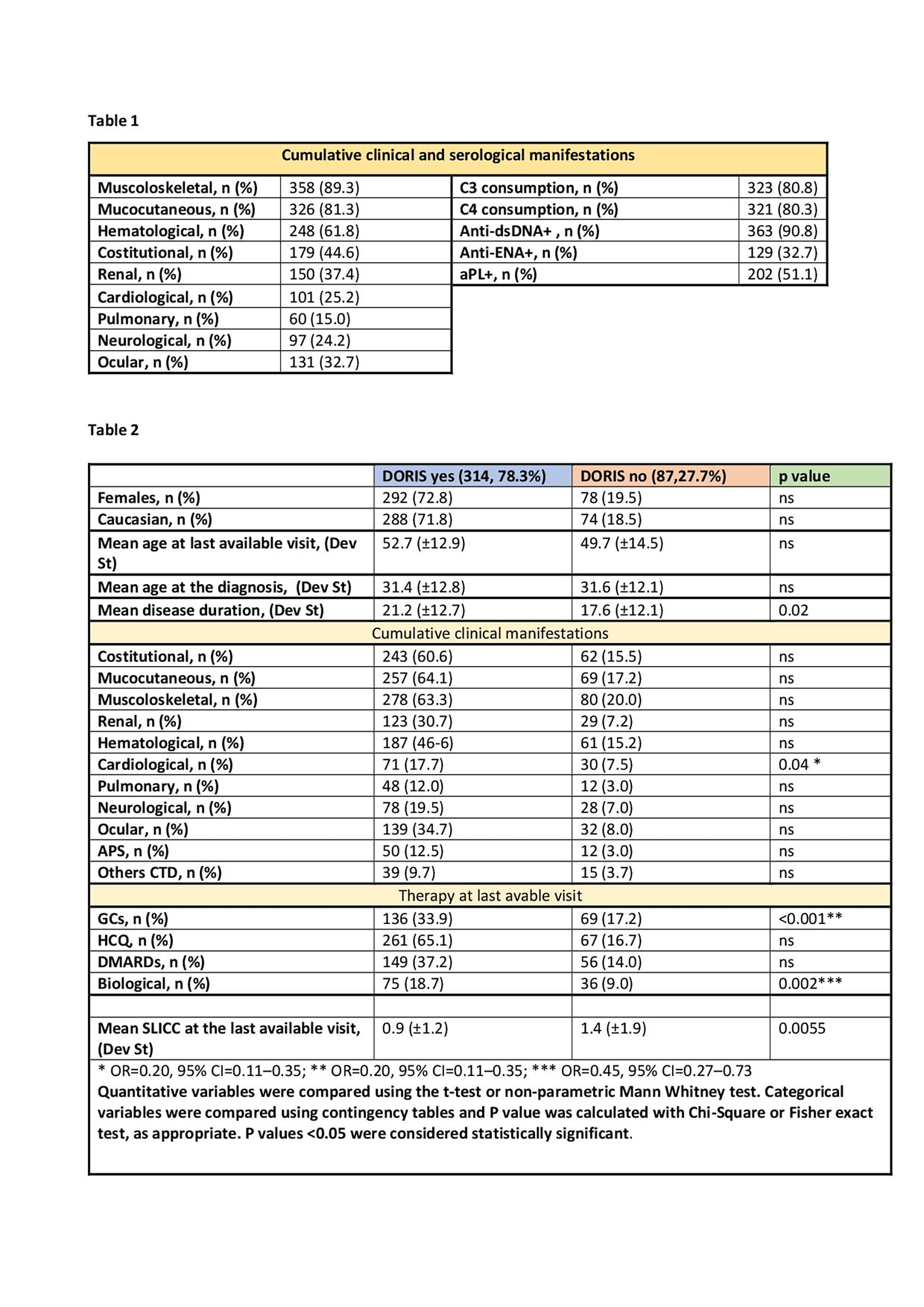
Results. Among 401 patients, 370(92.3%) were females and 362(90.3%) were Caucasian; mean age at diagnosis was 31 years(±12.7), with a mean disease duration of 20 years(±12.6). Cumulative clinical and serological manifestations are reported in Table1. At the last visit mean SLEDAI-2K was 1.3(±1.9) and 51.1% received GC at a mean daily dose of 4.4mg(±3.4), 81.2% HCQ, 50.1% DMARDs, and 23.4% biological therapies. 350(87.3%) reached the LLDAS, while 314(78.3%) met the DORIS criteria. Characteristics of patients in remission or not are detailed in Table2. Notably, patients meeting DORIS criteria showed less biologics(p=0.002), longer disease duration(p=0.02) and lower SLICC-SDI(p=0.0055). Among patients who did not achieve DORIS remission, 13(14.9%) required GC>5mg/day; 48(55.2%) had cSLEDAI>0, 10(11.5%) exhibited both cSLEDAI>0 and GC>5mg/day. Lastly, 14(16.1%) showed a Physician Global Assessment score>0.5. Among patients in remission, 23(7.3%) were still receiving 5mg/day of GCs. Of these, 3(13%) were tapering GC following a recent flare, 12(52.2%) couldn’t reduce the dose due to symptom recurrence, 6(26.1%) had no recent tapering attempts and 2(12.7%) continued GC for other indications.
Conclusions. A substantial proportion of long-standing SLE achieved DORIS remission, associated with longer disease duration, lower organ damage, and reduced use of CGs and biologics. Persistent low-dose GC therapy in some patients highlights the complexity of tapering strategies and suggest that formal remission does not always coincide with complete steroid withdrawal. Personalized management remains essential to optimize long-term outcomes. (1)Sanchèz et al,Rheumathology,2023 (2)Arnaud et al,Rheumathology,2020
Downloads
Download data is not yet available.
How to Cite
1.
PO:15:209 | Attainment of remission or lupus low disease activity state in single center Lupus Clinic: Paola Tedoldi1|2, Silvia Ebe Lucia Della Pina1|2, Claudia Barison1|2, Chiara Orlandi1|2, Cecilia Nalli1, Micaela Fredi2, Ilaria Cavazzana1|2, Franco Franceschini1|2 | 1Rheumatology and Clinical Immunology Unit- ERN ReCONNET, ASST Spedali Civili of Brescia Brescia, Italy; 2Department of Clinical and Experimental Sciences, University of Brescia Brescia, Italy. Reumatismo [Internet]. 2026 Mar. 18 [cited 2026 Oct. 19];77(s1). Available from: https://www.reumatismo.org/reuma/article/view/2325
Copyright (c) 2026 The Author(s)


This work is licensed under a Creative Commons Attribution-NonCommercial 4.0 International License.
PAGEPress has chosen to apply the Creative Commons Attribution NonCommercial 4.0 International License (CC BY-NC 4.0) to all manuscripts to be published.