
62nd National Congress of the Italian Society of Rheumatology
Vol. 77 No. s1 (2025): Abstract book of the 62th Conference of the Italian Society for...
 https://doi.org/10.4081/reumatismo.2025.2321
PO:14:198 | Temporal Trends in LLDAS and DORIS Achievement in SLE: Impact of Evolving International Recommendations
Laura Coladonato1, Marco Fornaro1, Angelica Napoletano1, Daniele Catamerò1, Giuseppe Lopalco1, Florenzo Iannone1 | 1UOC Reumatologia, Policlinico di Bari, DiMePre-J Bari, Italy
Publisher's note
All claims expressed in this article are solely those of the authors and do not necessarily represent those of their affiliated organizations, or those of the publisher, the editors and the reviewers. Any product that may be evaluated in this article or claim that may be made by its manufacturer is not guaranteed or endorsed by the publisher.
All claims expressed in this article are solely those of the authors and do not necessarily represent those of their affiliated organizations, or those of the publisher, the editors and the reviewers. Any product that may be evaluated in this article or claim that may be made by its manufacturer is not guaranteed or endorsed by the publisher.
133
Views
Materials and Methods. We conducted a retrospective analysis of 110 patients diagnosed with SLE, each with a minimum follow-up duration of 6 months. Clinical data were stratified into three time frames: Pre-2019, Pre-2023, and Post-2023, corresponding to the publication of updated international treatment guidelines. We evaluated the proportion of patients achieving LLDAS (according to both the 2019 and 2023 definitions) and DORIS remission at visits occurring prior to 2019, prior to 2023, and at the most recent visit after 2023, in alignment with the timing of these recommendations. Additionally, we analyzed longitudinal trends in corticosteroid use (prednisone-equivalent dose), Systemic Lupus Erythematosus Disease Activity Index (SLEDAI-2K), and Systemic Lupus International Collaborating Clinics Damage Index (SDI). Statistical significance was set at p<0.05. Definition of Remission (DORIS) • Clinical SLEDAI-2K = 0 (excluding serology), • Physician Global Assessment (PGA) < 0.5, • Stable use of antimalarials and immunosuppressants is allowed, • Glucocorticoids must be l.e. 5 mg/day LLDAS Definitions • LLDAS 2019: SLEDAI-2K l.e. 4 (excluding major organ involvement), no new clinical activity, PGA l.e. 1, and prednisone dose l.e. 7.5 mg/day. • LLDAS 2023: SLEDAI-2K l.e. 4 (excluding renal, CNS, and vasculitis activity), PGA l.e. 1, and corticosteroids l.e. 5 mg/day.
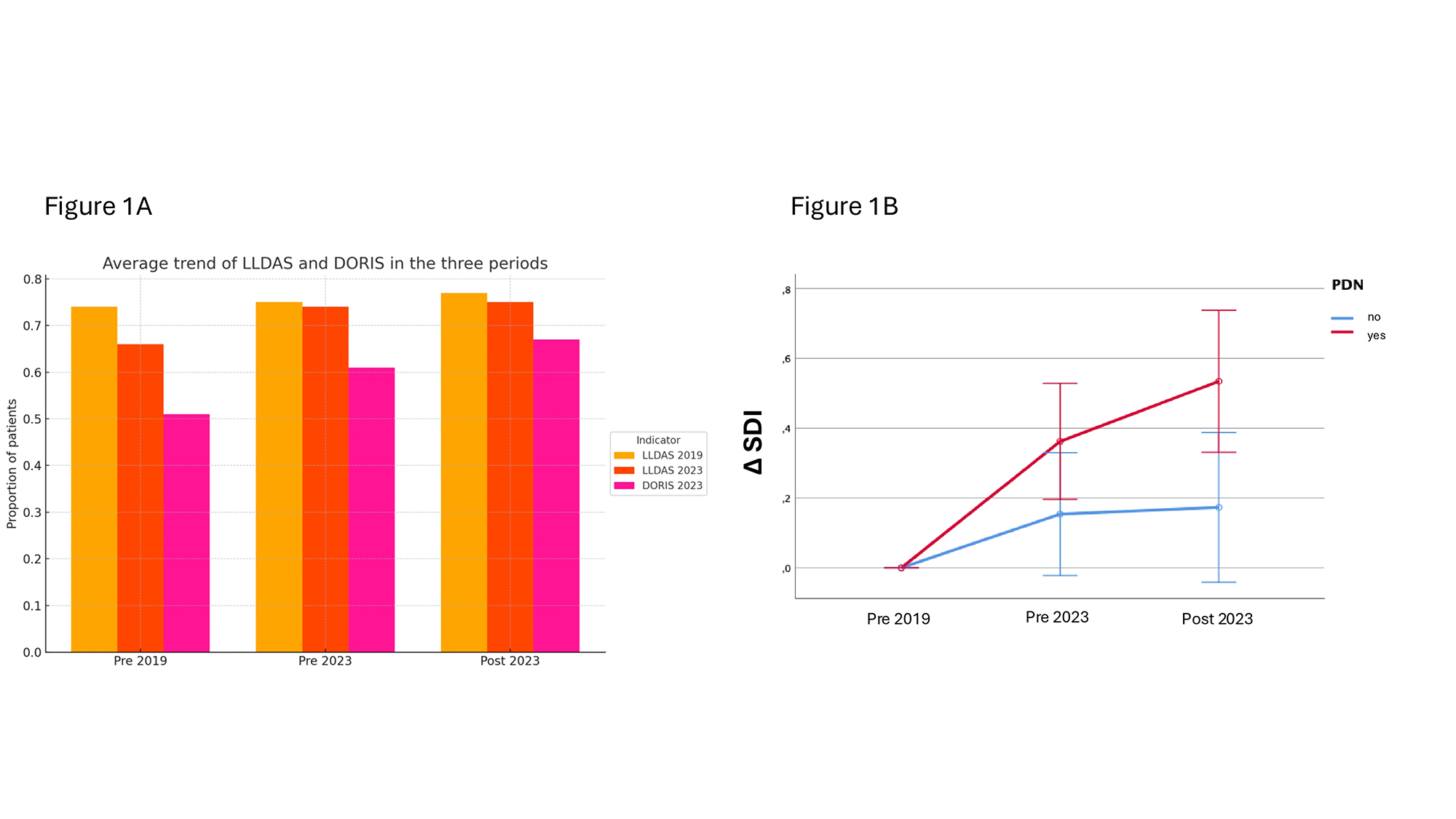
Results. The percentage of patients achieving LLDAS (2019 definition) increased slightly over time: 74% in Pre-2019, 75% in Pre-2023, and 77% in Post-2023. LLDAS 2023 achievement rose more substantially from 66% to 75%. DORIS remission showed the most marked improvement, from 51% to 67% (p<0.05 between Pre-2019 and Post-2023) (Figure 1A). Mean (SD) prednisone use declined significantly from mean (SD) 4.7 (4.1) mg/day to 2.4 (3.3) mg/day (p<0.05). SLEDAI showed a modest decrease, while mean (SD) SDI increased slightly from 0.9 (1.4) to 1.2 (1.7). Notably, patients who discontinued corticosteroids exhibited significantly less SDI progression (Figure 1B, p<0.05). Steroid exposure correlated positively with SDI (r = 0.324, p = 0.001) and SLEDAI-2K (r = 0.311, p = 0.001), while no direct correlation was found between SLEDAI-2K and SDI.
Conclusions. Our findings highlight a temporal improvement in disease control among SLE patients, as evidenced by increasing rates of LLDAS and DORIS remission, likely influenced by evolving international treatment guidelines. Achieving steroid-free status emerged as a critical factor in preventing long-term organ damage, underscoring the importance of glucocorticoid minimization. These results support the integration of treat-to-target strategies and steroid withdrawal as a key therapeutic objective in routine SLE management.
Downloads
Download data is not yet available.
How to Cite
1.
PO:14:198 | Temporal Trends in LLDAS and DORIS Achievement in SLE: Impact of Evolving International Recommendations: Laura Coladonato1, Marco Fornaro1, Angelica Napoletano1, Daniele Catamerò1, Giuseppe Lopalco1, Florenzo Iannone1 | 1UOC Reumatologia, Policlinico di Bari, DiMePre-J Bari, Italy. Reumatismo [Internet]. 2026 Mar. 18 [cited 2026 Oct. 19];77(s1). Available from: https://www.reumatismo.org/reuma/article/view/2321
Copyright (c) 2026 The Author(s)


This work is licensed under a Creative Commons Attribution-NonCommercial 4.0 International License.
PAGEPress has chosen to apply the Creative Commons Attribution NonCommercial 4.0 International License (CC BY-NC 4.0) to all manuscripts to be published.