
62nd National Congress of the Italian Society of Rheumatology
Vol. 77 No. s1 (2025): Abstract book of the 62th Conference of the Italian Society for...
 https://doi.org/10.4081/reumatismo.2025.2304
PO:07:098 | Reasons for treatment failure and their synovial correlate among patients with difficult-to-treat rheumatoid arthritis
Alessandro Giollo1, Mariangela Salvato1, Francesca Frizzera1, Kiren Khalid1, Lorenzo Di Luozzo1, Carlo Garaffoni2, Maria Capita2, Marianna Tamussin2, Giovanni Lanza2, Marny Fedrigo3, Annalisa Angelini3, Roberta Ramonda1, Ettore Silvagni2, Andrea Doria1 | 1UOC Reumatologia Padova, Italy; 2UOC Reumatologia Ferrara, Italy; 3UOC Patologia cardiovascolare Padova, Italy; 4UOC Anatomia Patologica Ferrara, Italy
Publisher's note
All claims expressed in this article are solely those of the authors and do not necessarily represent those of their affiliated organizations, or those of the publisher, the editors and the reviewers. Any product that may be evaluated in this article or claim that may be made by its manufacturer is not guaranteed or endorsed by the publisher.
All claims expressed in this article are solely those of the authors and do not necessarily represent those of their affiliated organizations, or those of the publisher, the editors and the reviewers. Any product that may be evaluated in this article or claim that may be made by its manufacturer is not guaranteed or endorsed by the publisher.
98
Views
Materials and Methods. The MATRIX-D2T was a prospective cohort, multi-centre study that included RA patients with moderate to high disease activity undergoing ultrasound-guided synovial tissue biopsy (UGSTB) at two institutions. Patients were eligible for inclusion if they fulfilled the EULAR D2TRA definition. The main tissue outcome was the Krenn Synovitis Score (KSS, ranging from 0 to 9); secondary outcomes included the main synovial pathotypes (lymphomyeloid, diffuse myeloid, pauci-immune fibroid), immunohistochemistry scores, and the count of lymphoid aggregates. The exposures comprised the number (1 to 5) of b/tsDMARDs that failed due to inefficacy (inefficacy score) or AEs (AEs score). All regression analyses were adjusted for disease duration.
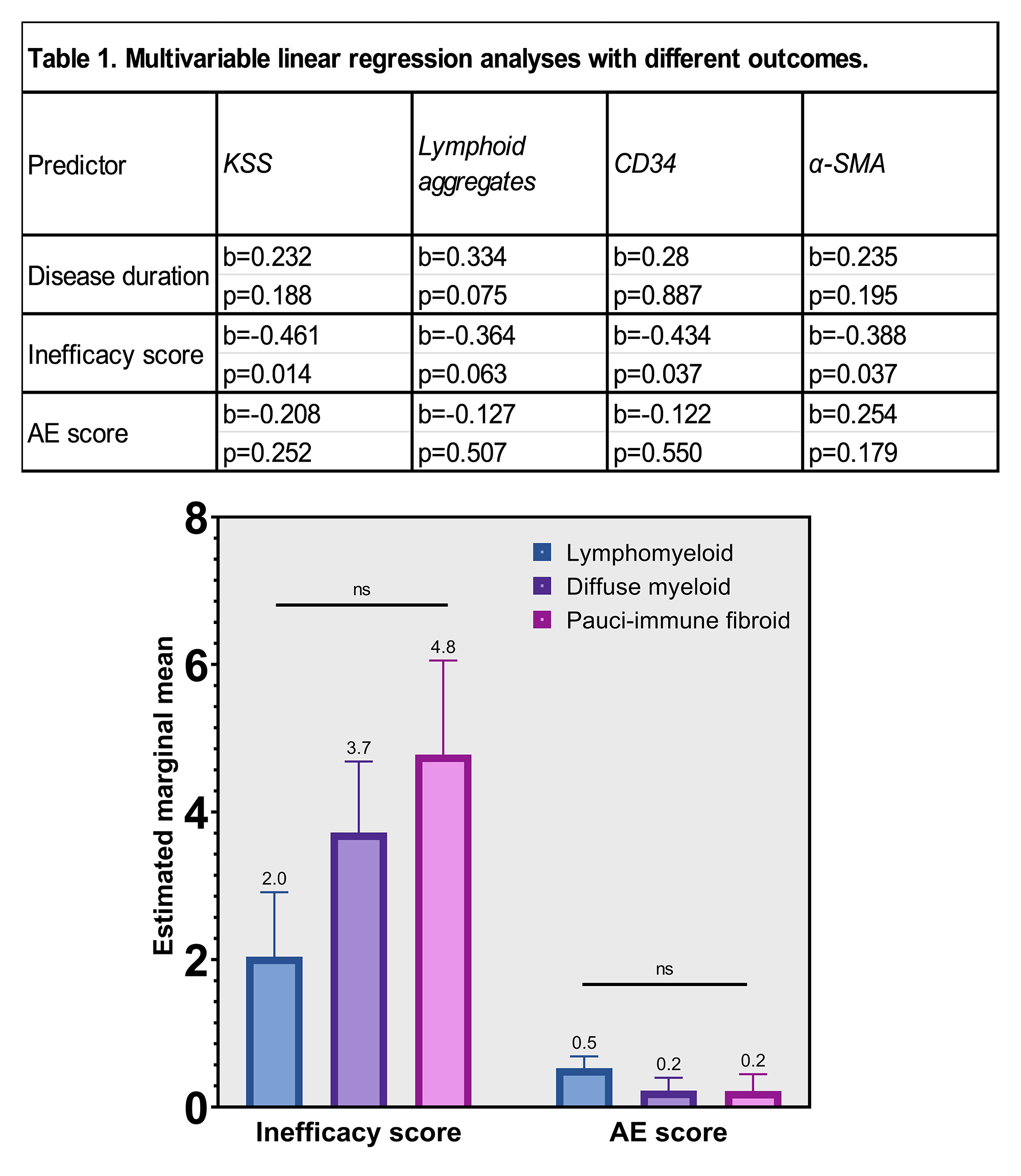
Results. Among 132 patients undergoing USGTB during the study period, 42 patients met the study criteria and were included (mean (SD) age 58 (11) years, duration 15 (10) years, females 62%). The median (IQR) number of failed b/tsDMARDs was 3 (2 to 5), and for csDMARDs, it was 2 (1 to 4). The median (IQR) probability of inefficacy:AE for treatment failure was 72% (40 to 86%). Inefficacy score was weakly correlated with PhGA (p=0.289, p=0.039) and not correlated with disease activity, duration, age, or PROMs; the AE score was not correlated with patients’ characteristics. In multivariable regression (Table 1), the inefficacy score was significantly and inversely associated with KSS, while the AE score was not. The quadratic term did not strengthen the association, nor was there interaction between inefficacy and AE scores or inefficacy scores and ACPA. A similar association with lymphoid aggregate count was close to significance. Immunohistochemistry analysis revealed CD34 and alfa-SMA were significantly and inversely associated with the inefficacy score. There was a trend for pauci-immune fibroid pathotype enrichment in patients with a higher probability of inefficacy and, likewise, a decreased frequency of lymphomyeloid pathotype (Figure); this trend was not seen for the AE scores. Sensitivity analysis of primary vs. secondary inefficacy and serious AEs vs. drug intolerance was underpowered to detect significant differences in KSS and other outcomes.
Conclusions. Compared to adverse events, inefficacy as the reason for D2TRA was moderately associated with the severity of synovitis. The higher occurrence of the pauci-immune fibroid pathotype and stromal density enriched with myofibroblasts and endothelial cells suggests exhausted synovial inflammation in some D2TRA patients with multidrug inefficacy.
Downloads
Download data is not yet available.
How to Cite
1.
PO:07:098 | Reasons for treatment failure and their synovial correlate among patients with difficult-to-treat rheumatoid arthritis: Alessandro Giollo1, Mariangela Salvato1, Francesca Frizzera1, Kiren Khalid1, Lorenzo Di Luozzo1, Carlo Garaffoni2, Maria Capita2, Marianna Tamussin2, Giovanni Lanza2, Marny Fedrigo3, Annalisa Angelini3, Roberta Ramonda1, Ettore Silvagni2, Andrea Doria1 | 1UOC Reumatologia Padova, Italy; 2UOC Reumatologia Ferrara, Italy; 3UOC Patologia cardiovascolare Padova, Italy; 4UOC Anatomia Patologica Ferrara, Italy. Reumatismo [Internet]. 2026 Mar. 18 [cited 2026 Oct. 16];77(s1). Available from: https://www.reumatismo.org/reuma/article/view/2304
Copyright (c) 2026 The Author(s)


This work is licensed under a Creative Commons Attribution-NonCommercial 4.0 International License.
PAGEPress has chosen to apply the Creative Commons Attribution NonCommercial 4.0 International License (CC BY-NC 4.0) to all manuscripts to be published.