62nd National Congress of the Italian Society of Rheumatology
Vol. 77 No. s1 (2025): Abstract book of the 62th Conference of the Italian Society for Rheumatology, Rimini, 26-29 November 2025

S14:5 | Erosive hand osteoarthritis: premenopausal onset and more severe disease progression

Marta Favero1, Giacomo Cozzi1, Clarissa Benvoluti1, Laura Scagnellato1, Gianluca Poncina1, Stefano Rizzetto1, Mariagrazia Lorenzin1, Roberta Ramonda1 | 1UOC di Reumatologia, Dipartimento di Medicina-DIMED, Università di Padova, Italy

Publisher's note
All claims expressed in this article are solely those of the authors and do not necessarily represent those of their affiliated organizations, or those of the publisher, the editors and the reviewers. Any product that may be evaluated in this article or claim that may be made by its manufacturer is not guaranteed or endorsed by the publisher.
Published: 26 November 2025
82
Views
0
Downloads

Authors

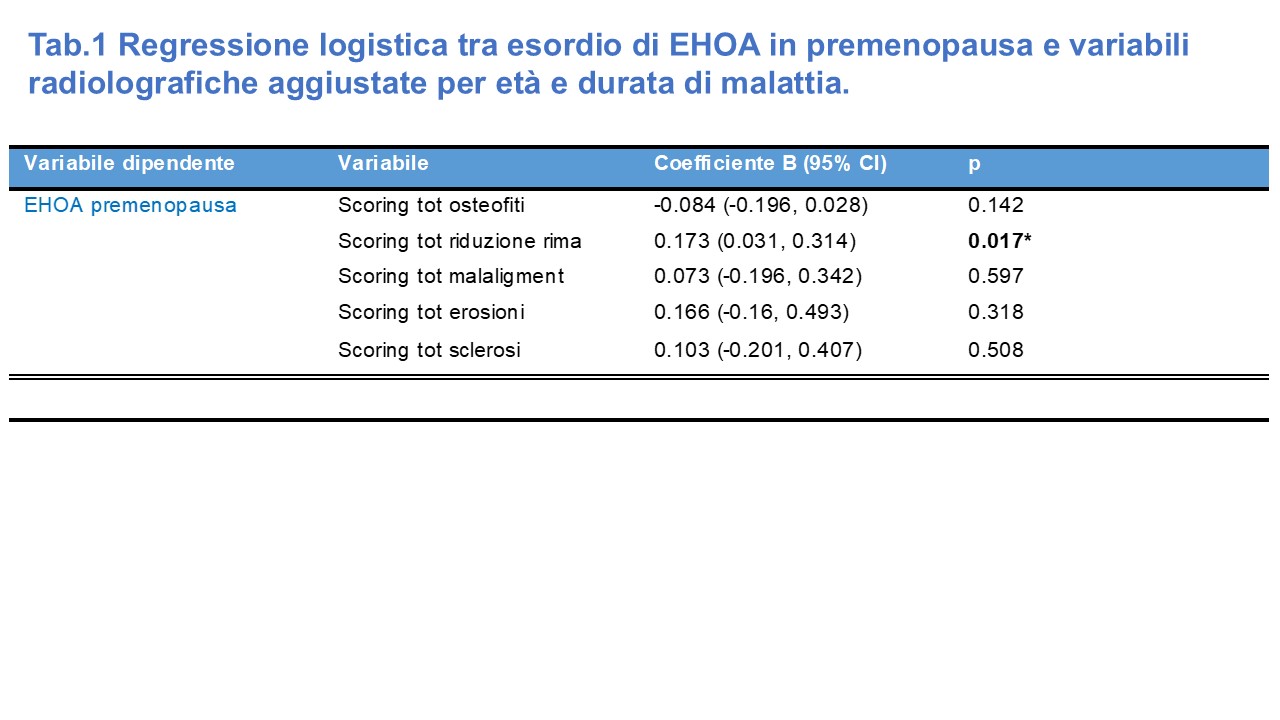
Background. Erosive hand osteoarthritis (EHOA) is a particularly aggressive and inflammatory subset of hand osteoarthritis (OA). It predominantly affects women and typically manifests after the age of 50, coinciding with the menopausal transition. However, recent evidence suggests that patients with EHOA, compared with those affected by non-erosive forms, may experience an earlier onset and a more severe clinical course with greater functional and radiographic impairment. The main objectives of our study were to: 1. Assess the prevalence of premenopausal onset among patients with EHOA; 2. Compare clinical, functional, and radiographic characteristics between patients with premenopausal and postmenopausal onset. Materials and Methods. A retrospective study was conducted on a cohort of 87 patients diagnosed with EHOA, followed at the Joint Pathology Outpatient Clinic of our Rheumatology Unit between January 2015 and February 2025. EHOA was diagnosed based on the presence of at least one central radiographic erosion involving a proximal or distal interphalangeal joint. Demographic, clinical, and laboratory data were collected, with particular attention to the age of symptom onset, menopausal status, and use of hormone replacement therapy (HRT). Joint function was assessed using validated AUSCAN and DREISER indices. Radiographic damage was evaluated using the Altman scoring system on bilateral hand radiographs. A total composite radiographic score was calculated by summing the individual joint scores for all assessed hand joints. Statistical analyses included Student’s t-test, and linear and logistic regression models, with statistical significance set at p < 0.05. Results. Eighty-seven patients with EHOA were retrospectively enrolled, with a mean age of 63.17 ± 8.85 years; 77 were women (88.5%). Among female patients, 71 (92.21%) were postmenopausal, and 17 (22.08%) had previously used or were currently using HRT. The mean disease duration was 13.75 ± 9 years. In 42.9% of women, symptom onset occurred before menopause: mean age at premenopausal onset was 44.91 ± 6.97 years versus 58.00 ± 6.96 years for postmenopausal onset. Functional assessment showed moderate-to-severe disability (AUSCAN: 30.90 ± 12.49 on 60; DREISER: 10.61 ± 6.26 on 30). Premenopausal disease onset was significantly associated with greater joint space narrowing on total radiographic scoring, confirmed by logistic regression adjusted for age and disease duration (p = 0.017) (Table 1). Conclusiuons. Premenopausal onset of EHOA was associated with more pronounced radiographic damage, suggesting a potential role of hormonal and genetic factors in the disease pathogenesis. These findings highlight the importance of a personalized management approach based on age at disease onset.

81_20250608173424.jpg

Downloads

Download data is not yet available.

Citations

How to Cite


1.
S14:5 | Erosive hand osteoarthritis: premenopausal onset and more severe disease progression: Marta Favero1, Giacomo Cozzi1, Clarissa Benvoluti1, Laura Scagnellato1, Gianluca Poncina1, Stefano Rizzetto1, Mariagrazia Lorenzin1, Roberta Ramonda1 | 1UOC di Reumatologia, Dipartimento di Medicina-DIMED, Università di Padova, Italy. Reumatismo [Internet]. 2025 Nov. 26 [cited 2026 Jan. 23];77(s1). Available from: https://www.reumatismo.org/reuma/article/view/2229