
 https://doi.org/10.4081/reumatismo.2025.2214
PO:34:217 | Possible role of phosphodiesterase type 5 inhibitors in the prevention of digital ulcers and videocapillaroscopic changes in patients with systemic sclerosis
Elena Platania1, Marius Cadar1, Ilaria Bisconti1, Davide Mohammad Reza Beigi1|2, Francesca Romana Di Ciommo1, Jacopo Landro1, Martina Salerno1, Beatrice De Girolamo1, Simona Truglia1, Fabrizio Conti1, Valeria Riccieri1 | 1S.C. Reumatologia; 2S.C. Reumatologia
All claims expressed in this article are solely those of the authors and do not necessarily represent those of their affiliated organizations, or those of the publisher, the editors and the reviewers. Any product that may be evaluated in this article or claim that may be made by its manufacturer is not guaranteed or endorsed by the publisher.
Background. In systemic sclerosis (SSc), phosphodiesterase type 5 inhibitors (PDE5i) are currently used in the treatment of pulmonary hypertension and in the management of refractory Raynaud’s phenomenon, and they appear to play a role in the healing of digital ulcers. However, the impact of these drugs on ulcer prevention and on nailfold videocapillaroscopy (NVC) findings remains poorly investigated.
Materials and Methods. In this single-center retrospective study, 17 patients diagnosed with SSc according to the 2013 ACR/EULAR criteria and treated with PDE5i for at least 12 months were enrolled. Clinical, serological, and capillaroscopic data were collected. Based on the occurrence of new digital ulcers (DU) after starting therapy, patients were divided into two groups (DU+ and DU–). NVC images before and after treatment were analyzed qualitatively and quantitatively. Capillaroscopic data were unavailable for five patients.
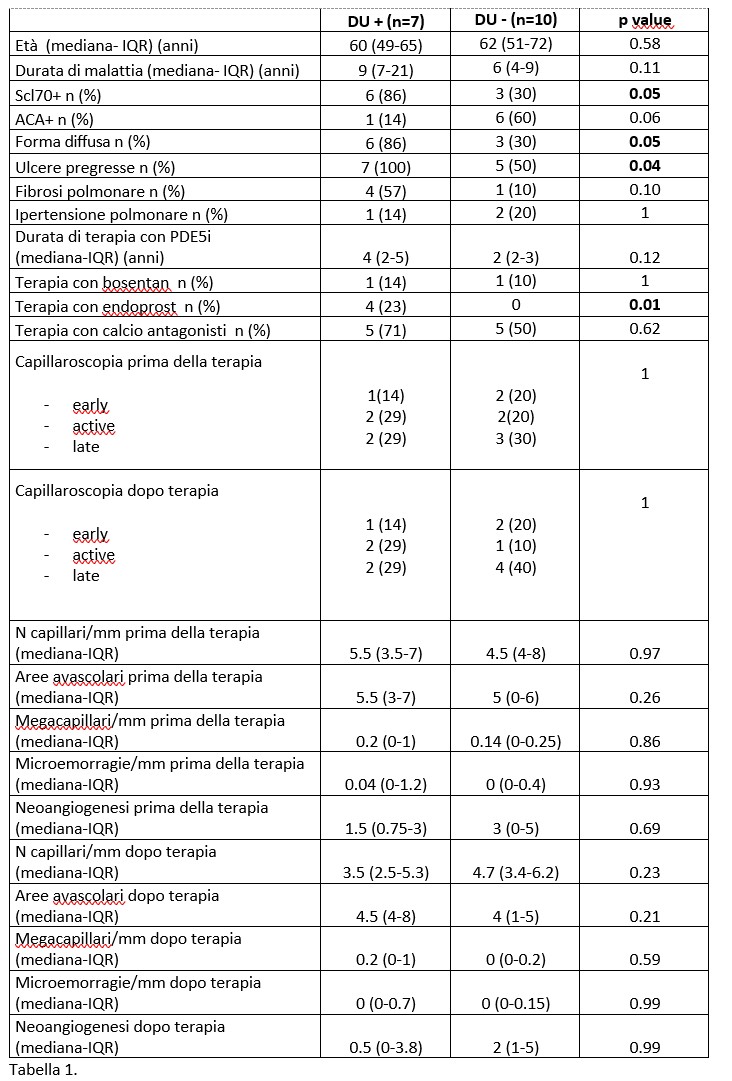
Results. Of the 17 patients enrolled, 14 (82%) were female, with a median age of 60 years (IQR 50–68). Twelve (70%) had a history of digital ulcers. Based on the occurrence of new DU during therapy, two groups were identified: DU+ (n=7, 41%) and DU– (n=10, 59%), as shown in Table 1. The groups were comparable in terms of age, disease duration, and duration of PDE5i exposure. Patients with recurrent DU more frequently had diffuse cutaneous disease, a history of previous DU, positivity for anti-Scl70 antibodies, and greater use of prostanoid therapy. Regarding capillaroscopy performed at a median interval of 3 years (IQR 2–5), no statistically significant differences were found between groups in terms of NVC pattern. Quantitative analysis of NVC showed that, although not statistically significant, in the DU+ group the absolute number of capillaries/mm decreased during therapy, while in the DU– group it remained stable. Conversely, the number of megacapillaries/mm remained stable in the DU+ group but decreased in the DU– group. The overall results are presented in Table 1.
Conclusions. Our data confirm the known association between DU recurrence and both anti-Scl70 positivity and the diffuse cutaneous form of SSc. From our pilot study, PDE5 inhibitors emerged as a valid therapeutic alternative in patients with DU, thanks to their ability to reduce the recurrence rate, which in our cohort was 59%. In patients treated with PDE5i, we observed a trend toward stabilization of specific SSc-related capillaroscopic abnormalities, associated with the absence of new DU. These findings need to be confirmed in larger cohorts and with a more accurate evaluation of concomitant therapies. 
Downloads
How to Cite

This work is licensed under a Creative Commons Attribution-NonCommercial 4.0 International License.
PAGEPress has chosen to apply the Creative Commons Attribution NonCommercial 4.0 International License (CC BY-NC 4.0) to all manuscripts to be published.