
 https://doi.org/10.4081/reumatismo.2025.2210
PO:33:203 | Efficacy and safety of rituximab in eosinophilic fasciitis: report of three cases and systematic literature review
Andrea Benini1, Beatrice Moccaldi1, Marco Binda1, Anna Cuberli1, Mariangela Favaro1, Andrea Doria1, Elisabetta Zanatta1 | 1UOC Reumatologia, Azienda Ospedale, Università di Padova, Italy
All claims expressed in this article are solely those of the authors and do not necessarily represent those of their affiliated organizations, or those of the publisher, the editors and the reviewers. Any product that may be evaluated in this article or claim that may be made by its manufacturer is not guaranteed or endorsed by the publisher.
Background. Eosinophilic fasciitis (EF) is a rare inflammatory condition classified among scleroderma-like syndromes. Corticosteroids represent the first-line treatment, followed by conventional immunosuppressants. In refractory cases, other agents have been used, including rituximab (RTX), although it is not currently included in EF guidelines (1). Our study aimed to evaluate the efficacy and safety of RTX by describing three cases from our centre and conducting a systematic review of the literature.
Methods. We included patients with a clinical and histological diagnosis of EF1 who were treated with RTX at our centre between 2010 and 2025. Demographic, clinical, laboratory, and instrumental data, as well as previous and concomitant therapies, were collected. Disease severity was assessed according to the Jinnin et al. score. A systematic review of the literature (01/2010–05/2025) was conducted in accordance with PRISMA guidelines using the Medline (PubMed) database, including studies published in English on adult patients with EF (population) treated with RTX (exposure), with the aim of evaluating efficacy and safety (outcomes).
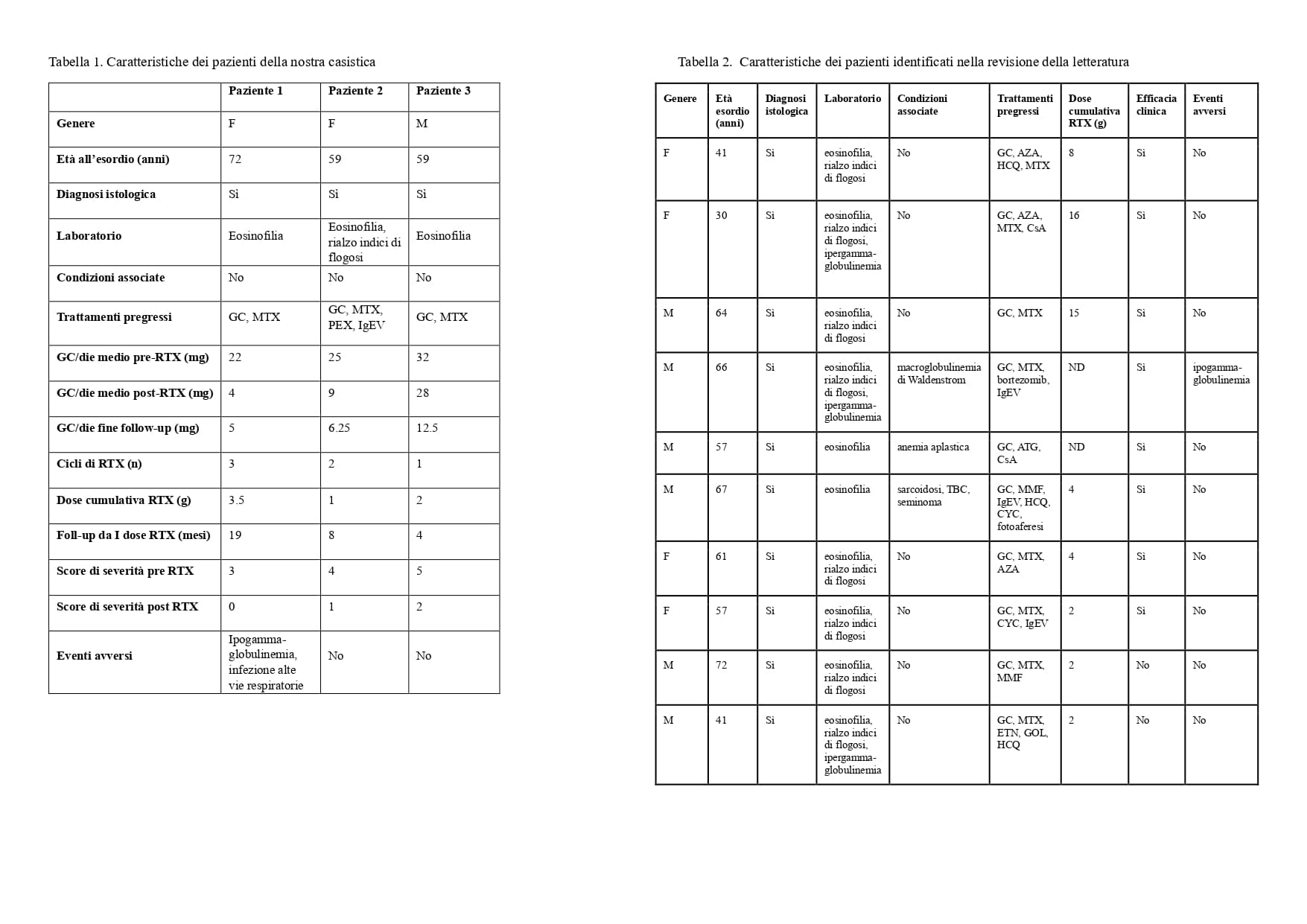
Results. Three patients with EF who were treated with RTX were identified. Demographic and clinical features are summarized in Table 1. All patients had typical skin involvement confirmed by histology. Physical triggers, infections, drugs, autoimmune diseases, oncological and hematological diseases were excluded. At the time of diagnosis, all patients presented with peripheral eosinophilia and were initially treated with corticosteroids and methotrexate. RTX was added due to progressive skin involvement and a worsening disease severity score. A rapid clinical improvement was observed in all cases, with a reduction in skin thickening, extent of involvement, and disease severity score. The mean daily corticosteroid dose at the last follow-up was 71% lower compared to the pre-RTX dose. In terms of safety, two non-serious adverse events were reported: hypogammaglobulinemia and an upper respiratory tract infection in one patient. A review of the literature identified ten additional cases of EF treated with RTX. Demographic, clinical, and treatment characteristics are reported in Table 2. RTX therapy was clinically effective in eight out of ten cases.
Conclusions. Rituximab may represent an effective and safe therapeutic option for patients with EF who are refractory to corticosteroids and conventional DMARDs. Both our case series and the literature data support the use of RTX in EF unrelated to hematologic conditions, highlighting its potential as a steroid-sparing agent with a favourable safety profile.
Downloads
How to Cite

This work is licensed under a Creative Commons Attribution-NonCommercial 4.0 International License.
PAGEPress has chosen to apply the Creative Commons Attribution NonCommercial 4.0 International License (CC BY-NC 4.0) to all manuscripts to be published.