
 https://doi.org/10.4081/reumatismo.2025.2195
PO:27:108 | Delphi consensus on the shared management of patients with rheumatologic and oncologic diseases
Luigi De Marco1, Augusta Ortolan2, Antonio Carletto3, Fulvia Ceccarelli4, Lorenzo Dagna5, Ginevra De Marchi6, Ennio Giulio Favalli7, Alessandro Inno8, Giuseppe Lopalco9, Francesco Ciccia10, Ennio Lubrano11, Luca Quartuccio12, Immacolata Prevete13, Roberta Ramonda14, Nicola Silvestris15, Marcello Tiseo16, Michelina Turri1, Maria Sole Chimenti1 | 1Reumatologia, allergologia e immunologia clinica, dipartimento di medicina dei sistemi, Università di Roma Tor Vergata; 2UOC Reumatologia e immunologia clinica, Fondazione Policlinico Universitario Agostino Gemelli IRCSS, Roma; 3Unità di Reumatologia, Dipartimento di medicina, AOUI università di Verona; 4Reumatologia, Dipartimento di Scienze Cliniche, Anestesiologiche Internistiche e Cardiovascolari, Sapienza Università di Roma; 5Unità di Immunologia, Reumatologia, Allergologia e malattie rare UnIRar, IRCSS San Raffaele, Milano; 6Unità di Reumatologia, Dipartimento di medicina, Azienda Sanitaria Universitaria Integrata, Università di Udine; 7Dipartimento di Reumatologia e scienze mediche, Istituto Gaetano Pini, Università di Milano; 8Oncologia Medica, IRCCS Ospedale Sacro Cuore Don Calabria, Negrar di Valpolicella (VR); 9UOC Reumatologia, Dipartimento di Medicina di Precisione e Rigenerativa e Area Ionica, Università di Bari "Aldo Moro"; 10Unità di Reumatologia, Dipartimento di Medicina di Precisione, Università della Campania L. Vanvitelli, Napoli; 11Unità di Reumatologia, Università degli Studi del Molise, Campobasso; 12SOC Clinica Reumatologica - ASUFC, Dipartimento di Medicina, Università degli Studi di Udine; 13UOC Reumatologia Azienda Ospedaliera San Camillo-Forlanini, Roma; 14UOC di Reumatologia, Dipartimento di Medicina DIMED, Azienda Ospedale Università di Padova; 15UOC Oncologia Medica e Dipartimento Area Medica - IRCCS Istituto Tumori Giovanni Paolo II, Bari; 16UOC di Oncologia Medica, Azienda Ospedaliero-Universitaria di Parma, Italy
All claims expressed in this article are solely those of the authors and do not necessarily represent those of their affiliated organizations, or those of the publisher, the editors and the reviewers. Any product that may be evaluated in this article or claim that may be made by its manufacturer is not guaranteed or endorsed by the publisher.
Background. The intersection between rheumatologic and oncologic diseases, especially concerning the use of immunostimulatory cancer therapies, poses relevant clinical challenges. Immunotherapy may induce rheumatologic or autoimmune manifestations, while csDMARDs or bDMARDs can affect the efficacy and course of oncologic treatment. The aim of this project was to develop expert-based recommendations, through consensus between the Italian Society of Rheumatology and the Italian Association of Medical Oncology, to support the shared management of patients with concomitant rheumatologic disease and malignancy, as well as immune-mediated adverse events from cancer therapies.
Materials and Methods. A modified Delphi process was conducted according to principles of anonymity, iterative feedback, and multidisciplinary involvement (18 clinicians including rheumatologists, oncologists, and methodologists). After a narrative literature review (54 articles, 1988–2024), three key assumptions and 11 consensus statements were defined. Each statement was rated (0–10) via Google Forms. Critical or low-consensus feedback was revised and re-voted. Consensus was achieved when at least 75% of respondents scored >7.5.
Results. Three key assumptions and 11 statements were submitted to voting in two separate sessions. The three main assumptions were: (1) tumor development may result directly or indirectly from rheumatologic disease or its therapies; (2) clinical evaluation must consider both oncologic stage and rheumatologic activity; (3) clinical management should be shared between oncologist and rheumatologist. The first assumption did not reach consensus. Statements in Sections A and B achieved consensus (Figure 1). Section A addressed the onset of malignancy in rheumatologic patients. Experts agreed on shared management, individualized evaluation of therapeutic continuation, relevance of cancer history, possible DMARD withdrawal in remission, and joint management in severe or active cases. Paraneoplastic syndromes require oncologic treatment, possibly combined with immunosuppressants if indicated. Section B focused on the onset of rheumatologic conditions during cancer therapies. The crucial role of collaboration was highlighted to manage immune-related adverse events (irAEs), therapeutic escalation from symptomatic drugs to targeted agents (e.g., IL-6R, CD20, IL-17A, IL-23, PDE4 inhibitors), and the use of CTCAE criteria despite their limitations in classifying rheumatologic toxicity. Non-consensual statements were revised and re-voted: Section A, 4th (immunosuppressant discontinuation in remission); Section B, 1st and 4th (management of rheumatologic manifestations during ICI therapy).
Conclusions. The consensus provides recommendations for multidisciplinary management of onco-rheumatologic patients based on clinical expertise. It represents a useful foundation to address clinical scenarios lacking strong evidence, pending prospective studies.

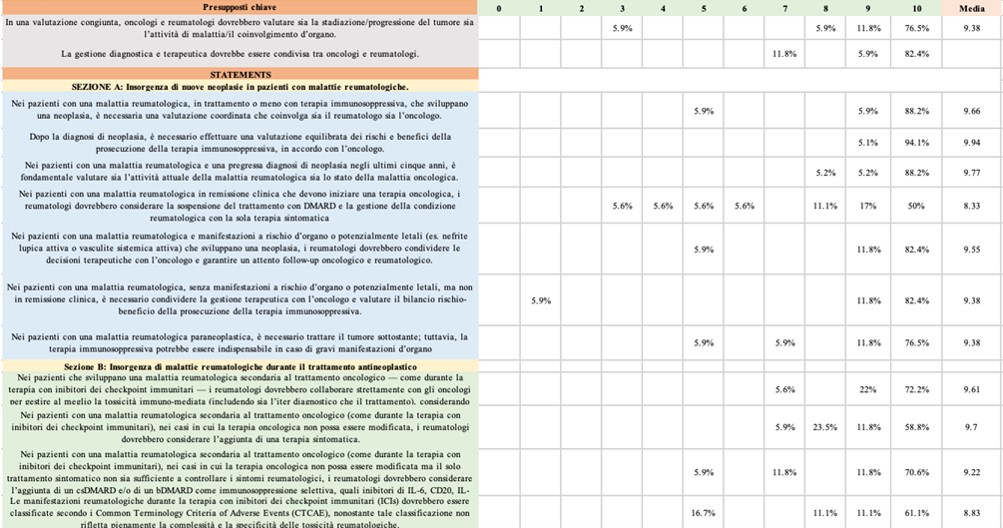
Figure 1. Delphi Consensus: list of key assumptions and statements shared with experts. Columns from 0 to 10 report the percentage of votes expressed for each item.
Downloads
How to Cite

This work is licensed under a Creative Commons Attribution-NonCommercial 4.0 International License.
PAGEPress has chosen to apply the Creative Commons Attribution NonCommercial 4.0 International License (CC BY-NC 4.0) to all manuscripts to be published.