
 https://doi.org/10.4081/reumatismo.2025.2170
PO:18:276 | Use of anifrolumab in the treatment of difficult-to-treat manifestations in systemic lupus erythematosus
Antonella Grimaldi1, Giuseppe Alessandrini2, Laura Quarta1, Maria Rita Ricciardi1, Daniela Costanza1, Clara Minerba1, Eugenio Quarta1 | 1UOC Reumatologia Verona; 2Specialista Dermatologo in Libera Professione, Italy
All claims expressed in this article are solely those of the authors and do not necessarily represent those of their affiliated organizations, or those of the publisher, the editors and the reviewers. Any product that may be evaluated in this article or claim that may be made by its manufacturer is not guaranteed or endorsed by the publisher.
Background and Objective. To describe our experience with the use of anifrolumab (AFM) in a small single-center cohort of patients (pts) with systemic lupus erythematosus (SLE), with particular focus on the management of refractory manifestations. SLE is a systemic autoimmune disease that can affect virtually any organ or system. Refractory manifestations represent an unmet need in disease management, as they are associated with higher glucocorticoid (GC) exposure, increased risk of cumulative organ damage, and reduced quality of life (QoL). Type I interferons (IFN-I) play a key role in antiviral defense; however, in SLE patients, IFN-I signaling pathways are upregulated both in genetic predisposition and in epigenetic changes characteristic of the disease, contributing to disease onset and activity. Several clinical and laboratory features of SLE—including lymphopenia—are associated with the overexpression of IFN-I–regulated genes, providing a strong rationale for targeting this pathway. Anifrolumab, a monoclonal antibody that inhibits the type I interferon receptor, offers new therapeutic perspectives in this setting.
Materials and Methods. We report on 5 female SLE patients aged 35–64 years, followed from September 2024 to the present. Four pts presented with cutaneous involvement: acute cutaneous lupus (n=2), subacute cutaneous lupus (SCLE)(n=1), and discoid lupus with scarring alopecia (DLE) (n=1). One pt exhibited predominant constitutional (persistent remittent fever up to 39.5°C for ~1 year, fatigue) and hematologic involvement (leukopenia–lymphopenia). These manifestations prompted initiation of AFM therapy. Previous manifestations (currently in remission) included articular (3 pts), serosal (pleural effusion, 1 pt), and renal involvement (class III glomerulonephritis, 1 pt). At the time of our observation, pts (previously followed in other Centers) were receiving hydroxychloroquine (except the pt with constitutional/hematologic involvement, due to intolerance) and GCs (except the pt with DLE, who had discontinued GCs due to lack of efficacy on cutaneous disease). Three of the five pts had a remote history of traditional immunosuppressant use. Anti-dsDNA antibodies were present in 3 pts, and C4 was reduced in 4 pts.
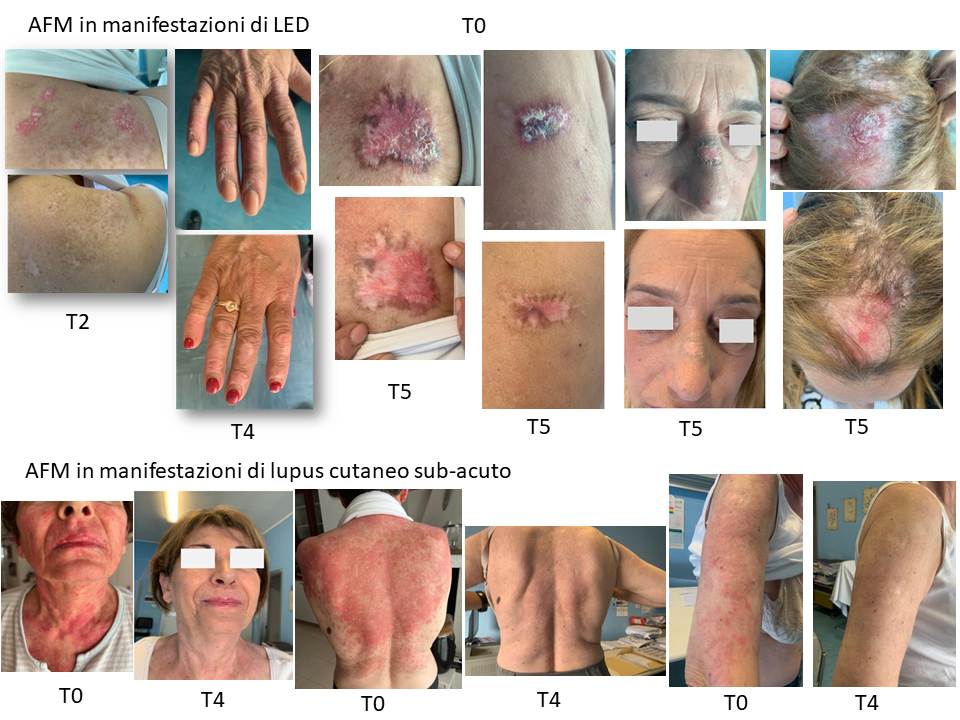
Results. Treatment with AFM led to improvement in all cutaneous manifestations, with complete remission in two cases, after only a few months of therapy. A marked clinical benefit was also observed in the DLE case, a notoriously refractory manifestation (CLASI score improved from 17 [T0] to 8 [T5]). The pt with persistent fever and leukopenia–lymphopenia—also typically refractory—experienced rapid resolution of symptoms and improvement in fatigue (SLEDAI decreased from 6 [T0] to 2 [T2]). All pts were able to taper GCs, with complete withdrawal achieved in two pts with cutaneous disease.
Conclusions. Our findings confirm the efficacy of AFM, as previously demonstrated in clinical trials, across selected SLE disease domains. They highlight the potential to extend precision medicine principles to SLE management and to consider AFM as a valuable therapeutic option for difficult-to-treat manifestations.

Downloads
How to Cite

This work is licensed under a Creative Commons Attribution-NonCommercial 4.0 International License.
PAGEPress has chosen to apply the Creative Commons Attribution NonCommercial 4.0 International License (CC BY-NC 4.0) to all manuscripts to be published.