
 https://doi.org/10.4081/reumatismo.2025.2135
PO:07:095 | Clinical impact of therapeutic modification following changes in AIFA reimbursement criteria for JAK inhibitors in patients with RA in remission/low disease activity: analysis of the multicenter JAK-SWAP RER study in Emilia-Romagna
Marta Raschella1, Giulia Furia1, Martina Di Nunzio1, Francesco Luca Renzullo2, Francesco Girelli2, Federica Pignatti3, Francesco Ursini3, Licia Vultaggio4, Pierluigi Cataleta4, Elena Bravi5, Eugenio Arrigoni5, Francesca Bergossi6, Enrica Vandelli7, Massimo Reta6|7, Viola Magnani8, Andreina Manfredi8|9, Giuseppe Germanò8, Alessandra Bortoluzzi1, Marcello Govoni1, Ettore Silvagni1 | 1Unità Operativa Complessa di Reumatologia, Dipartimento di Scienze Mediche, Università degli Studi di Ferrara e Azienda Ferrara; 2UOS Reumatologia, Ospedale GB Morgagni, Forlì; 3UOC Reumatologia, Istituto ortopedico Rizzoli, Bologna; 4UO Reumatologia, AUSL Romagna Ospedale di Ravenna; 5UO Reumatologia, Azienda USL di Piacenza; 6Reumatologia Osp. Maggiore, Bologna; 7UO Medicina Interna ad Indirizzo Reumatologico Interaziendale SC AUSL Bologna, IRCCS Policlinico di SantOrsola, Bologna; 8U.O Reumatologia, Santa Maria Nuova di Reggio Emilia; 9Università degli studi di Modena e Reggio Emilia, Italy
All claims expressed in this article are solely those of the authors and do not necessarily represent those of their affiliated organizations, or those of the publisher, the editors and the reviewers. Any product that may be evaluated in this article or claim that may be made by its manufacturer is not guaranteed or endorsed by the publisher.
Background. Since March 2023, AIFA has introduced new reimbursement criteria for JAK-inhibitors (JAKis), restricting their use to patients with rheumatoid arthritis (RA) without specific risk factors and with previous failure of bDMARD therapy. These restrictions have influenced prescribing behavior, leading in some cases to treatment changes in patients already receiving JAKis. The primary objective of this study is to evaluate the frequency of maintenance of remission/low disease activity (REM/LDA) at 6 months, and to identify potential associated factors, in patients undergoing treatment modification compared with those who continued the ongoing therapy.
Materials annd Methjods. In this prospective, multicenter, observational cohort study, we enrolled patients with RA in stable REM/LDA for at least 6 months on JAKi therapy (03/2023–07/2024), for whom a therapeutic modification was proposed (dose reduction, treatment discontinuation with switch to another bDMARD, or discontinuation without switching) due to non-fulfillment of AIFA reimbursement conditions. At 6-month follow-up (T6), the frequency of REM/LDA maintenance was assessed, while additional therapeutic modifications (cs/b/tsDMARDs) and adverse events (AEs) were evaluated during the 12-month total follow-up. Associations between clinical-demographic characteristics and T6 outcomes were analyzed using univariate logistic regression.
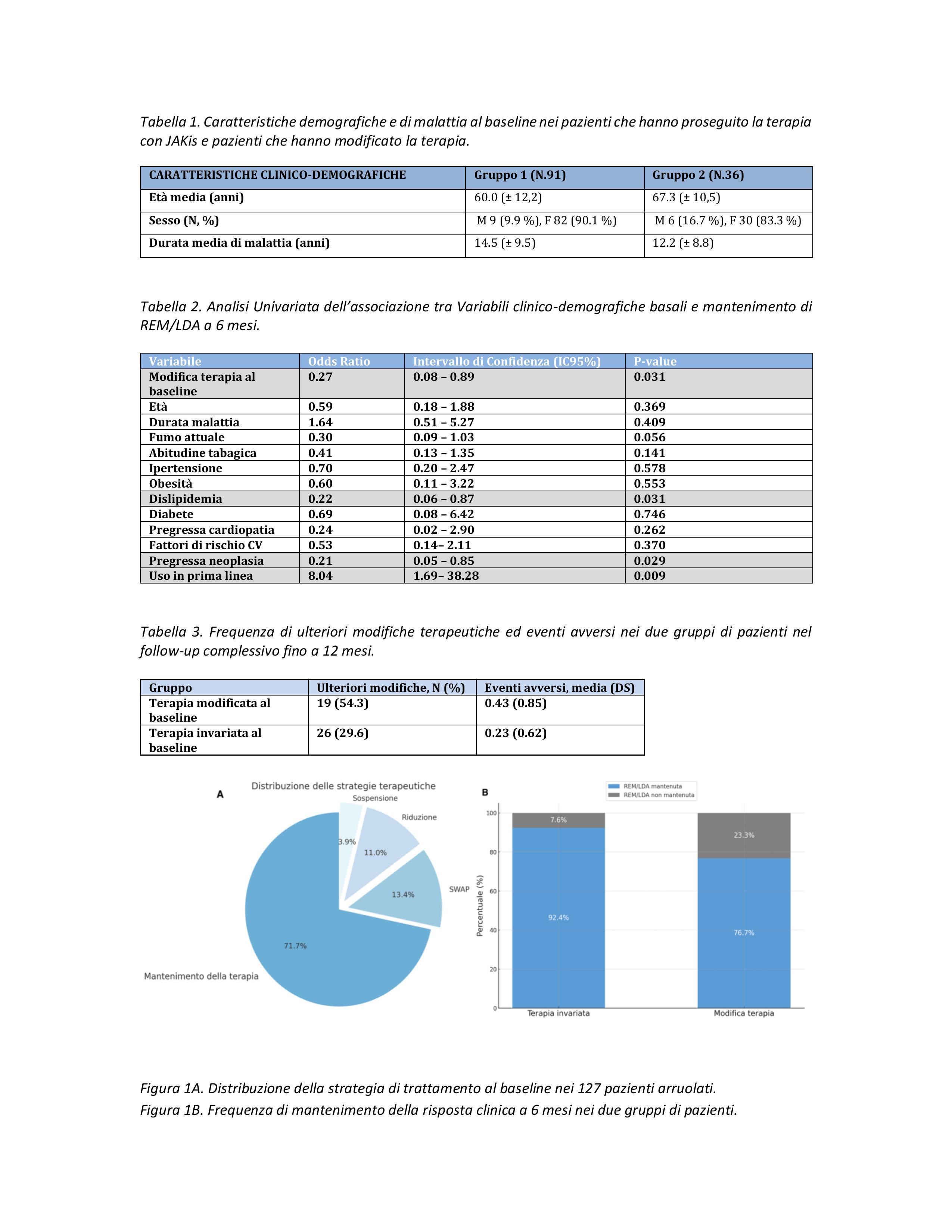
Results. A total of 127 patients were enrolled (Table 1). Among them, 36 underwent JAKi modification at baseline (17 switches, 14 dose reductions, 5 discontinuations), while 91 maintained JAKi therapy, of whom 16 remained eligible for reimbursement according to AIFA criteria (Figure 1A). At T6, 109 patients were reassessed. Maintenance of REM/LDA at T6 was significantly less frequent in the group that modified therapy at baseline compared to those who continued treatment (23 (76.7%) vs 73 (92.3%), p=0.024; OR 0.27, 95% CI 0.08–0.88) (Figure 1B). Univariate analysis showed that dyslipidemia and history of malignancy were associated with reduced REM/LDA maintenance, whereas first-line bDMARD use correlated with greater clinical stability (Table 2). Patients who modified therapy at baseline showed a higher frequency of further treatment changes (19 (54.3%) vs 26 (29.6%), p=0.010) and a higher mean (SD) number of AEs (0.43 (0.85) vs 0.23 (0.62), p=0.12) during the 12-month follow-up (Table 3).
Conclusions. The analysis of the JAK-SWAP RER study suggest that modifying an effective JAK inhibitor regimen in clinically stable RA patients is associated with poorer clinical outcomes at 6 months, an increased need for further treatment changes, and a trend toward a higher rate of AEs. A conservative management approach should be preferred in patients in REM/LDA, even following changes in reimbursement criteria, particularly in those treated in later therapeutic lines.

Downloads
How to Cite

This work is licensed under a Creative Commons Attribution-NonCommercial 4.0 International License.
PAGEPress has chosen to apply the Creative Commons Attribution NonCommercial 4.0 International License (CC BY-NC 4.0) to all manuscripts to be published.