
 https://doi.org/10.4081/reumatismo.2025.2125
PO:02:023 | Monocentric analysis of systemic glucocorticoids in PsA: the art of balancing prescriptive appropriateness and risk factor management
Chiara Crotti1 2, Gilberto Cincinelli1, Giorgia Trignani13, Luca Ingrao13, Miriam Perino13, Roberto Caporali13 | 1Dipartimento di Reumatologia e Scienze Mediche - UOC Clinica Reumatologica, ASST Pini-CTO, Milano; 2Dipartimento di Reumatologia e Scienze Mediche - UOC Osteoporosi e Malattie Metaboliche dell Osso - ASST Pini-CTO, Milano; 3Dipartimento di Scienze Cliniche e di Comunità - Università degli Studi di Milano, Italy
All claims expressed in this article are solely those of the authors and do not necessarily represent those of their affiliated organizations, or those of the publisher, the editors and the reviewers. Any product that may be evaluated in this article or claim that may be made by its manufacturer is not guaranteed or endorsed by the publisher.
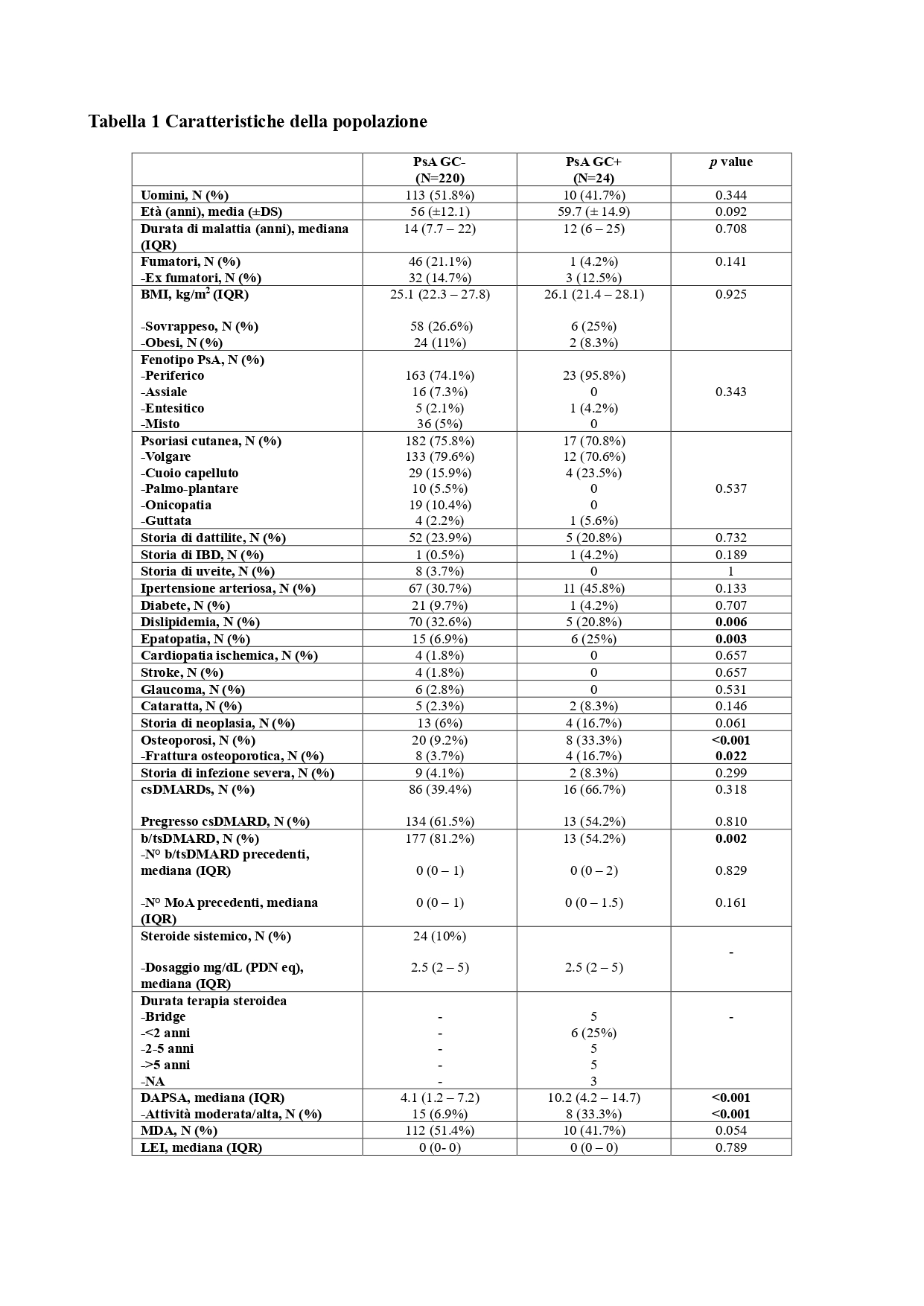
Objective: Psoriatic Arthritis (PsA) is a pleiomorphic disease. The latest guidelines1 recommend glucocorticoids (GCs) preferentially as local therapy, emphasising that the use of systemic GCs may raise further safety issues, especially due to the high prevalence of comorbidities and cardiovascular risk factors in PsA. Literature data regarding the prevalence of GCs in PsA are scarce. The aim of this study is to analyse, in a monocentric cohort, the prevalence, dosage, and variables associated with GCs prescription in PsA. Materials and Methods: PsA patients whose latest assessment was by 31 May 2025 were recruited in a cross-sectional manner. Data analysed included disease characteristics, comorbidities, ongoing therapies and relevant GCs dosages. Student's t-test and Mann-Whitney test were used for continuous variables, and Chi-square or Fisher’s exact test for categorical variables. Results: A total of 244 patients diagnosed with PsA were enrolled (mean age 55.7 years, males 123 (50.4%), peripheral PsA phenotype 186 (76.2%), axial 16 (6.6%), enthesitis 6 (2.5%), mixed 36 (14.7%)). Demographic and clinical characteristics of the population are shown in Table 1. Patients with PsA on GCs therapy (GCs+) were 24/244 (9.8%), with a median dosage of 2.5 mg prednisolone equivalent. Comparison between the GCs+ and GCs- groups showed similar characteristics in terms of disease duration (median 12 vs 14 years, p= 0.708), similar distribution among disease subsets (p= 0.343), and similar disease manifestations (dactylitis 20.8% vs 23.8%, p= 0.732; associated IBD 4.2% vs 0.5%, p= 0.189; enthesitis detected by LEI Index, p= 0.789). The two groups (GCs+ vs GCs-) differed significantly in terms of disease activity [median DAPSA 10.2 (4.2–14.7) vs 4.1 (1.2–7.2), p<0.001], even when stratified by moderate/high disease activity (33.3% vs 6.9%, p<0.001), and in b/tsDMARD prescription (54.2% vs 81.2%, p=0.002). The distribution of comorbidities was significantly different between GCs+ and GCs-, particularly for the prevalence of osteoporosis (33.3% vs 9.2%, p<0.001), fragility fractures (16.7% vs 3.7%, p=0.022), liver disease (25% vs 6.9%, p=0.003), and dyslipidaemia (20.8% vs 32.6%, p=0.006). Conclusions: Our data confirm that systemic GCs are prescribed in real-life practice. Their use appears reserved for more active disease, where therapeutic optimisation has not yet been achieved. However, the use of systemic GCs is not without side effects, particularly those related to osteoporotic comorbidities.

Downloads
How to Cite

This work is licensed under a Creative Commons Attribution-NonCommercial 4.0 International License.
PAGEPress has chosen to apply the Creative Commons Attribution NonCommercial 4.0 International License (CC BY-NC 4.0) to all manuscripts to be published.