
 https://doi.org/10.4081/reumatismo.2025.2100
PO:37:270 | Efficacy of iloprost as a therapy for skin ulcers in cryofibrinogenemia and cryoglobulinemia: a complex case in a fragile patient
Luca Keller Sarmiento1, Amelia Spinella2, Marco De Pinto2, Giorgia Roveta1, Dilia Giuggioli1|2. | 1Università degli Studi di Modena e Reggio Emilia, Modena, Italy; 2Unità di Reumatologia del Policlinico di Modena, Modena, Italy.
All claims expressed in this article are solely those of the authors and do not necessarily represent those of their affiliated organizations, or those of the publisher, the editors and the reviewers. Any product that may be evaluated in this article or claim that may be made by its manufacturer is not guaranteed or endorsed by the publisher.
Background. We present the case of a 75-year-old patient with a past medical history of melanoma removed in 2020, type 2 diabetes mellitus, cognitive decline evolving into Lewy body dementia, and IgG-lambda MGUS (0.5 g/dL) under hematological follow-up.
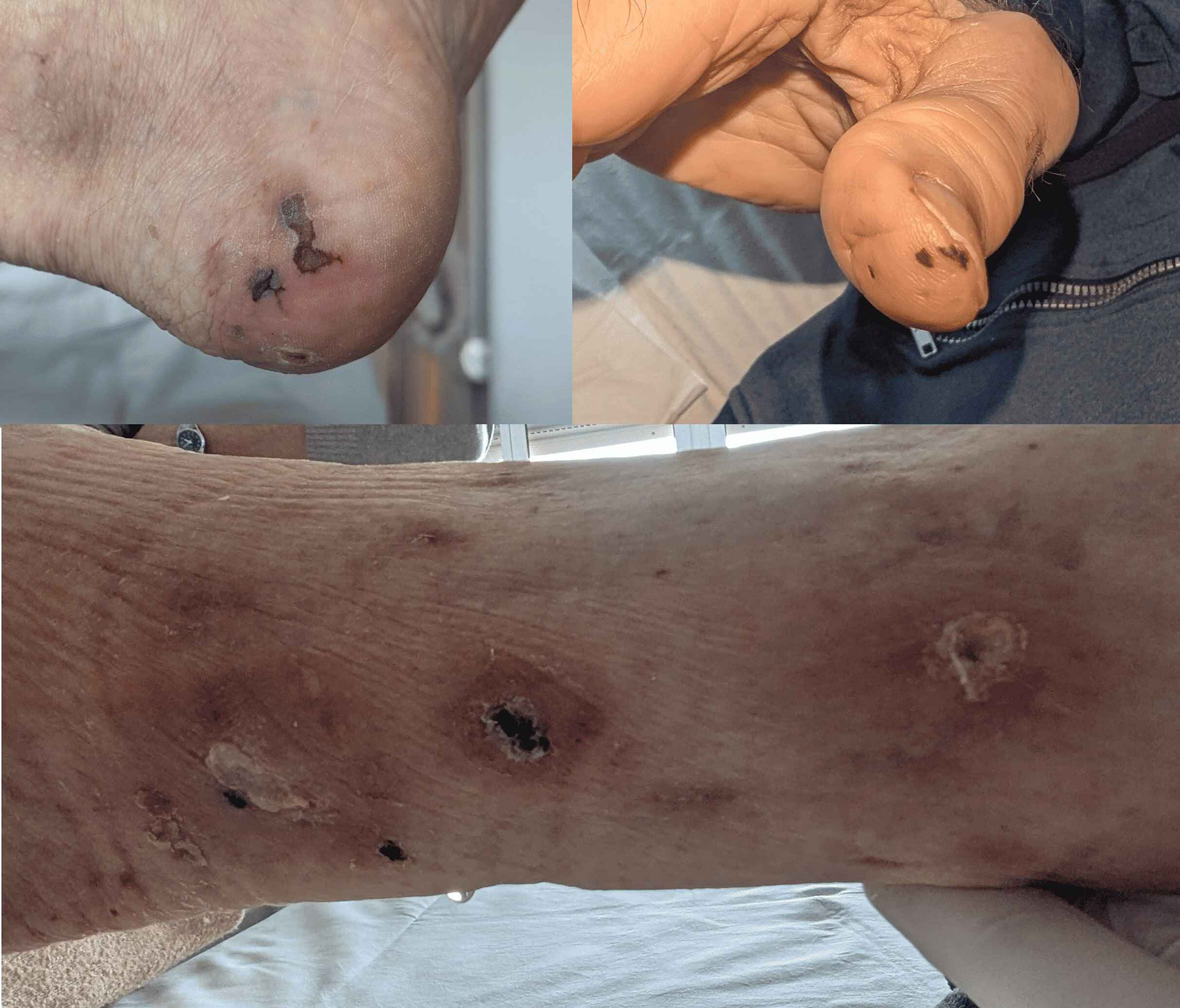
Case Report. Starting in 2020, the patient reported the recurrent appearance of small, subcentimeter ulcers on the fingers, which resolved spontaneously within a few weeks, and an isolated episode of frank purpura on the lower limbs, which subsequently evolved into dyschromic scars. In the rheumatological field, immunological and instrumental tests were performed (capillaroscopy, echocardiogram, ANA, ENA, ANCA, ACPA, antiphospholipids, RF, C3/C4, PCR, serologies for HBV and HCV, Bence Jones proteinuria), all of which were within normal limits. In this context, the presence of a 6% cryocrit was documented, composed of monoclonal IgM-lambda cryoglobulin (2%) and cryofibrinogen (4%). Subsequent hematological investigation with flow cytometry documented a circulating T-LGL population (30%), with no evidence of clonality on bone marrow biopsy, nor signs of myelodysplasia. In the absence of criteria for overt lymphoproliferative disease, there was no indication for specific treatment. In the following years, subcentimeter digital lesions continued to appear episodically, always self-limiting, without deep ulcerations or purpuric recurrences. However, in early 2025, following reported exposure to low temperatures, a sudden worsening was observed, with the appearance of crusted ulcers on the lower limbs, not consistent with vascular distribution. The major lesions were located on the lateral surface of both legs (up to 4 cm in diameter), on the heels, and on some toes. The patient initially reported home management without benefit. A lower extremity ECD was negative for occlusive changes. A skin biopsy of a lesion on the right heel showed partial epidermal ulcerative necrosis, hyperkeratosis, epidermal hyperplasia, and in the dermis, scar-like fibrosis, reactive vascular proliferation, and minimal lymphocytic inflammation, with no histological evidence of vasculitis. The patient arrived at the Difficult Wounds service of the Rheumatology unit in February 2025. Considering the comorbidities, the histological picture, and the high-titer cryofibrinogen, monthly therapy with Iloprost via continuous infusion was initiated, along with advanced local wound care. Progressive resolution of the lesions was observed by May 2025, with good tolerance to the therapy and no apparent clinical recurrences.
Conclusions. Iloprost represents an effective and well-tolerated therapeutic option for the treatment of ulcers associated with cryofibrinogenemia, especially in fragile patients for whom the use of immunosuppressants is risky or contraindicated. In complex cases, multidisciplinary discussion is confirmed to be crucial for a correct diagnostic assessment and targeted management.

Downloads
How to Cite

This work is licensed under a Creative Commons Attribution-NonCommercial 4.0 International License.
PAGEPress has chosen to apply the Creative Commons Attribution NonCommercial 4.0 International License (CC BY-NC 4.0) to all manuscripts to be published.