

 https://doi.org/10.4081/reumatismo.2025.2041
PO:15:221 | Proteins upregulated in thrombotic antiphospholipid syndrome link to platelet function in contrast with non-antiphospholipid-related thrombosis: insights from two systematic reviews
Silvia Mancuso1, Claudia Ciancarella1, Luca Rapino1, Simona Truglia1, Cristiano Alessandri1, Fabrizio Conti1. | 1Dipartimento di Scienze Cliniche Internistiche, Anestesiologiche e Cardiovascolari - Rheumatology Unit, Sapienza Univers, Roma, Italy.
All claims expressed in this article are solely those of the authors and do not necessarily represent those of their affiliated organizations, or those of the publisher, the editors and the reviewers. Any product that may be evaluated in this article or claim that may be made by its manufacturer is not guaranteed or endorsed by the publisher.
Background. Antiphospholipid syndrome (APS) is a systemic autoimmune disorder characterized by thrombosis, pregnancy morbidity, and other clinical manifestations in the presence of antiphospholipid antibodies (aPL). Despite advances in research since its identification in 1983, no targeted therapies beyond anticoagulation have been developed, and the 10-year mortality rate remains at 9.3%. This study aims to inform future therapeutic strategies by exploring proteomic differences between thrombotic APS (tAPS) and non-aPL-related thrombosis.
Methods. We conducted two systematic literature reviews (SLRs) following PRISMA guidelines to identify upregulated proteins in tAPS and in non-aPL-related thrombosis. Eligible studies were controlled observational studies focused on proteomic analysis. Upregulated proteins were used as input for gene cluster analysis, followed by gene enrichment analysis utilizing Gene Ontology (GO). Network analysis was conducted.
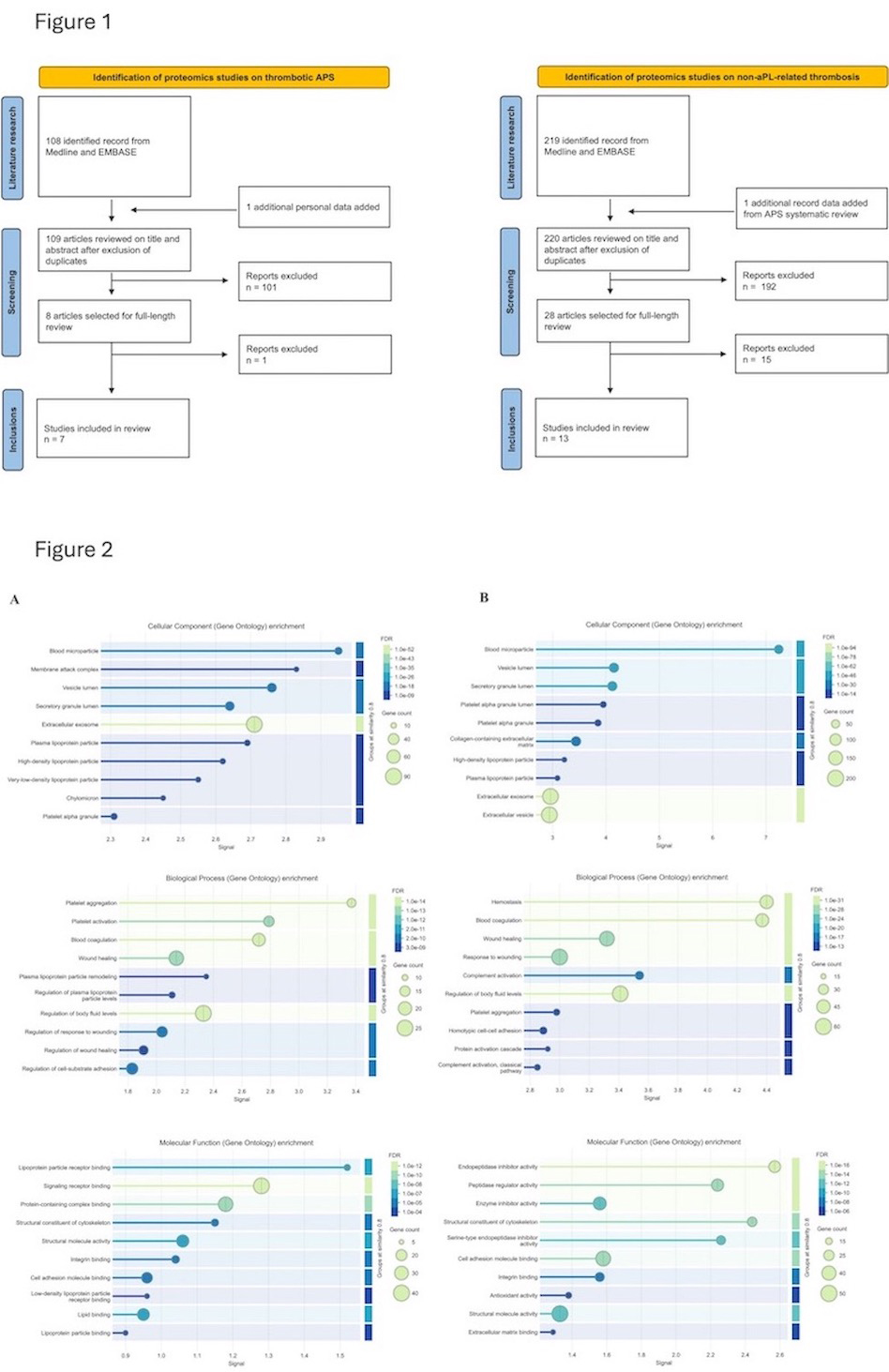
Results. Out of 108 and 209 records screened, 7 studies on tAPS and 13 on non-aPL-related thrombosis met the inclusion criteria (Figure 1). A total of 118 proteins were found to be upregulated in tAPS, compared to 319 in non-aPL-related thrombosis. Cellular component enrichment revealed that the upregulated proteins in tAPS originate from blood microparticle, membrane attack complex and vesicle lumen. Similarly, the upregulated proteins in non-aPL-related thrombosis originate from blood microparticle, vesicle lumen and secretory granules. GO enrichment analysis highlighted distinct biological processes: in tAPS, the top terms were platelet aggregation, platelet activation, and blood coagulation. Conversely, in non-aPL thrombosis, the leading processes were hemostasis, blood coagulation, and wound healing, with platelet-related processes ranking only seventh. Notably, the upregulation of platelet-related proteins in tAPS patients was observed even outside the acute phase, suggesting a persistent alteration in platelet-related pathways. Furthermore, molecular function analysis showed that tAPS-related proteins are predominantly involved in receptor and protein complex binding, whereas non-aPL-related thrombosis proteins are mainly involved in enzymatic activity (Figure 2).
Conclusion. Our findings highlight the central role of platelet-related processes in tAPS pathogenesis. By elucidating the unique proteomic and functional characteristics of tAPS, this study provides a foundation for future research into targeted therapies that address platelet involvement in APS pathogenesis. 
Downloads
How to Cite

This work is licensed under a Creative Commons Attribution-NonCommercial 4.0 International License.
PAGEPress has chosen to apply the Creative Commons Attribution NonCommercial 4.0 International License (CC BY-NC 4.0) to all manuscripts to be published.