

 https://doi.org/10.4081/reumatismo.2025.2022
PO:07:111 | Worsening of patient-reported outcomes is an early predictor of disease flare in patients with rheumatoid arthritis in course of treatment with conventional synthetic disease modifying anti-rheumatic drugs
Ludovico De Stefano1|2, Federica Sabatelli1|2, Clelia Zampaglione1|2, Blerina Xoxi2, Antonio Manzo1|2, Carlomaurizio Montecucco1|2, Serena Bugatti1|2. | 1Department of Internal Medicine and Therapeutics, University of Pavia, Pavia, Italy; 2Division of Rheumatology, IRCCS Policlinico San Matteo Foundation, Pavia, Italy.
All claims expressed in this article are solely those of the authors and do not necessarily represent those of their affiliated organizations, or those of the publisher, the editors and the reviewers. Any product that may be evaluated in this article or claim that may be made by its manufacturer is not guaranteed or endorsed by the publisher.
Background. Rheumatoid arthritis (RA) has a relapsing-remitting course that impedes the achievement of sustained remission and impairs quality of life in many patients. The ability to predict flares of the disease could assist personalized management and treatment approaches. Aim of this study was to test whether longitudinal variations in measures of disease activity and patient-reported outcomes (PRO) after the achievement of stable disease control could predict imminent flares in patients with RA.
Methods. From a larger dataset of 817 patients with early RA (duration of symptoms at referral <12 months) undergoing a treat-to-target strategy with methotrexate (MTX) and followed tightly at 3-month intervals, we extracted those who had achieved at least low disease activity (DAS28 <3.2) at two consecutive visits during the first year of treatment. Flare was defined as any increase in DAS28 >1.2, or final DAS28 >3.2 at the visit immediately following the achievement of stable disease control. Longitudinal variations of swollen and tender joint counts, C-reactive protein (CRP) levels, patient global assessment of disease activity (PGA) and pain scores in course of stable DAS28 <3.2 were tested for their ability to predict disease flare.
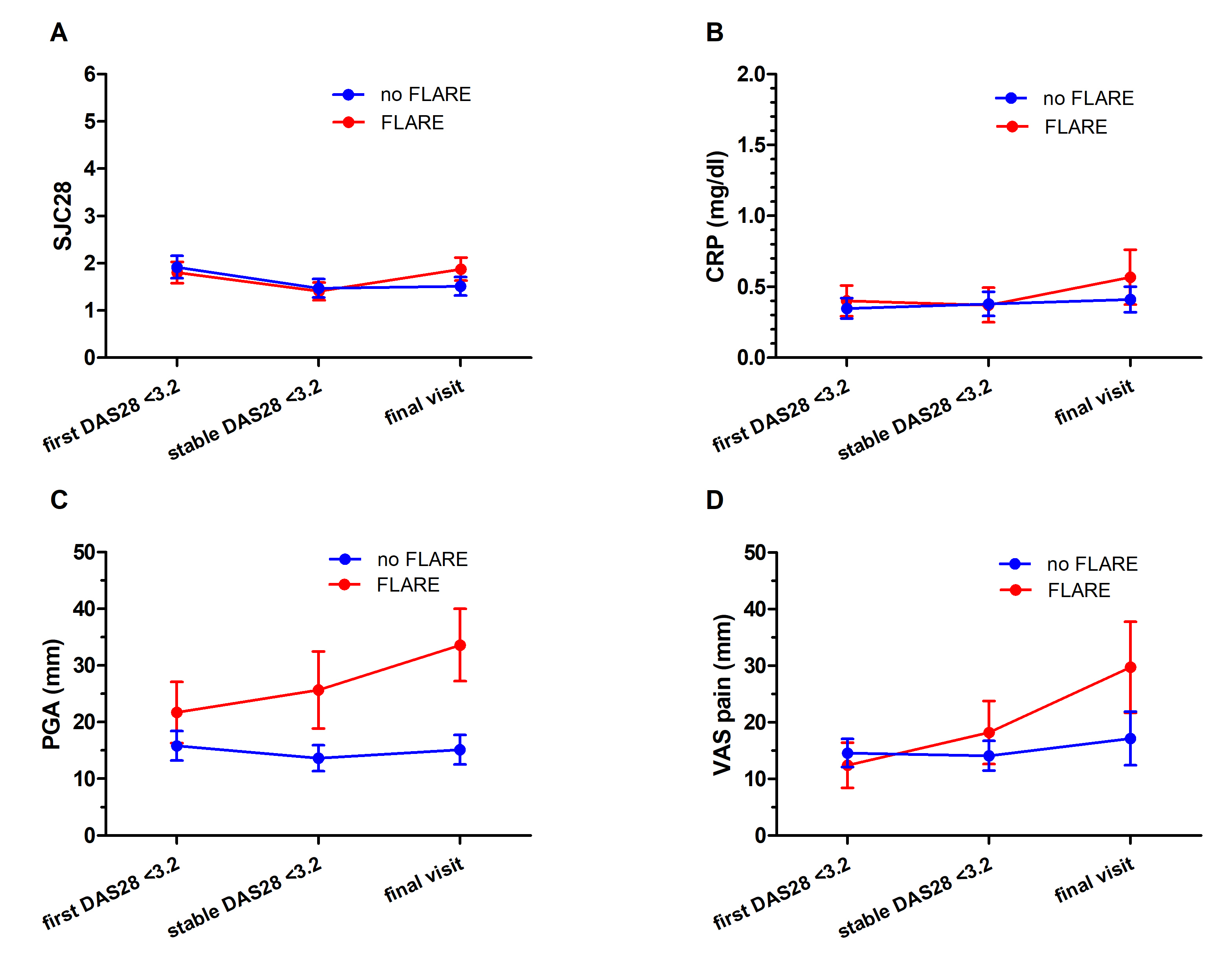
Results. We analyzed 927 visits from 309 patients with early RA achieving stable disease control (DAS28 <3.2 in two consecutive occasions) during the first year of treatment. Flare at the subsequent visit was experienced by 21.4% of the patients. Demographic variables, disease activity measures, autoantibody status, dose of MTX and glucocorticoids at the first visit in DAS28 <3.2 failed to predict future RA flare. As shown in Figure 1A, B, the number of swollen joints an CRP levels remained stable until the time of flare. In contrast, worsening of PGA and VAS pain scores pre-dated the occurrence of flare (Figure 1C, D). Using the Youden index to derive a cut-point that optimally balanced sensitivity with specificity, an increase in PGA >10 mm could identify impending flares with an AUC (95% CI) of 0.68 (0.58-0.79). After stratification for the autoantibody status, the most predictive cut-off of PGA increase was >7 mm in autoantibody-positive and >23 mm in autoantibody-negative patients.
Conclusions. In patients with early RA, longitudinal variations of PROs are early warning signs of impending flares in both autoantibody-positive and -negative subjects. Our study adds to the growing body of evidence that supports the use of PROs for monitoring of RA patients. 
Downloads
How to Cite

This work is licensed under a Creative Commons Attribution-NonCommercial 4.0 International License.
PAGEPress has chosen to apply the Creative Commons Attribution NonCommercial 4.0 International License (CC BY-NC 4.0) to all manuscripts to be published.