
 https://doi.org/10.4081/reumatismo.2025.1999
CO:12:5 | Aortic inflammation and aneurysm risk in giant cell arteritis: a multicenter imaging study
Caterina Ricordi1, Chiara Marvisi1, Konstanze V. Guggenberger2, Rudolf A. Werner3, Pamela Mancuso8, Giulia Besutti4, Sebastian E. Serfling5, Roberto Farì4, Matthias Frohlich6, Rexhep Durmo7, Michael Gernert6, Lucia Spaggiari4, Annibale Versari7, Paolo Giorgi Rossi8, Pierpaolo Pattacini4, Marc Schmalzing6, Carlo Salvarani1, Thorsten Bley9, Francesco Muratore1. | 1Rheumatology Unit, AUSL IRCCS di Reggio Emilia and Università di Modena e Reggio Emilia, Italy; 2Department of Diagnostic and Interventional Neuroradiology, University Hospital Wuerzburg, Germany; 3Department of Nuclear Medicine, University of Frankfurt, Germany; 4Department of Radiology, AUSL IRCCS di Reggio Emilia, Italy; 5Department of Nuclear Medicine, University Hospital Wuerzburg, Germany; 6Rheumatology and Clinical Immunology, Department of Internal Medicine II, University Hospital Wuerzburg, Germany; 7Nuclear Medicine Unit, AUSL IRCCS di Reggio Emilia, Italy; 8Epidemiology Unit, AUSL-IRCCS di Reggio Emilia, Italy; 9Department of Diagnostic and Interventional Radiology, University Hospital Wuerzburg, Germany
All claims expressed in this article are solely those of the authors and do not necessarily represent those of their affiliated organizations, or those of the publisher, the editors and the reviewers. Any product that may be evaluated in this article or claim that may be made by its manufacturer is not guaranteed or endorsed by the publisher.
Background. The study’s aims were to evaluate the prevalence of aortitis and aortic aneurysm in patients with newly diagnosed giant cell arteritis (GCA), to estimate the rate of aortic growth, and to identify clinical and imaging predictors of aortic aneurysm development.
Materials and Methods. We conducted a retrospective cohort study involving patients with new-onset GCA from two European centers. Included patients underwent baseline thoracic aortic imaging (PET/CT or MRI) within 6 months of the diagnosis and had at least one follow-up imaging of the thoracic aorta at least 6 months later. Aortitis was defined by FDG uptake (equal or greater than grade 2 according to Meller’s scale) on PET/CT or vessel wall thickening/oedema on MRI. Outcomes included aortic diameter and prevalent aortic aneurysms at baseline, aortic growth during follow-up assessed by annualized area changes in mm2/year per segment, and incident aneurysms. Analyses were performed at both patient’s and aortic segment’s level. Multivariable regression models were adjusted for sex and age.
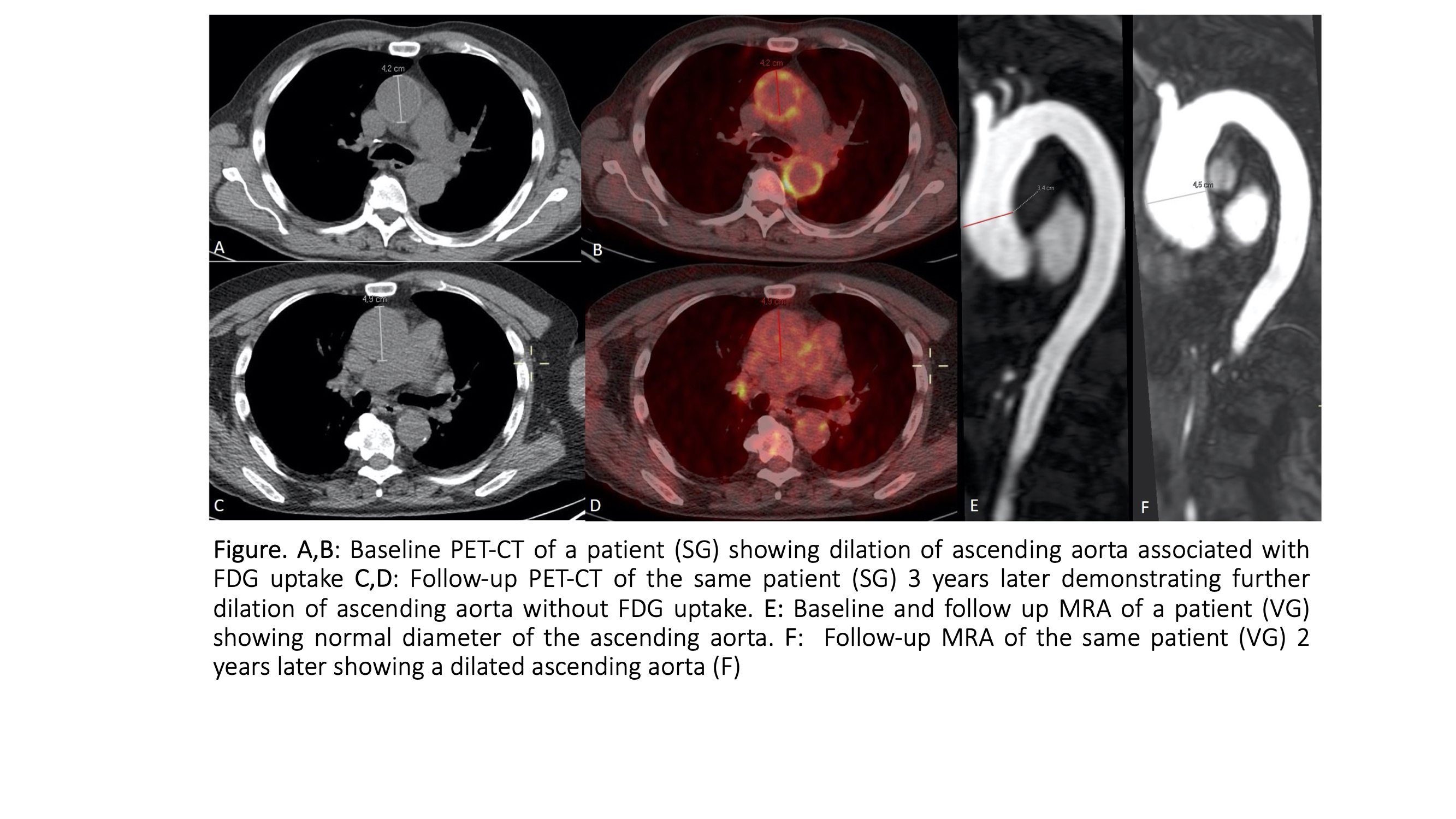
Results. A total of 157 patients were included, (mean age 67.9±9.1 years; 69.4% female). Aortitis was present in 93/154 (60.4%) patients at baseline (detected in 32.6% of MRIs and in 71.2% of PET/CT scans) and was associated with younger age (66.5 vs 69.7 years, p=0.028) and fewer cranial ischemic symptoms at disease onset (18.5% vs. 41.7%, p=0.002). Baseline aortic aneurysms were identified in 19.6% of patients and in 5.8% of aortic segments, predominantly in the mid-ascending aorta. Aortitis at baseline was associated with larger aortic diameters (beta = 0.184; p<0.0001) and higher odds of prevalent aneurysm (ORadj=2.3; 95% CI: 1.0–5.1). Over a median follow-up of 30 months, incident aneurysms developed in 9.8% of patients and 4.1% of aortic segments without baseline dilation (Figure). Baseline aortic diameter was the strongest predictor of aortic growth (beta= 0.088; p=0.006) and incident aneurysm formation (HRadj=3.9; 95% CI: 2.0–7.3). Visual symptoms were associated with smaller aortic area increase (beta= -0.111; p=0.038). Mean annual growth of the aortic area ranged from 0.00 to 0.03 mm2/year, without differences between patients with or without baseline aortitis. Aortitis increased the risk of aneurysm progression only among patients already on glucocorticoids at time of baseline imaging, although not reaching statistical significance (HRadj=3.2, 95% CI 0.65-15.7).
Conclusions. Aortic involvement is common in GCA patients at diagnosis, and baseline aortitis was associated with prevalent aneurysms and larger aortic diameters but not with subsequent risk of aneurysm formation. Instead, baseline aortic diameter was the most robust predictor of aortic enlargement and aneurysm formation in our cohort. These findings support the hypothesis that inflammation contributes to the initial damage while its progression could be self-perpetuating. Early morphological imaging assessment and longitudinal monitoring of aortic dimensions are necessary in GCA patients. 
Downloads
How to Cite

This work is licensed under a Creative Commons Attribution-NonCommercial 4.0 International License.
PAGEPress has chosen to apply the Creative Commons Attribution NonCommercial 4.0 International License (CC BY-NC 4.0) to all manuscripts to be published.