
 https://doi.org/10.4081/reumatismo.2025.1984
CO:08:5 | Clinical impact of anti-Ro52 antibodies in idiopathic inflammatory myopathies: insights from a multicenter Italian cohort
Paola Bizioli1, Cesare Tomasi2, Francesca Bellisai3, Francesca Buzzulini4, Antonio Tonutti5|6, Angela Ceribelli5|6, Edoardo Conticini3, Anna Ghirardello7, Luca Iaccarino7, Danilo Villalta4, Franco Franceschini1, Ilaria Cavazzana1. | 1Rheumatology and Clinical Immunology Unit - ERN ReCONNET, ASST Spedali Civili of Brescia; 2Department of Clinical and Experimental Sciences, University of Brescia; 3Department of Medicine, Surgery and Neurosciences, Rheumatology Unit, University of Siena; 4Department of Laboratory Immunology and Allergology, Santa Maria degli Angeli Hospital, Pordenone; 5Department of Biomedical Sciences, Humanitas University, Rozzano (MI); 6Rheumatology and Clinical Immunology, Istituti di Ricovero e Cura a Carattere Scientifico, Humanitas Research Hospital, Rozzano (MI); 7Division of Rheumatology, Department of Medical and Surgical Sciences, University of Padova, Italy
All claims expressed in this article are solely those of the authors and do not necessarily represent those of their affiliated organizations, or those of the publisher, the editors and the reviewers. Any product that may be evaluated in this article or claim that may be made by its manufacturer is not guaranteed or endorsed by the publisher.
Background. Anti-Ro52 antibodies are frequently found in idiopathic inflammatory myopathies (IIM), with a prevalence up to 30%, and are strongly associated with antisynthetase syndrome (ASyS), interstitial lung disease (ILD), and dysphagia (1;2;3). Their co-occurrence especially with anti-Jo1 or anti-MDA5, have been linked to more severe disease, including rapidly progressive ILD (1). However, they do not always correlate with worse prognosis (4). This study aimed to assess the clinical relevance of anti-Ro52 in IIM, focusing on disease phenotype and systemic involvement.
Methods. This multicenter study (five Italian centers) included all patients with IIM positive for anti-Ro52 and/or myositis-specific antibodies (MSA). Patients were stratified into three groups: isolated anti-Ro52, anti-Ro52+MSA, and MSA-only. Clinical and laboratory features were collected, with emphasis on pulmonary involvement assessed by pulmonary function tests (PFTs) and high-resolution CT.
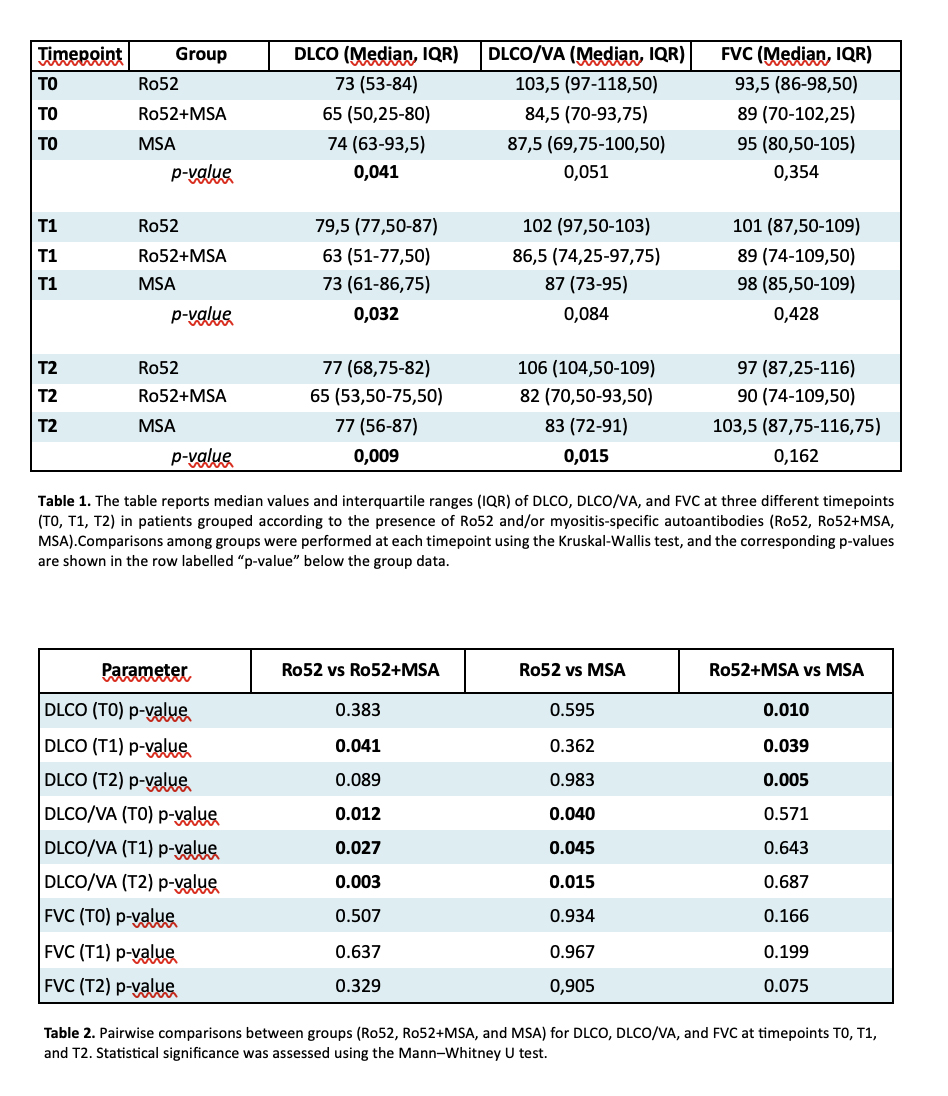
Results. A total of 242 patients were included (median age: 63 years, IQR 53.75-73; median disease duration: 5 years, IQR 3-12; median follow-up: 60 months, IQR 25-120). Ro52+MSA patients showed the highest prevalence of antisynthetase syndrome (p<0.001). Baseline median DLCO was lower in Ro52+MSA (65%, IQR 54–74) than in Ro52-only (73%; IQR 62–78), and MSA (75.5%; IQR 68–84) patients. DLCO and DLCO/VA remained consistently lower in Ro52+MSA. Significant differences were observed at multiple timepoints between Ro52+MSA and the other groups for DLCO and DLCO/VA. FVC did not differ significantly, though lower medians were seen in Ro52+MSA patients (Table 1-2). ILD and dyspnoea were more frequent in Ro52+MSA (61.7% and 47.6%, respectively; p < 0.001 and p = 0.010). Arthritis showed a borderline difference (p = 0.050), with lower prevalence in Ro52-only patients. Myositis and peak CPK levels were statistically less frequent in Ro52-only patients. Raynaud’s phenomenon was not observed in Ro52-only cases (p = 0.002). ESR was higher in Ro52+MSA patients (p = 0.024), while no differences in CRP were observed. Cutaneous features varied: Gottron’s papules and mechanic’s hands were strongly associated with Ro52+MSA patients (p < 0.001), while periungual telangiectasias were more common in Ro52-positive individuals, especially in those with isolated Ro52. Conversely, sclerodactyly and puffy hands were more commonly seen in MSA patients (p < 0.001).
Conclusions. Anti-Ro52 positivity, especially with MSA, defines a distinct IIM phenotype characterized by ILD, elevated ESR, and specific cutaneous features. The increased ILD prevalence in Ro52+MSA may relate to the higher frequency of antisynthetase syndrome and possible co-occurance with anti-Jo1, though subgroup analysis was limited by small numbers. The low number of isolated anti-Ro52 patients also limits comparisons, supporting the need for further studies in larger cohorts.
 References
1. Allameen NA, Lai YW, Lian G, Lee TZ, Selvakumaran S, Tan RYT, Xu C. Physiotherapy and occupational therapy in rheumatoid arthritis: Bridging functional and comorbidity gaps. Best Pract Res Clin Rheumatol. 2025;39(1):102032.
2. Decker MR, Grace KT, Holliday CN, Bevilacqua KG, Gottlieb A, Black MC. Safe and stable housing for intimate partner violence survivors: A framework for policy and practice. Am J Public Health. 2022;112(7):1012-1020.
3. Valle AR, Zuntini AR, Smith SA, Vasconcelos TNC, Barnes RW, et al. Phylogenomics and the rise of the angiosperms. Nature. 2024;616(7981):785-791.
4. Pepper AE, Liu X, Ciannamea S, Xu DL, et al. Immune receptor mimicking hormone receptors: a new paradigm in plant biology. Stress Biol. 2023;3(1):14.
Downloads
How to Cite

This work is licensed under a Creative Commons Attribution-NonCommercial 4.0 International License.
PAGEPress has chosen to apply the Creative Commons Attribution NonCommercial 4.0 International License (CC BY-NC 4.0) to all manuscripts to be published.