
62nd National Congress of the Italian Society of Rheumatology
Vol. 77 No. s1 (2025): Abstract book of the 62th Conference of the Italian Society for...
 https://doi.org/10.4081/reumatismo.2025.2393
S05:5 | Romosozumab in Post-Menopausal Women with Multiple Myeloma, a Prospective 12-Month Study
Giovanni Adami1, Mariana Diz Lopes1, Camilla Benini1, Davide Gatti1, Ombretta Viapana1, Elena Marchetti2, Martina Tinelli2, Maurizio Rossini1 | 1UOC Reumatologia, Università degli Studi di Verona Verona, Italy; 2UOC Ematologia, Università degli Studi di Verona Verona, Italy
Publisher's note
All claims expressed in this article are solely those of the authors and do not necessarily represent those of their affiliated organizations, or those of the publisher, the editors and the reviewers. Any product that may be evaluated in this article or claim that may be made by its manufacturer is not guaranteed or endorsed by the publisher.
All claims expressed in this article are solely those of the authors and do not necessarily represent those of their affiliated organizations, or those of the publisher, the editors and the reviewers. Any product that may be evaluated in this article or claim that may be made by its manufacturer is not guaranteed or endorsed by the publisher.
115
Views
Methods. We conducted a 12-month prospective observational study on postmenopausal women with osteoporosis and multiple myeloma (MM) treated with monthly ROMO. BMD was assessed at baseline, 6, and 12 months with DXA. HR-pQCT, bone turnover makers and several MM markers (M-protein, immunoglobulins, free light chains, b2-microglobulin) were monitored. Repeated measures were analyzed using mixed-effects models.
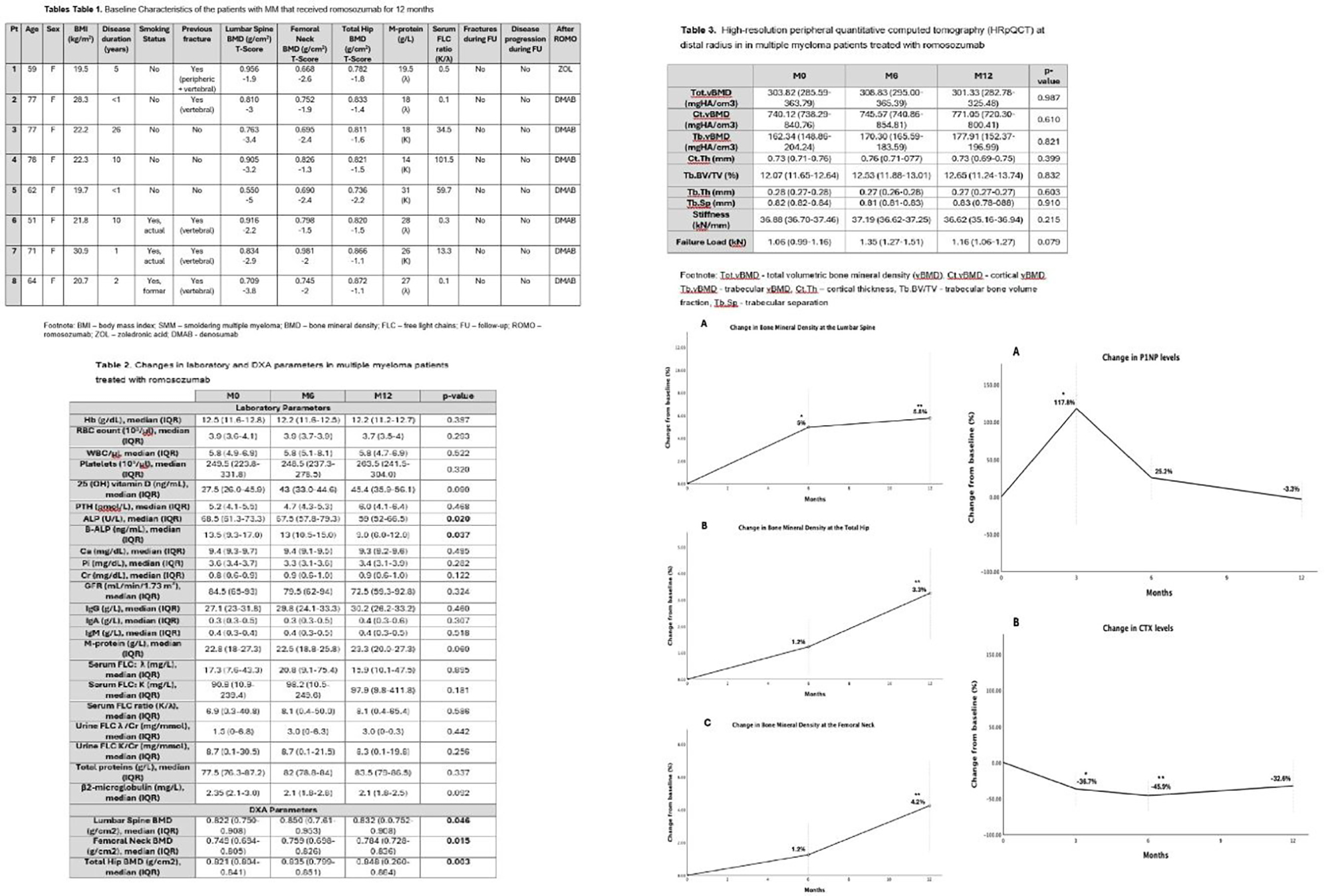
Results. Eight female patients with MM without evidence of CRAB (mean age 67.4±9.9 years) completed 12 months of ROMO. A significant BMD increase was observed at the lumbar spine (+5.8%, p=0.048), femoral neck (+4.2%, p=0.020), and total hip (+3.3%, p=0.002). P1NP rose sharply at month 3 (+117.8%) and returned to baseline by month 12 (p=0.006). CTX decreased progressively, showing a trend towards significance (-53.6%, p=0.060). ALP and B-ALP significantly declined by month 12 (p=0.020 and p=0.022). No significant changes occurred in immunoglobulins, M-protein, or light chains. B2-microglobulin decreased at month 12 (from 2.35 to 2.1mg/L, p=0.042), but the overall trend was not significant (p=0.092). Estimated failure load increased at month 6 (p=0.033) while the other HR-pQCT parameters remained stable throughout the study.
Conclusions. In this exploratory study of postmenopausal women with MM and osteoporosis, ROMO significantly improved BMD and modulated BTMs, without any evidence of disease progression over the 12-month period. These findings support ROMO as a potential bone-targeted therapy in patients with osteoporosis and MM.
Downloads
Download data is not yet available.
How to Cite
1.
di Reumatologia SI. S05:5 | Romosozumab in Post-Menopausal Women with Multiple Myeloma, a Prospective 12-Month Study: Giovanni Adami1, Mariana Diz Lopes1, Camilla Benini1, Davide Gatti1, Ombretta Viapana1, Elena Marchetti2, Martina Tinelli2, Maurizio Rossini1 | 1UOC Reumatologia, Università degli Studi di Verona Verona, Italy; 2UOC Ematologia, Università degli Studi di Verona Verona, Italy. Reumatismo [Internet]. 2026 Mar. 18 [cited 2026 Oct. 25];77(s1). Available from: https://www.reumatismo.org/reuma/article/view/2393
Copyright (c) 2026 The Author(s)


This work is licensed under a Creative Commons Attribution-NonCommercial 4.0 International License.
PAGEPress has chosen to apply the Creative Commons Attribution NonCommercial 4.0 International License (CC BY-NC 4.0) to all manuscripts to be published.