
62nd National Congress of the Italian Society of Rheumatology
Vol. 77 No. s1 (2025): Abstract book of the 62th Conference of the Italian Society for...
 https://doi.org/10.4081/reumatismo.2025.2392
S02:6 | Monocyte-Driven Inflammation and Inflammasome Activation in ANCA-Positive EGPA: Evidence of Persistent Immune Activation During Remission
Chiara Baggio1, Luca Iorio1, Carlotta Boscaro2|3, Federica Davanzo1, Marta Tonello1, Mattia Albiero4, Andrea Doria1, Paolo Sfriso1, Roberto Padoan1, Francesca Oliviero1 | 1Rheumatology Unit, Department of Medicine, University of Padova, Italy; 2Department of Medicine, University of Padova, Italy; 3Veneto Institute of Molecular Medicine, Laboratory of Experimental Diabetology, Italy; 4Department of Surgery, Oncology, and Gastroenterology, University of Padova, Italy
Publisher's note
All claims expressed in this article are solely those of the authors and do not necessarily represent those of their affiliated organizations, or those of the publisher, the editors and the reviewers. Any product that may be evaluated in this article or claim that may be made by its manufacturer is not guaranteed or endorsed by the publisher.
All claims expressed in this article are solely those of the authors and do not necessarily represent those of their affiliated organizations, or those of the publisher, the editors and the reviewers. Any product that may be evaluated in this article or claim that may be made by its manufacturer is not guaranteed or endorsed by the publisher.
81
Views
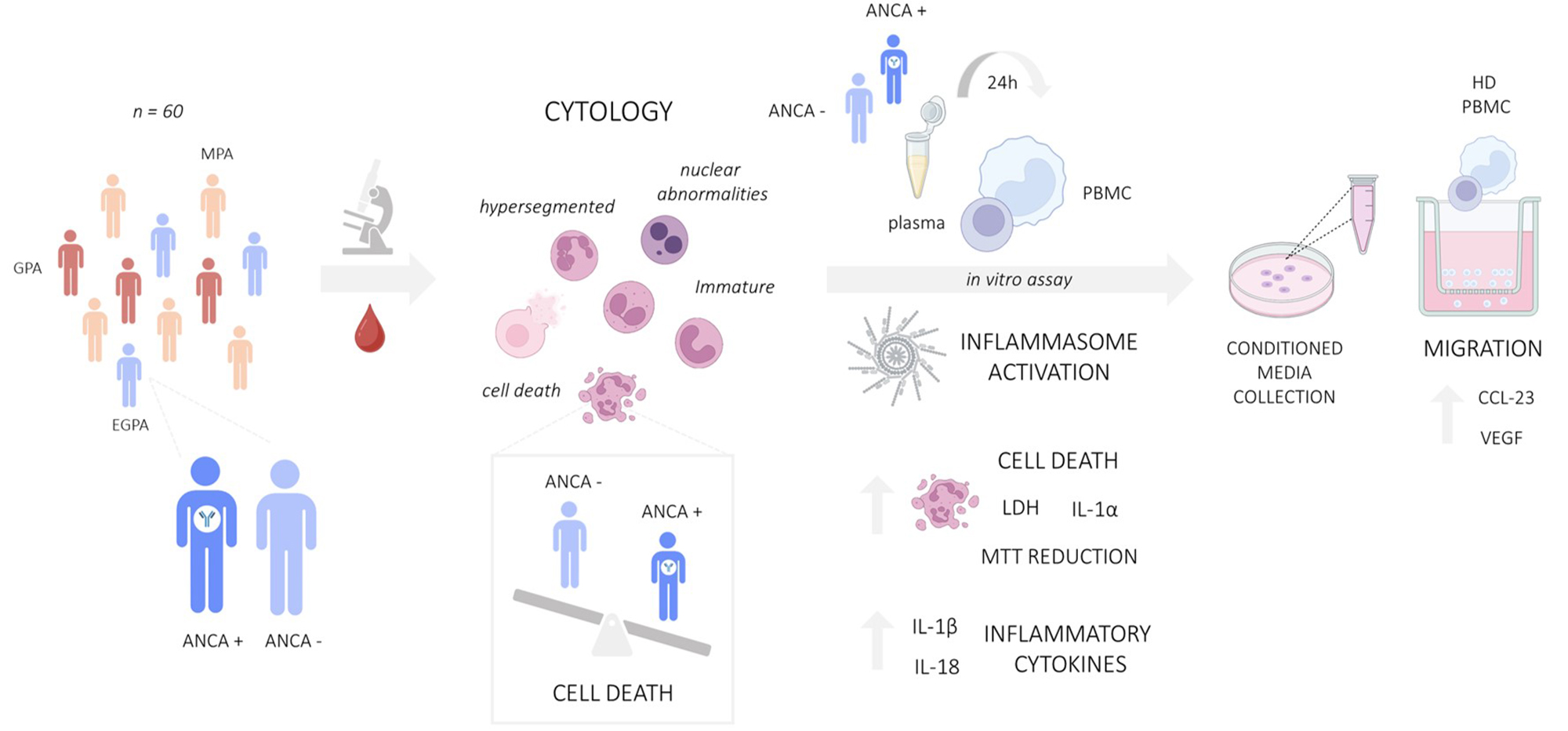
Materials and Methods. Peripheral blood samples from AAV patients (n = 60) and HD (n = 28) were evaluated by May-Grünwald Giemsa staining. HD PBMCs were stimulated with plasma from EGPA patients (ANCA ++, ANCA +, ANCA-), controls positive for antiphospholipid antibodies (IgG) and HDs. Cell death was assessed by Trypan Blue, LDH, IL-1 release, and Annexin V/PI staining. MTT assays measured cell metabolism. ELISA was used to quantify IL-1, IL-18, IL-1, VEGF, and CCL-23 in plasma and PBMC supernatants. Chemotaxis assays evaluated cell migration to conditioned media, with or without pharmacological inhibition using Anakinra (IL-1 receptor antagonist) or the CCR1 inhibitor J113863.
Results. EGPA patients displayed a distinct neutrophil phenotype with increased hypersegmentation, vacuolization, and presence of immature neutrophils. Plasma from ANCA-positive EGPA patients induced significantly increased PBMC death, reduced metabolic activity, and increased release of inflammasome-related cytokines compared to ANCA-negative patients and controls. Conditioned media from PBMCs stimulated with ANCA+ plasma promoted significant PBMC migration, which was positively correlated with IL-1, IL-18, IL-1, VEGF, and CCL-23 levels. Notably, both Anakinra and CCR1 inhibition significantly reduced plasma-induced PBMC migration, suggesting a key role for IL-1 signaling and CCL-23/CCR1 axis in EGPA-driven chemotaxis.
Conclusions. Our findings demonstrate persistent subclinical immune activation and inflammasome engagement in mononuclear cells stimulated with plasma from EGPA ANCA + patients, even during remission. This supports the use of cytokine and chemokine profiling as potential biomarkers of immune activity and relapse risk. EGPA should be considered a distinct immunopathological entity within the AAV spectrum, with implications for personalized treatment.
Downloads
Download data is not yet available.
How to Cite
1.
S02:6 | Monocyte-Driven Inflammation and Inflammasome Activation in ANCA-Positive EGPA: Evidence of Persistent Immune Activation During Remission: Chiara Baggio1, Luca Iorio1, Carlotta Boscaro2|3, Federica Davanzo1, Marta Tonello1, Mattia Albiero4, Andrea Doria1, Paolo Sfriso1, Roberto Padoan1, Francesca Oliviero1 | 1Rheumatology Unit, Department of Medicine, University of Padova, Italy; 2Department of Medicine, University of Padova, Italy; 3Veneto Institute of Molecular Medicine, Laboratory of Experimental Diabetology, Italy; 4Department of Surgery, Oncology, and Gastroenterology, University of Padova, Italy. Reumatismo [Internet]. 2026 Mar. 18 [cited 2026 Oct. 19];77(s1). Available from: https://www.reumatismo.org/reuma/article/view/2392
Copyright (c) 2026 The Author(s)


This work is licensed under a Creative Commons Attribution-NonCommercial 4.0 International License.
PAGEPress has chosen to apply the Creative Commons Attribution NonCommercial 4.0 International License (CC BY-NC 4.0) to all manuscripts to be published.