
62nd National Congress of the Italian Society of Rheumatology
Vol. 77 No. s1 (2025): Abstract book of the 62th Conference of the Italian Society for...
 https://doi.org/10.4081/reumatismo.2025.2389
PO:36:252 | Long-Term Outcomes of Patients with Takayasu Arteritis in the Era of Biological Agents: a Multicenter International Study
Alessandro Tomelleri1, Durga Prasanna Misra2, Fatma Alibaz-Oner3, Chiara Marvisi4, Chiara Calabrese1, Upendra Rathore2, Aysegul Avcu3, Adele Del Giudice4, Elisabetta Olivi4, Caterina Ricordi4, Corrado Campochiaro1, Elena Baldissera1, Marco Matucci-Cerinic1, Haner Direskeneli3, Carlo Salvarani4, Lorenzo Dagna1 | 1IRCCS Ospedale San Raffaele, Unità di Immunologia, Reumatologia, Allergologia e Malattie Rare Milano, Italy; 2Sanjay Gandhi Postgraduate Institute of Medical Sciences SGPGIMS, Clinical Immunology and Rheumatology Lucknow Country, India; 3Marmara University, School of Medicine, Department of Internal Medicine, Division of Rheumatology Istanbul, Turkey; 4Azienda USL-IRCCS di Reggio Emilia, Unità di Reumatologia Reggio Emilia, Italy
Publisher's note
All claims expressed in this article are solely those of the authors and do not necessarily represent those of their affiliated organizations, or those of the publisher, the editors and the reviewers. Any product that may be evaluated in this article or claim that may be made by its manufacturer is not guaranteed or endorsed by the publisher.
All claims expressed in this article are solely those of the authors and do not necessarily represent those of their affiliated organizations, or those of the publisher, the editors and the reviewers. Any product that may be evaluated in this article or claim that may be made by its manufacturer is not guaranteed or endorsed by the publisher.
148
Views
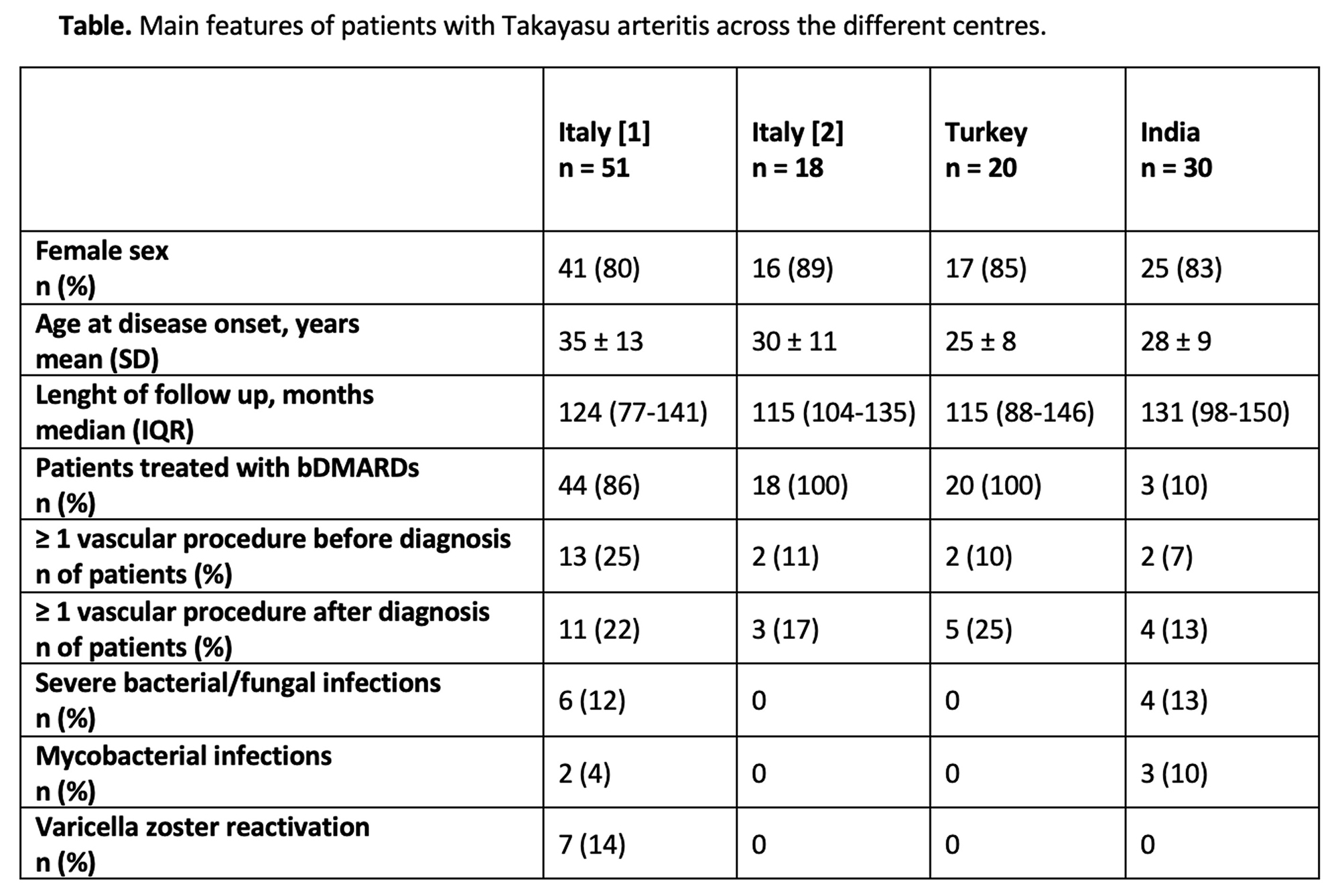
Methods. Medical records of TAK patients followed at four centres (2 in Italy, 1 in India, 1 in Turkey) for at least 60 months were retrospectively reviewed. Baseline data included demographics, clinical features, vascular involvement, and initial treatment. Outcomes included progression of vascular damage, need for procedures, use of csDMARDs and bDMARDs, glucocorticoid (GC) tapering and discontinuation, and major complications. Logistic and linear regression were used to identify predictors of GC withdrawal, vascular procedures, and infections.
Results. A total of 119 patients (84% women; mean age at diagnosis 31±23 years) were included. Median follow-up was 122 (IQR 92–145) months. At diagnosis, 48 patients (40%) already showed advanced vascular damage: occlusions in 38 (32%) involving 62 vessels, aneurysms in 9 (8%) involving 12 vessels, and one dissection (1%). Nineteen (16%) had previously undergone at least one vascular procedure (36 total). GCs were initiated in 112 patients (94%) and permanently discontinued in 41 (34%), after a median of 49 (IQR 49–74) months. No baseline predictors of GC discontinuation were found. csDMARDs were prescribed in 112 patients (94%), mostly at baseline (87%); bDMARDs were prescribed in 85 patients (71%), after a median of 17 (8–51) months, accounting for 151 therapy courses: TNF inhibitors (69%), tocilizumab (23%), JAK inhibitors (5%), and rituximab, ustekinumab, and secukinumab (1% each). During follow-up, 25 patients (21%) developed new arterial occlusions (33 vessels), 7 (6%) new aneurysms (8 vessels), and one patient a new dissection. At least one vascular procedure was performed in 23 patients (19%) for 36 new interventions. Baseline involvement of the abdominal aorta (OR 4.741, 95% CI 1.625–13.833), coeliac trunk (OR 3.054, 95% CI 1.197–7.796), superior mesenteric artery (OR 2.869, 95% CI 1.117–7.369), right renal artery (OR 2.885, 95% CI 1.104–7.539), and left renal artery (OR 5.386, 95% CI 2.023–14.334) predicted future vascular procedures. Infectious complications occurred in 14 patients (12%): 8 bacterial, 2 fungal, 5 mycobacterial; VZV reactivation was reported in 7 (6%). Older age at disease onset was associated with a higher risk of infections (p = 0.003). Other long-term complications included hypertension (13%), ischaemic heart disease (6%), diabetes (3%), osteoporotic fractures (3%), stroke (2%), and pulmonary embolism (2%).
Conclusions. Despite widespread use of biologics, sustained GC withdrawal was achieved in only one-third of patients with TAK, often after prolonged exposure. Vascular procedures remain common, especially in cases with abdominal vessel involvement. Cardiovascular and infectious events, particularly in older patients, are the main long-term complications of TAK.
Downloads
Download data is not yet available.
How to Cite
1.
PO:36:252 | Long-Term Outcomes of Patients with Takayasu Arteritis in the Era of Biological Agents: a Multicenter International Study: Alessandro Tomelleri1, Durga Prasanna Misra2, Fatma Alibaz-Oner3, Chiara Marvisi4, Chiara Calabrese1, Upendra Rathore2, Aysegul Avcu3, Adele Del Giudice4, Elisabetta Olivi4, Caterina Ricordi4, Corrado Campochiaro1, Elena Baldissera1, Marco Matucci-Cerinic1, Haner Direskeneli3, Carlo Salvarani4, Lorenzo Dagna1 | 1IRCCS Ospedale San Raffaele, Unità di Immunologia, Reumatologia, Allergologia e Malattie Rare Milano, Italy; 2Sanjay Gandhi Postgraduate Institute of Medical Sciences SGPGIMS, Clinical Immunology and Rheumatology Lucknow Country, India; 3Marmara University, School of Medicine, Department of Internal Medicine, Division of Rheumatology Istanbul, Turkey; 4Azienda USL-IRCCS di Reggio Emilia, Unità di Reumatologia Reggio Emilia, Italy. Reumatismo [Internet]. 2026 Mar. 18 [cited 2026 Oct. 16];77(s1). Available from: https://www.reumatismo.org/reuma/article/view/2389
Copyright (c) 2026 The Author(s)


This work is licensed under a Creative Commons Attribution-NonCommercial 4.0 International License.
PAGEPress has chosen to apply the Creative Commons Attribution NonCommercial 4.0 International License (CC BY-NC 4.0) to all manuscripts to be published.