
62nd National Congress of the Italian Society of Rheumatology
Vol. 77 No. s1 (2025): Abstract book of the 62th Conference of the Italian Society for...
 https://doi.org/10.4081/reumatismo.2025.2386
PO:35:233 | Tocilizumab is associated with improved relapse-free survival in polymyalgia rheumatica: a multicentre retrospective study
Milena Bond1, Giovanni Adami2, Marianna Tamussin3, Mario Frasca4, Sara Zandonella Callegher1, Marcello Govoni3, Maurizio Rossini2, Lorenzo Dagna4, Marco Matucci Cerinic4, Christian Dejaco1, Alessandro Tomelleri4 | 1Department of Rheumatology, Brunico Hospital ASAA-SABES, Teaching Hospital of the Paracelsius Medical University Bunico, Italy; 2Rheumatology Unit, University of Verona, Policlinico Borgo Roma Verona, Italy; 3Rheumatology Unit, Department of Medical Sciences, University of Ferrara and Azienda Ospedaliero-Universitaria S. Anna Ferrara, Italy; 4Unit of Immunology, Rheumatology, Allergy and Rare Diseases, IRCCS San Raffaele Hospital Milano, Italy
Publisher's note
All claims expressed in this article are solely those of the authors and do not necessarily represent those of their affiliated organizations, or those of the publisher, the editors and the reviewers. Any product that may be evaluated in this article or claim that may be made by its manufacturer is not guaranteed or endorsed by the publisher.
All claims expressed in this article are solely those of the authors and do not necessarily represent those of their affiliated organizations, or those of the publisher, the editors and the reviewers. Any product that may be evaluated in this article or claim that may be made by its manufacturer is not guaranteed or endorsed by the publisher.
98
Views
Methods. consecutive patients seen from 2015 onwards at three Italian centres with a confirmed clinical diagnosis of PMR, who had received at least one DMARD during their disease course and had a minimum follow-up of 6 months from DMARD initiation, were included. Relapse was defined as the recurrence of PMR symptoms and/or elevated inflammatory markers requiring an increase in glucocorticoid dose or a change in immunosuppressive therapy. A time-to-event (relapse) analysis was performed considering treatment courses as the unit of analysis; each new course was defined by the initiation of a DMARD. Cox proportional hazards models were adjusted for age, sex, initial prednisone dose, prednisone dose at the time of DMARD initiation, number of relapses before DMARD initiation, and C-reactive protein (CRP) level at diagnosis.
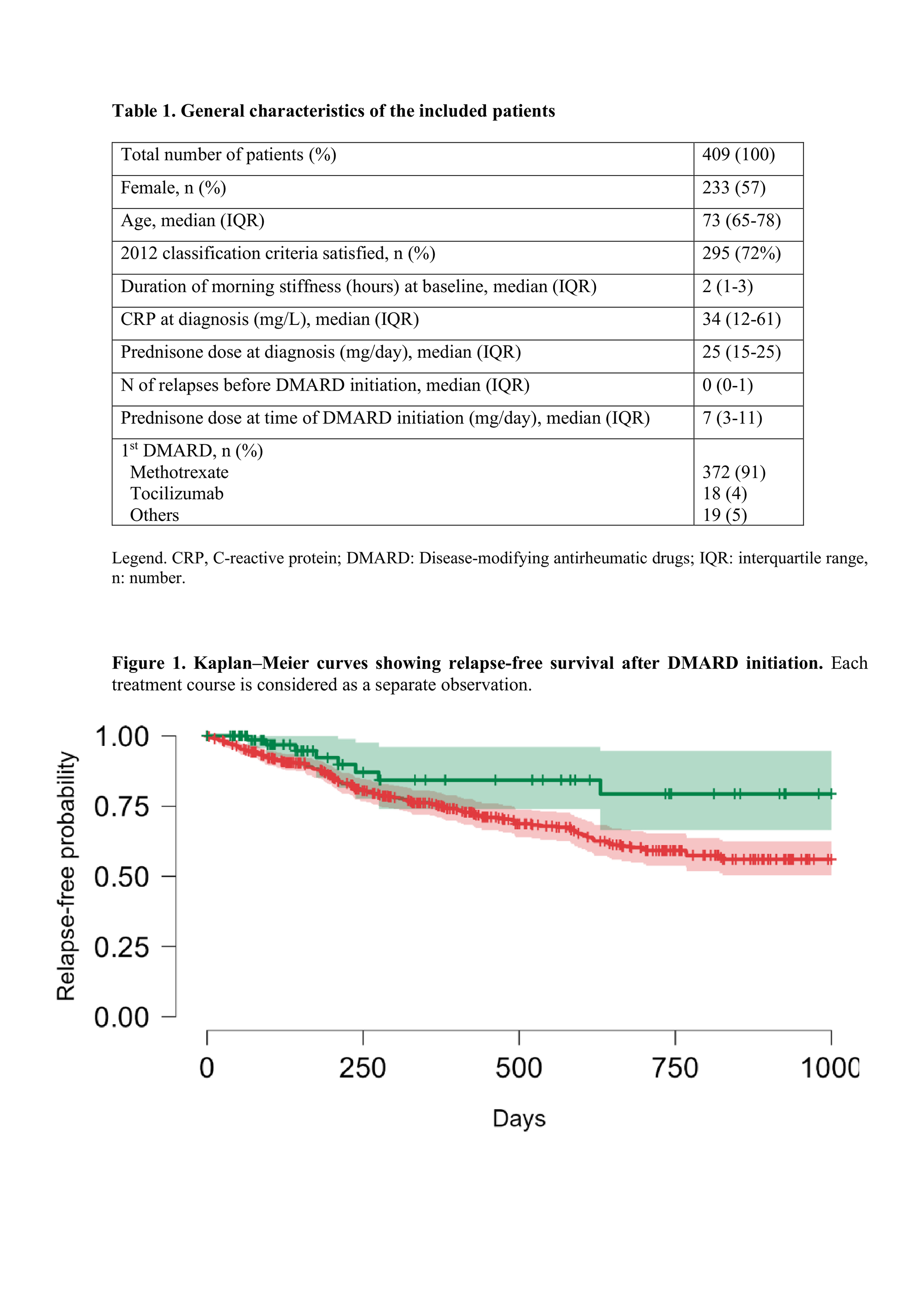
Results. We included 409 patients from three Italian tertiary centres; their baseline characteristics are summarized in Table 1. The median follow-up after DMARD initiation was 822 (interquartile range: 502-1167) days. A total of 515 treatment courses were included (431 cDMARDs, 84 TCZ), with 138 and 8 relapses observed, respectively. The most frequent reasons for DMARD initiation were steroid dependency and relapse. In the Cox regression multivariate analysis, TCZ was associated with a 71% reduction of the risk of relapses compared to other DMARDs (aHR 0.29, 95% CI 0.12–0.65, p=0.0017), with a longer relapse-free survival (mean 853 vs. 715 days, long rank p=0.019), as shown in Figure 1. In multivariable analysis, the number of relapses prior to 1st DMARD (aHR 1.50, 95% CI 1.21–1.85) and the prednisone dose at the time of DMARD initiation (aHR 1.07, 95% CI 1.04–1.09) were also independently associated with an increased risk of a subsequent relapse. Sex, age, and CRP levels at diagnosis were not significantly associated with relapse risk.
Conclusions. TCZ was associated with a significantly lower risk of relapse and longer relapse-free survival compared to cDMARDs, supporting its potential role as an effective treatment option in selected patients with PMR.
Downloads
Download data is not yet available.
How to Cite
1.
PO:35:233 | Tocilizumab is associated with improved relapse-free survival in polymyalgia rheumatica: a multicentre retrospective study: Milena Bond1, Giovanni Adami2, Marianna Tamussin3, Mario Frasca4, Sara Zandonella Callegher1, Marcello Govoni3, Maurizio Rossini2, Lorenzo Dagna4, Marco Matucci Cerinic4, Christian Dejaco1, Alessandro Tomelleri4 | 1Department of Rheumatology, Brunico Hospital ASAA-SABES, Teaching Hospital of the Paracelsius Medical University Bunico, Italy; 2Rheumatology Unit, University of Verona, Policlinico Borgo Roma Verona, Italy; 3Rheumatology Unit, Department of Medical Sciences, University of Ferrara and Azienda Ospedaliero-Universitaria S. Anna Ferrara, Italy; 4Unit of Immunology, Rheumatology, Allergy and Rare Diseases, IRCCS San Raffaele Hospital Milano, Italy. Reumatismo [Internet]. 2026 Mar. 18 [cited 2026 Oct. 19];77(s1). Available from: https://www.reumatismo.org/reuma/article/view/2386
Copyright (c) 2026 The Author(s)


This work is licensed under a Creative Commons Attribution-NonCommercial 4.0 International License.
PAGEPress has chosen to apply the Creative Commons Attribution NonCommercial 4.0 International License (CC BY-NC 4.0) to all manuscripts to be published.