
62nd National Congress of the Italian Society of Rheumatology
Vol. 77 No. s1 (2025): Abstract book of the 62th Conference of the Italian Society for...
 https://doi.org/10.4081/reumatismo.2025.2384
PO:35:224 | Capturing What BVAS Misses: Patient-Reported Outcomes Reflect Disease Activity and Burden in EGPA
Marta Codirenzi1, Federica Davanzo1, Luca Iorio1, Eleonora Fiorin1, Roberta Prevedello1, Roberto Padoan1, Andrea Doria1 | 1Unità di reumatologia, dipartimento di medicina DIMED,Università degli studi di Padova, Italy
Publisher's note
All claims expressed in this article are solely those of the authors and do not necessarily represent those of their affiliated organizations, or those of the publisher, the editors and the reviewers. Any product that may be evaluated in this article or claim that may be made by its manufacturer is not guaranteed or endorsed by the publisher.
All claims expressed in this article are solely those of the authors and do not necessarily represent those of their affiliated organizations, or those of the publisher, the editors and the reviewers. Any product that may be evaluated in this article or claim that may be made by its manufacturer is not guaranteed or endorsed by the publisher.
97
Views
Methods. This study aimed to evaluate the sensitivity of PROMs in detecting disease activity compared to standard clinical evaluations, particularly BVAS version 3 (BVASv3). Changes in clinical and PROM scores were analyzed at baseline (T0), 12 months (T12), and last follow-up (LFU) using non-parametric paired tests (Wilcoxon). Correlation analyses (Spearman and Pearson) were conducted to evaluate the associations between PROMs and BVAS. Furthermore, PROM scores were compared between patients in clinical remission and those with active disease. The AAV- PRO questionnaire comprises 29 items distributed across six domains: organ-specific symptoms (OSS), systemic symptoms (SS), treatment side effects (TSE), social and emotional impact (SEI), concerns about the future (CAF), and physical function (PF).
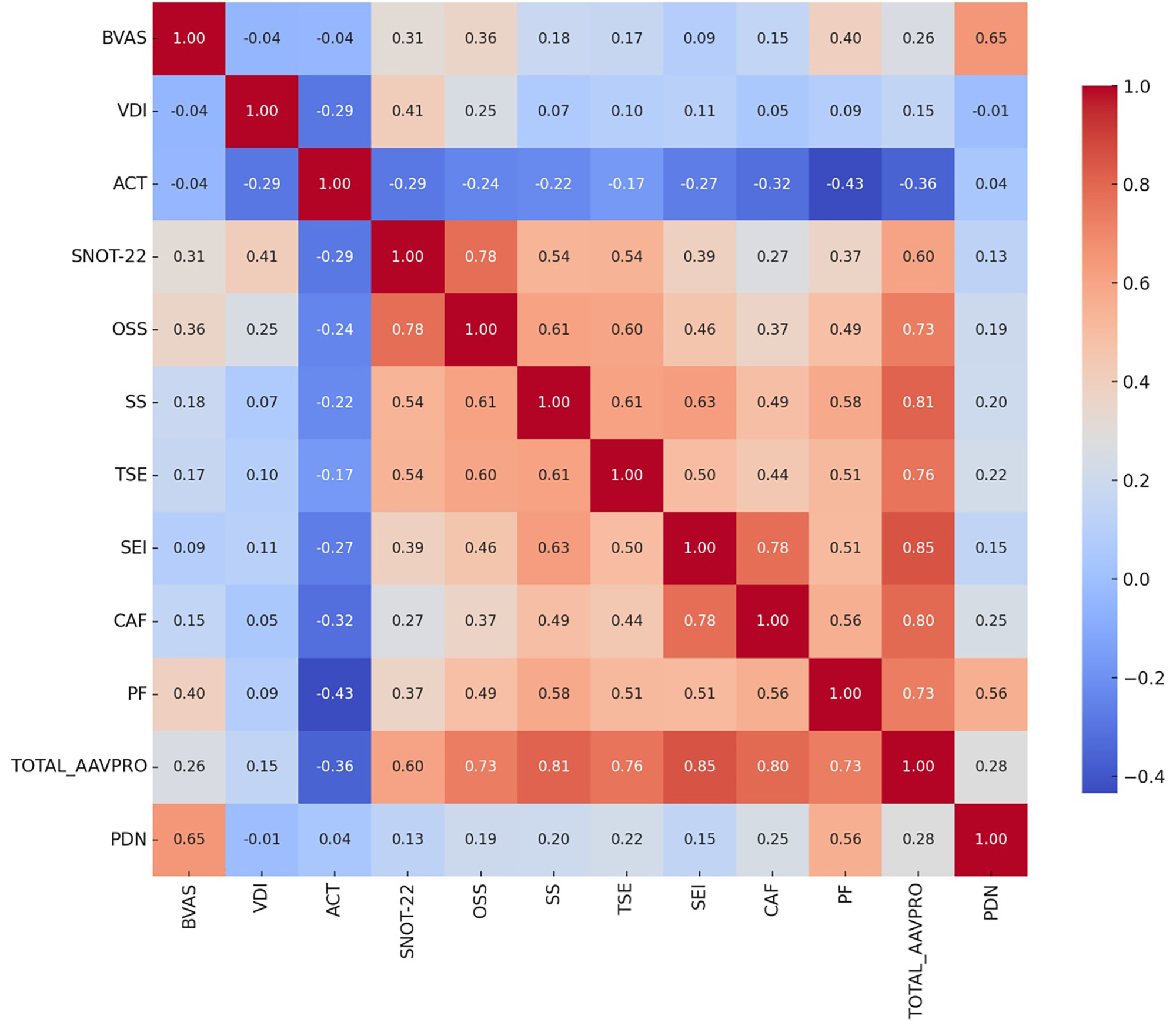
Results. Forty patients with EGPA (median age 54 years, 50% female) were treated with anti–IL5/r or anti- IL4/13 biologics—primarily mepolizumab 300 mg—and had a median disease duration of 57.5 months; at diagnosis, all had pulmonary symptoms, 97.5% had asthma, 90% ENT symptoms, 62.5% neurological involvement, 32.5% cutaneous, 25% cardiac, and 5% gastrointestinal or renal, with 42.5% ANCA-MPO positivity. Despite prior immunosuppressive treatment and previous ENT surgery in most patients, at the time of analysis, 60% had ongoing ENT symptoms, 50% had asthma symptoms, and the median BVAS and VDI were 3.5 and 4, respectively. At 12 months, BVAS scores significantly decreased to 0 (p<0.001), with prednisone use reduced from a median of 2.8 mg/day to 0 mg/day (p<0.001). VDI scores slightly increased from 4 to 5 (p=0.0047). Significant improvements were observed in SNOT-22 (median from 47 [32–58] to 25 [10–41]; p=0.008) and in all AAV-PRO domains, except CAF. Despite clinical remission at 12 months, patients still reported residual symptomatology, with median SNOT-22 and total AAV-PRO scores of 23 and 30, respectively. To further explore the relationship between PROMs and disease activity, 198 observations were analyzed, of which 133 (67%) were in remission and 65 (33%) active disease. PROMs differed significantly between these groups. BVAS correlated strongly with PF (r=0.399,p<0.0001), OSS (r=0.365,p<0.0001), and SNOT-22 (r=0.315,p=0.0007). ACT scores were inversely correlated with disease activity and total AAV-PRO (r=0.357,p=0.0002). No significant correlations were observed between BVAS or VDI and the total AAV-PRO score.
Conclusions. Biologic therapies in EGPA lead to clinical remission and reduced glucocorticoid use, while patient- reported outcomes highlight residual symptom burden, underscoring the value of integrating PROMs into routine assessments to better capture patient experiences and guide care.
Downloads
Download data is not yet available.
How to Cite
1.
PO:35:224 | Capturing What BVAS Misses: Patient-Reported Outcomes Reflect Disease Activity and Burden in EGPA: Marta Codirenzi1, Federica Davanzo1, Luca Iorio1, Eleonora Fiorin1, Roberta Prevedello1, Roberto Padoan1, Andrea Doria1 | 1Unità di reumatologia, dipartimento di medicina DIMED,Università degli studi di Padova, Italy. Reumatismo [Internet]. 2026 Mar. 18 [cited 2026 Oct. 16];77(s1). Available from: https://www.reumatismo.org/reuma/article/view/2384
Copyright (c) 2026 The Author(s)


This work is licensed under a Creative Commons Attribution-NonCommercial 4.0 International License.
PAGEPress has chosen to apply the Creative Commons Attribution NonCommercial 4.0 International License (CC BY-NC 4.0) to all manuscripts to be published.