

62nd National Congress of the Italian Society of Rheumatology
Vol. 77 No. s1 (2025): Abstract book of the 62th Conference of the Italian Society for...
 https://doi.org/10.4081/reumatismo.2025.2382
PO:35:222 | Distinctive Features of Localized Vasculitis of the Gastrointestinal Tract Compared to Takayasu Arteritis: Insights from a Multicenter Cohort Study
Vittorio Dibenedetto1|2|3, Alessandro Tomelleri1|2, Corrado Campochiaro1|2, Elena Baldissera1|2, Luca Moroni1|2, Padoan Roberto4, Marco Matucci-Cerinic1|2|3, Lorenzo Dagna1|2|3 | 1Unit of Immunology, Rheumatology, Allergy and Rare Diseases UNIRAR, IRCCS San Raffaele Hospital Milan, Italy; 2Inflammation, Fibrosis and Ageing Intitiative INFLAGE, IRCCS San Raffaele Hospital Milan, Italy; 3Vita-Salute San Raffaele University, Milan, Italy Milan, Italy; 4University Hospital of Padova, Department of Internal Medicine and Rheumatology Padova, Italy
Publisher's note
All claims expressed in this article are solely those of the authors and do not necessarily represent those of their affiliated organizations, or those of the publisher, the editors and the reviewers. Any product that may be evaluated in this article or claim that may be made by its manufacturer is not guaranteed or endorsed by the publisher.
All claims expressed in this article are solely those of the authors and do not necessarily represent those of their affiliated organizations, or those of the publisher, the editors and the reviewers. Any product that may be evaluated in this article or claim that may be made by its manufacturer is not guaranteed or endorsed by the publisher.
87
Views
Methods. Patients with LVGT were identified from two referral centres. They were required to have at least one comprehensive vascular imaging study demonstrating isolated inflammation in at least one GI artery, with or without involvement of the abdominal aorta. Data were anonymously collected using a standardized case report form, capturing baseline demographic, clinical, biological, radiological findings, treatment, and follow-up outcomes. A comparison of baseline features with a cohort of patients with TAK (classified according to the 2022 Criteria) with involvement of GI arteries from one of the two centers was performed. Non-parametric tests were used.
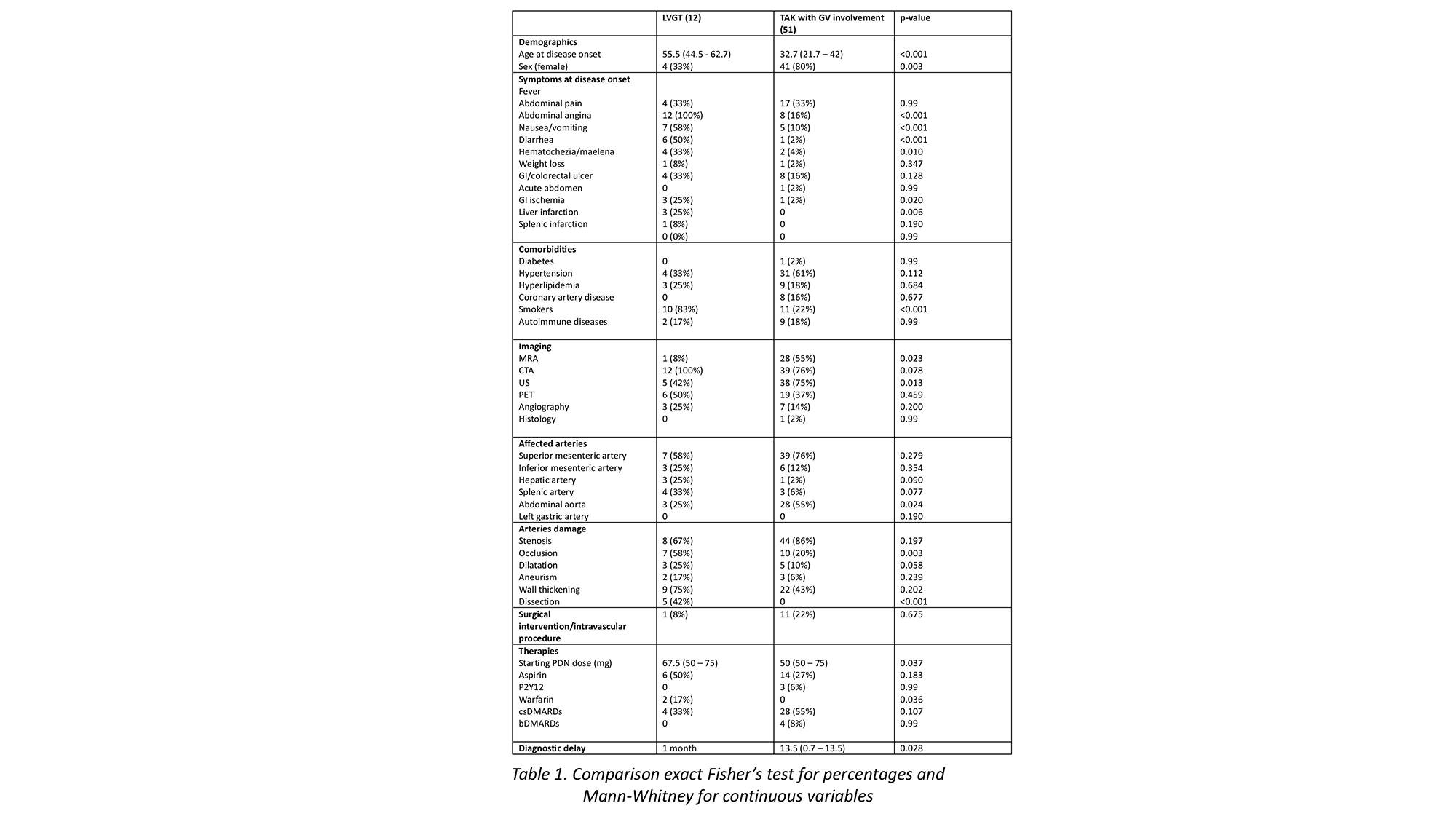
Results. Twelve patients with LVGT were identified (67% male) with a median age at disease onset of 55 years (IQR, 44–62). Diagnostic delay from first symptom onset was 1 month (IQR, 1–4). All patients presented to the Emergency Department. Main presenting symptoms and organ involvement at presentation are summarized in Table. Vasculitis diagnosis was confirmed by a computed tomography angiography (CTA) in all cases. A second imaging evaluation was performed in almost all cases. No patient underwent histological confirmation. Table summarizes the affected vessels. Two patients underwent surgery/intravascular procedure at baseline; one had surgery 8 months later. Glucocorticoids (GC) were started in 11 patients and stopped in 9 after a median of 9 months (IQR, 4–12). Four patients were started on methotrexate. No patient was started on bDMARD. No major complications or deaths were reported during a median observation period of 33 months (IQR, 7–88). Compared to TAK patients, LVGT cases showed significant differences in sex distribution, age at onset, diagnostic delay, vessel involvement and initial GC dosage. Of note, GI symptoms, ischemia, vascular occlusion, and dissection were more frequent in LVGT, while TAK had a longer diagnostic delay.
Conclusions. LVGT exhibits unique clinical and demographic characteristics when compared to TAK. Imaging techniques, especially CTA, play a key role in diagnosis. GCs are the primary treatment and show good efficacy with a generally favourable prognosis. Our findings highlight the importance of identifying LVGT as a distinct condition to ensure prompt diagnosis and personalized treatment.
Downloads
Download data is not yet available.
How to Cite
1.
PO:35:222 | Distinctive Features of Localized Vasculitis of the Gastrointestinal Tract Compared to Takayasu Arteritis: Insights from a Multicenter Cohort Study: Vittorio Dibenedetto1|2|3, Alessandro Tomelleri1|2, Corrado Campochiaro1|2, Elena Baldissera1|2, Luca Moroni1|2, Padoan Roberto4, Marco Matucci-Cerinic1|2|3, Lorenzo Dagna1|2|3 | 1Unit of Immunology, Rheumatology, Allergy and Rare Diseases UNIRAR, IRCCS San Raffaele Hospital Milan, Italy; 2Inflammation, Fibrosis and Ageing Intitiative INFLAGE, IRCCS San Raffaele Hospital Milan, Italy; 3Vita-Salute San Raffaele University, Milan, Italy Milan, Italy; 4University Hospital of Padova, Department of Internal Medicine and Rheumatology Padova, Italy. Reumatismo [Internet]. 2026 Mar. 18 [cited 2026 Oct. 16];77(s1). Available from: https://www.reumatismo.org/reuma/article/view/2382
Copyright (c) 2026 The Author(s)


This work is licensed under a Creative Commons Attribution-NonCommercial 4.0 International License.
PAGEPress has chosen to apply the Creative Commons Attribution NonCommercial 4.0 International License (CC BY-NC 4.0) to all manuscripts to be published.