
62nd National Congress of the Italian Society of Rheumatology
Vol. 77 No. s1 (2025): Abstract book of the 62th Conference of the Italian Society for...
 https://doi.org/10.4081/reumatismo.2025.2376
PO:33:199 | Prevalence and clinical associations of antiphospholipid antibodies in patients with systemic sclerosis in the SPRING-SIR registry
Antonio Tonutti1|2, Ilaria Cavazzana3, Angela Ceribelli1|2, Maria De Santis1|2, Giacomo De Luca4|5, Maria Grazia Lazzaroni3, Franco Franceschini3, Carlo Selmi1|2, Valeria Riccieri6, Silvia Laura Bosello7, Fabio Cacciapaglia8, Veronica Codullo9, Francesca Ingegnoli10, Dilia Giuggioli11, Rossella De Angelis12, Clodoveo Ferri11, Marco Matucci-Cerinic4|5 | 1Department of Biomedical Sciences, Humanitas Universityce Pieve Emanuele, Milan, Italy; 2Rheumatology and Clinical Immunology, IRCCS Humanitas Research Hospital Rozzano, Milan, Italy; 3Rheumatology and Clinical Immunology - ASST Spedali Civili Brescia - Department of Clinical and Experimental Sciences - Brescia, Italy; 4Vita-Salute San Raffaele University Milan, Italy; 5Unit of Immunology, Rheumatology, Allergy and Rare Diseases UnIRAR and INFLAGE Initiative, IRCCS San Raffaele Hospital Milan, Italy; 6University of Rome La Sapienza Rome, Italy; 7Catholic University of Sacred Heart Rome, Italy; 8LUM University Bari, Italy; 9Rheumatology Unit, Fondazione IRCCS Policlinico San Matteo Pavia, Italy; 10University of Milan Milan, Italy; 11University of Modena and Reggio Emilia Modena, Italy; 12Politechnic University of Marche Ancona, Italy
Publisher's note
All claims expressed in this article are solely those of the authors and do not necessarily represent those of their affiliated organizations, or those of the publisher, the editors and the reviewers. Any product that may be evaluated in this article or claim that may be made by its manufacturer is not guaranteed or endorsed by the publisher.
All claims expressed in this article are solely those of the authors and do not necessarily represent those of their affiliated organizations, or those of the publisher, the editors and the reviewers. Any product that may be evaluated in this article or claim that may be made by its manufacturer is not guaranteed or endorsed by the publisher.
89
Views
Antonio Tonutti, Ilaria Cavazzana, Angela Ceribelli, Maria De Santis, Giacomo De Luca, Maria Grazia Lazzaroni, Franco Franceschini, Carlo Selmi, Valeria Riccieri, Silvia Laura Bosello, Fabio Cacciapaglia, Veronica Codullo, Francesca Ingegnoli, Dilia Giuggioli, Rossella De Angelis, Clodoveo Ferri, Marco Matucci-Cerinic,
Methods. Among SSc and VEDOSS patients enrolled in SPRING, data on aPL positivity (recorded as a dichotomous variable) were extracted. Cross-sectional comparisons were performed between aPL-positive and -negative patients. Mixed-effects logistic and linear regression was applied to assess the impact of aPL on disease trajectories during follow-up in SSc patients.
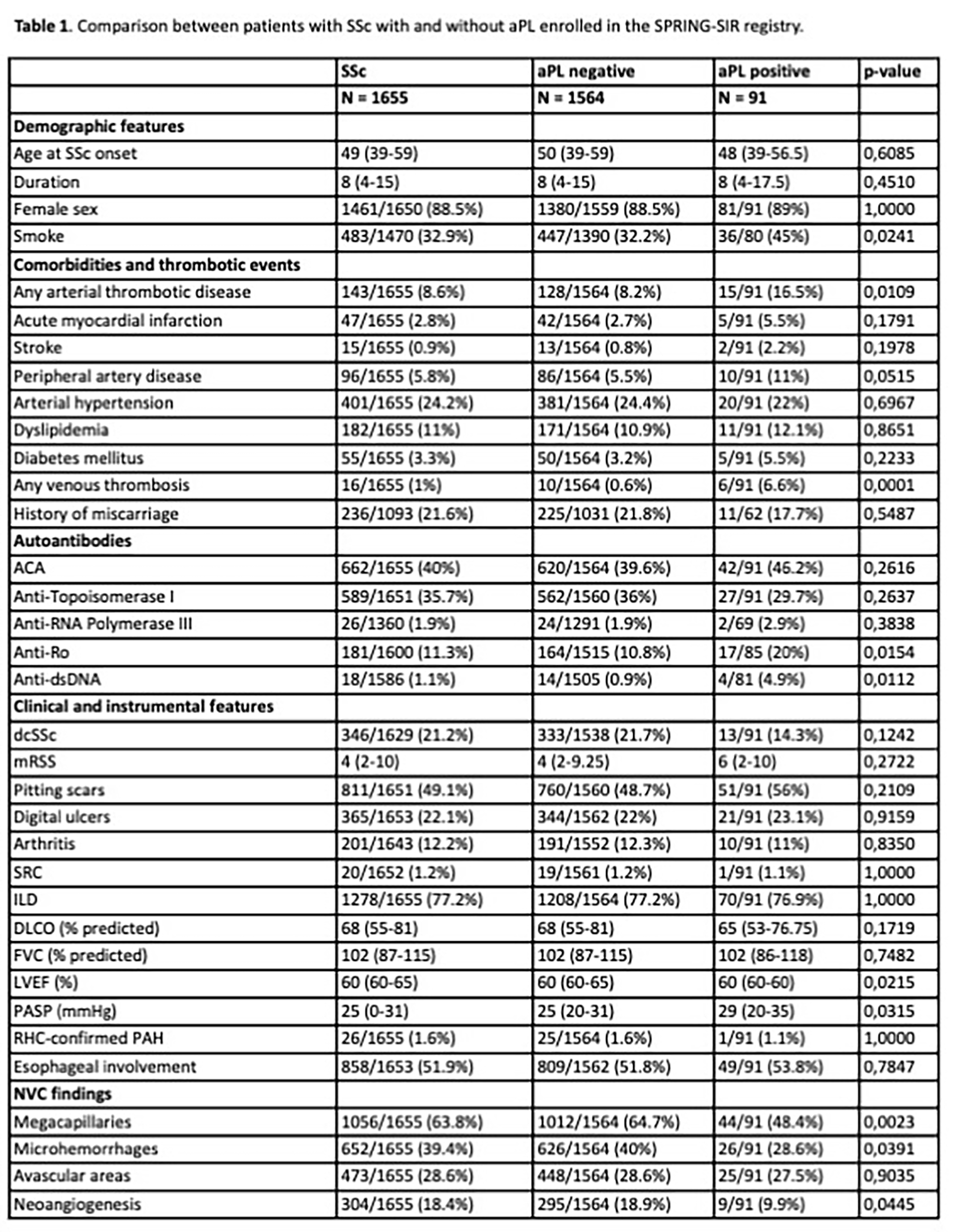
Results. Data on aPL status were available for 1655/1922 (86%) SSc and 211/268 (79%) VEDOSS patients, respectively. In the SSc group (Table 1), 91 patients (5.5%) tested positive for aPL. Demographic characteristics were comparable between aPL-positive and -negative groups, except for smoking habit, more frequent in aPL+ cases (p=0.02). The aPL-positive group had a higher history of arterial (17% vs. 8%; p=0.01) and venous (6.6% vs. 0.6%; p<0.001) thrombotic events, but no difference in miscarriage rates. Antiphosholipid syndrome was diagnosed in 2 cases. Patients with aPL showed higher pulmonary artery systolic pressure (PASP) on echocardiography compared to those without aPL (29 mmHg [IQR 30–35] vs. 25 mmHg [20–31]; p=0.03) and a slightly lower left ventricular ejection fraction (LVEF). Lower rates of nailfold capillaroscopy (NFC) abnormalities were observed in aPL-positive patients. While there was no difference in SSc-specific autoantibodies, the aPL-positive group exhibited a higher prevalence of anti-Ro (20% vs. 11%; p=0.01) and anti-dsDNA (5% vs. 1%; p=0.01). Longitudinal analysis, adjusted for confounders (age, disease duration, SSc-related autoantibodies, skin subset), demonstrated a significant association between aPL positivity and incident pitting scars (OR 5.4, 95% CI 1.6–18.5; p=0.009), but not other vascular outcomes such as digital ulcers, renal crisis, PASP, LVEF, or DLCO. Among VEDOSS patients, the prevalence of aPL was 5.2% (11/211), similar to established SSc (p=0.86). No demographic, clinical, or serological differences were noted between VEDOSS patients with and without aPL.
Conclusions. In this large cohort, aPL were present in approximately 5% SSc patients, including those with very early disease. Our findings confirm the association of aPL with thrombotic events in SSc. The clinical phenotype of SSc patients with aPL is characterized by the presence of autoantibodies suggestive of overlap with other connective tissue diseases (anti-Ro, anti-dsDNA), milder microvascular damage as reflected by NFC, but a paradoxically increased risk of developing pitting scars. Strict evaluation of traditional cardiovascular risk factors should be mandatory, given the higher rate of smokers among aPL+ cases.
Downloads
Download data is not yet available.
How to Cite
1.
PO:33:199 | Prevalence and clinical associations of antiphospholipid antibodies in patients with systemic sclerosis in the SPRING-SIR registry: Antonio Tonutti1|2, Ilaria Cavazzana3, Angela Ceribelli1|2, Maria De Santis1|2, Giacomo De Luca4|5, Maria Grazia Lazzaroni3, Franco Franceschini3, Carlo Selmi1|2, Valeria Riccieri6, Silvia Laura Bosello7, Fabio Cacciapaglia8, Veronica Codullo9, Francesca Ingegnoli10, Dilia Giuggioli11, Rossella De Angelis12, Clodoveo Ferri11, Marco Matucci-Cerinic4|5 | 1Department of Biomedical Sciences, Humanitas Universityce Pieve Emanuele, Milan, Italy; 2Rheumatology and Clinical Immunology, IRCCS Humanitas Research Hospital Rozzano, Milan, Italy; 3Rheumatology and Clinical Immunology - ASST Spedali Civili Brescia - Department of Clinical and Experimental Sciences - Brescia, Italy; 4Vita-Salute San Raffaele University Milan, Italy; 5Unit of Immunology, Rheumatology, Allergy and Rare Diseases UnIRAR and INFLAGE Initiative, IRCCS San Raffaele Hospital Milan, Italy; 6University of Rome La Sapienza Rome, Italy; 7Catholic University of Sacred Heart Rome, Italy; 8LUM University Bari, Italy; 9Rheumatology Unit, Fondazione IRCCS Policlinico San Matteo Pavia, Italy; 10University of Milan Milan, Italy; 11University of Modena and Reggio Emilia Modena, Italy; 12Politechnic University of Marche Ancona, Italy. Reumatismo [Internet]. 2026 Mar. 18 [cited 2026 Oct. 16];77(s1). Available from: https://www.reumatismo.org/reuma/article/view/2376
Copyright (c) 2026 The Author(s)


This work is licensed under a Creative Commons Attribution-NonCommercial 4.0 International License.
PAGEPress has chosen to apply the Creative Commons Attribution NonCommercial 4.0 International License (CC BY-NC 4.0) to all manuscripts to be published.