
62nd National Congress of the Italian Society of Rheumatology
Vol. 77 No. s1 (2025): Abstract book of the 62th Conference of the Italian Society for...
 https://doi.org/10.4081/reumatismo.2025.2375
PO:33:193 | Self-reported oropharyngeal dysphagia and swallowing-related quality of life in people with systemic sclerosis: preliminary results of a cross-sectional study
Nikla Pacenti1, Devis Benfaremo2, Federica Lucia Galli2, Andrea Colangelo3, Gianluca Moroncini2 | 1Internal Medicine Residency Program, Marche Polytechnic University Ancona, Italy; 2Department of Clinical and Molecular Sciences, Marche Polytechnic University Ancona, Italy; 3Medical student, Marche Polytechnic University Ancona, Italy
Publisher's note
All claims expressed in this article are solely those of the authors and do not necessarily represent those of their affiliated organizations, or those of the publisher, the editors and the reviewers. Any product that may be evaluated in this article or claim that may be made by its manufacturer is not guaranteed or endorsed by the publisher.
All claims expressed in this article are solely those of the authors and do not necessarily represent those of their affiliated organizations, or those of the publisher, the editors and the reviewers. Any product that may be evaluated in this article or claim that may be made by its manufacturer is not guaranteed or endorsed by the publisher.
82
Views
Methods. We recruited 60 consecutive SSc patients from the Scleroderma Unit of Marche University Hospital, Ancona, Italy (EUSTAR Center 034). Every participant completed the Italian version of three questionnaires: the Eating Assessment Tool-10 (EAT-10), the Swallowing Quality of Life Questionnaire (SWAL-QoL) and the Dysphagia Handicap Index (DHI). EAT-10 score of 3 or greater is abnormal. The total scores of EAT-10, DHI and SWAL-QoL and patients’ clinical characteristics were summarized using descriptive statistics. Statistically significant differences between patients self-reporting dysphagia symptoms (EAT-10 score >3) and non-dysphagic patients were evaluated using non-parametric tests and Chi-squared test as appropriate. Correlations between variables was estimated using the Spearman correlation coefficient. Agreement between self-reported dysphagia by EAT-10 and documentation of proximal dysphagia in medical records was assessed by Cohen’s kappa.
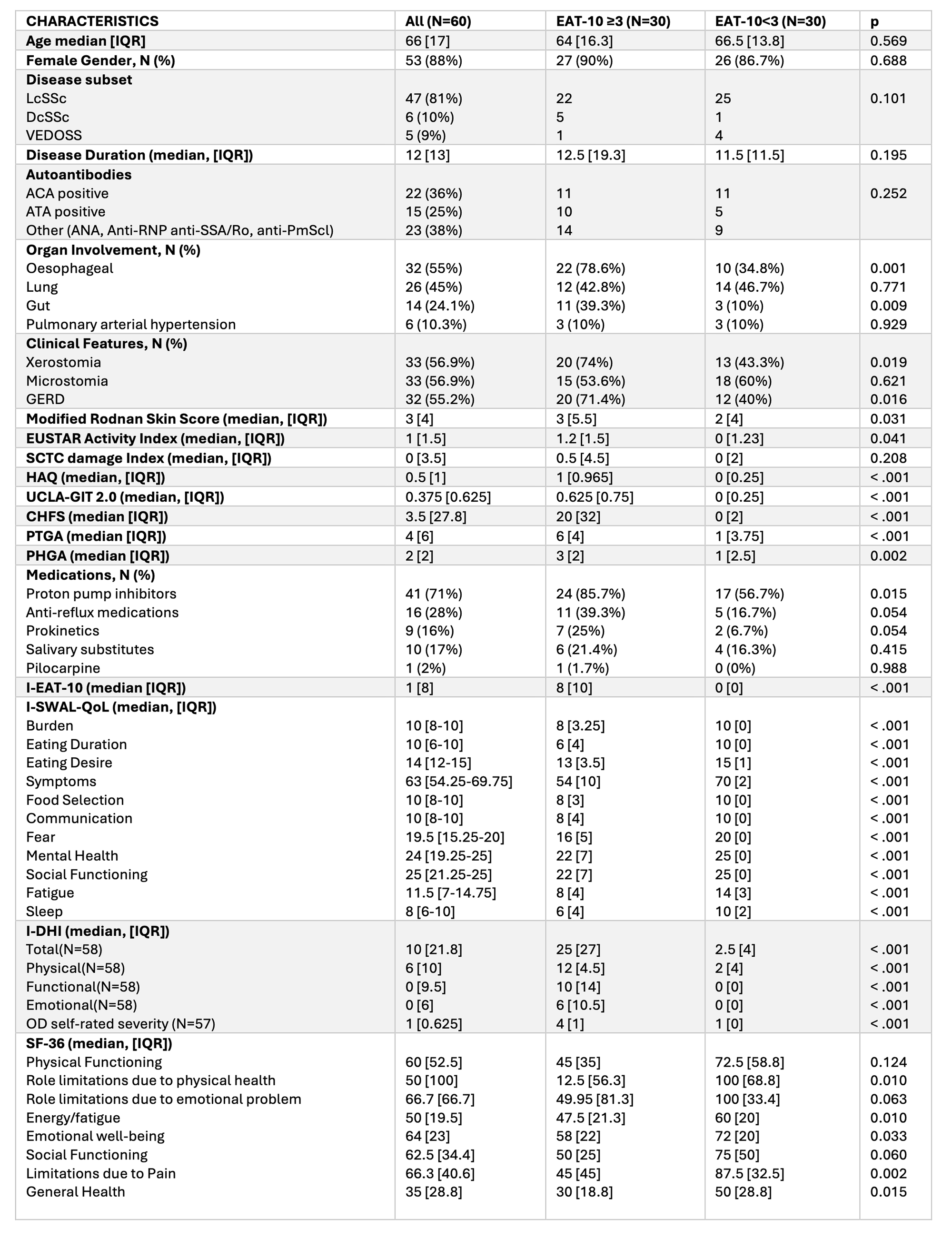
Results. Among 60 SSc patients, 30 (50%) had an EAT-10 score >3. Patients with OD were more likely to have esophageal involvement (78% vs 34%, p=0.001), reflux and use proton pump inhibitors (71% vs 40% and 85% vs 56%, p=0.016 and 0.015, respectively) and self-reported xerostomia (74% vs 43%, p = 0.019). They also have a higher burden of disease activity (mRSS and EUSTAR-AI, p<0.05) and poorer functioning and QoL. The median SWAL-QoL and DHI scores were all significantly lower or higher, respectively, in dysphagic patients. There was a very strong correlation between all the sub-scores of the three questionnaires. EAT-10 was moderately correlated with GIT2.0-10 (rho 0.75), measures of physical functioning (Cochin hand function scale rho 0.63, HAQ rho 0.67) and global assessment (PtGA and PhGA rho 0.54 and 0.45, respectively), but not with SSc disease activity. Importantly, EAT-10 showed a moderate correlation with SF-36 sub-scales, including limitations due to physical role and pain (rho -0.54 and -0.53, respectively) and limitations due to emotional problems and mental health (rho -0.43 and -0.36, respectively). Significant correlations between DHI and SWAL-QoL sub-scores and CHFS, HAQ, PtGA and PhGA and SF-36 were also observed. Agreement between self-reported dysphagia by EAT-10 and proximal dysphagia on medical records was excellent (Cohen’s kappa 0.93, p<0.0001).
Conclusions. Proximal dysphagia involves half of SSc patients and is associated with disease burden and poor QoL. EAT-10, DHI, SWAL-QoL are valid and reliable instruments to detect self-reported OD in SSc patients. Further studies should address the impact of speech language therapy on swallowing impairment.
Downloads
Download data is not yet available.
How to Cite
1.
PO:33:193 | Self-reported oropharyngeal dysphagia and swallowing-related quality of life in people with systemic sclerosis: preliminary results of a cross-sectional study: Nikla Pacenti1, Devis Benfaremo2, Federica Lucia Galli2, Andrea Colangelo3, Gianluca Moroncini2 | 1Internal Medicine Residency Program, Marche Polytechnic University Ancona, Italy; 2Department of Clinical and Molecular Sciences, Marche Polytechnic University Ancona, Italy; 3Medical student, Marche Polytechnic University Ancona, Italy. Reumatismo [Internet]. 2026 Mar. 18 [cited 2026 Oct. 16];77(s1). Available from: https://www.reumatismo.org/reuma/article/view/2375
Copyright (c) 2026 The Author(s)


This work is licensed under a Creative Commons Attribution-NonCommercial 4.0 International License.
PAGEPress has chosen to apply the Creative Commons Attribution NonCommercial 4.0 International License (CC BY-NC 4.0) to all manuscripts to be published.