
62nd National Congress of the Italian Society of Rheumatology
Vol. 77 No. s1 (2025): Abstract book of the 62th Conference of the Italian Society for...
 https://doi.org/10.4081/reumatismo.2025.2372
PO:32:182 | Disease characteristics of anti-centromere positive systemic sclerosis patients and risk factors for organ involvement: data from the EUSTAR cohort
Corrado Campochiaro1, Jelena Colic2, Del Papa Nicoletta3, Oliver Distler4, Serena Guiducci5, Florenzo Iannone6, David Launay7, Yair Levy8, Britta Maurer9, Arsene Mekinian10, Predrag Ostojic2, Gabriela Riemekasten11, Petros Sfikakis12, Bojana Stamenkov13, Ulrich Walker14, Marie Elise Truchetet15, Madelon Vonk16, Francesco Del Galdo17, Giacomo De Luca1, Lorenzo Dagna1, Marco Matucci Cerinic1, Yannick Allanore18 | 1IRCCS San Raffaele Hospital; Vita Salute San Raffaele University Milan, Italy; 2University of Belgrade Belgrade, Serbia; 3UOC Reumatologia Clinica, ASST G. Pini CTO Milan, Italy; 4University Hospital Zurich Zurich, Switzerland; 5Department of Rheumatology, University of Florence Florence, Italy; 6Rheumatology Unit Bari, Italy; 7CHU Lille Lille, France; 8Department of Medicine Kfar Saba, Israel; 9Department for BioMedical Research, University of Bern Bern, Switzerland; 10Service de medecine interne Paris, France; 11Department of Rheumatology University of Lubeck Lubeck Germany; 12National and Kapodistrian University of Athens Athens, Greece; 13University School of Medicine, Nis Nis, Serbia; 14University Hospital Basel, Basel Basel, Switzerland; 15Bordeaux Hospital and University Bordeaux, France; 16Radboud University Nijmegen Medical Centre, Nijmegen, The Netherlands; 17Leeds Institute of Rheumatic and Muskuloskeletal Medicine Leeds, United Kingdom; 18Cochin Hospital Paris, France
Publisher's note
All claims expressed in this article are solely those of the authors and do not necessarily represent those of their affiliated organizations, or those of the publisher, the editors and the reviewers. Any product that may be evaluated in this article or claim that may be made by its manufacturer is not guaranteed or endorsed by the publisher.
All claims expressed in this article are solely those of the authors and do not necessarily represent those of their affiliated organizations, or those of the publisher, the editors and the reviewers. Any product that may be evaluated in this article or claim that may be made by its manufacturer is not guaranteed or endorsed by the publisher.
314
Views
Corrado Campochiaro, Jelena Colic, Del Papa Nicoletta, Oliver Distler, Serena Guiducci, Florenzo Iannone, David Launay, Yair Levy, Britta Maurer, Arsene Mekinian, Predrag Ostojic, Gabriela Riemekasten, Petros Sfikakis, Bojana Stamenkov, Ulrich Walker, Marie Elise Truchetet, Madelon Vonk, Francesco Del Galdo, Giacomo De Luca, Lorenzo Dagna, Marco Matucci Cerinic, Yannick Allanore
Methods. SSc patients from the EUSTAR database with known ACA-positive status, were included. Patients’ data were analyzed at their first inclusion in database(“whole cohort”). Those with available information about disease duration, were then segregated into 4 different cohorts based on their disease duration: T1(0-1 year); T2(2-5 years); T3(6-10 years) and T4(>10 years). The following organ involvements were explored: ILD(based on HRCT); PH(echo sPAP>=45mmHg as a proxy); heart involvement; scleroderma renal crisis(SRC); gastrointestinal(GIT), musculoskeletal involvement(MSK) and digital ulcers(DUs). The prevalence of organ involvements in the whole cohort and the 4 derived cohorts was calculated. Multivariable logistic regression models were built to identify risk factors for specific damage in the entire cohort and in those belonging to T1. The final risk model was based on 3 different clusters: cluster 1(demographic and lifestyle), cluster 2(variables already identified in the literature) and cluster 3 (relevant variables based on expert opinion), using stepwise selection based on the Akaike Information Criterion and ROC and AUC analysis.
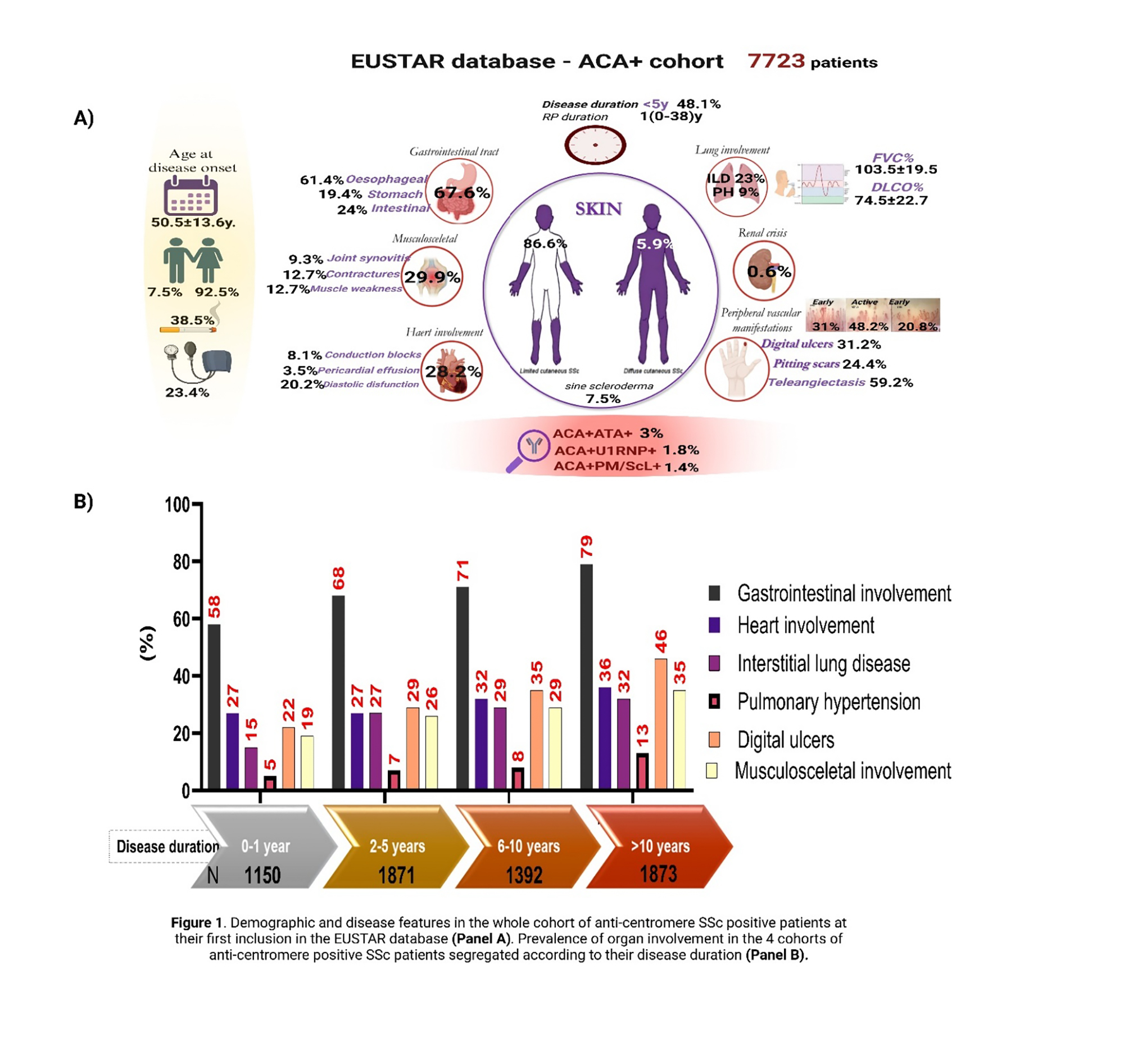
Results. 7723(39.6%) ACA-positive SSc patients were identified. Demographics are shown in Figure 1A. GIT involvement was the most common(67.6%) followed by DU(31.2%) and MSK(29.9%), see Figure 1A. Disease duration was available for 6286(81%) patients. After segregating patients, 1150(18.3%) patients belonged to T1, 1871(29.8%) to T2, 1392(22.1%) to T3 and 1873(29.8%) to T4. In these 4 cohorts a significant increase in the prevalence of organ involvements from T1 to T4 was observed(p<0.05 for all comparisons), reaching 2-3 times higher for the majority of organ damage in T4 compared to T1, see Figure 1B. At multivariable logistic regression analyses in the whole cohort(Figure 2A), the strongest predictors for organ involvement were: age of onset >50 years for echoPH and heart involvement, male gender and %pFVC<80 for ILD, telangiectasias for PH, late capillaroscopy pattern and male gender for DU and raised CRP for ILD, PH and heart involvement. After restricting the analysis on T1(Figure 2B) we confirmed that age >50 years is an independent risk factor for heart involvement, male gender for ILD and DU, %pFVC<80 for ILD and raised CRP for ILD and heart involvement.
Conclusions. ACA-positive SSc patients experience disease progression over time. We identified risk factors for different organ involvements in the whole cohort and in early patients. Future analyses will confirm whether these risk factors will also apply to patients with longer disease duration to validate the 'red flags' that might guide clinical practice and participation of specific individuals in future clinical trials.
Downloads
Download data is not yet available.
How to Cite
1.
PO:32:182 | Disease characteristics of anti-centromere positive systemic sclerosis patients and risk factors for organ involvement: data from the EUSTAR cohort: Corrado Campochiaro1, Jelena Colic2, Del Papa Nicoletta3, Oliver Distler4, Serena Guiducci5, Florenzo Iannone6, David Launay7, Yair Levy8, Britta Maurer9, Arsene Mekinian10, Predrag Ostojic2, Gabriela Riemekasten11, Petros Sfikakis12, Bojana Stamenkov13, Ulrich Walker14, Marie Elise Truchetet15, Madelon Vonk16, Francesco Del Galdo17, Giacomo De Luca1, Lorenzo Dagna1, Marco Matucci Cerinic1, Yannick Allanore18 | 1IRCCS San Raffaele Hospital; Vita Salute San Raffaele University Milan, Italy; 2University of Belgrade Belgrade, Serbia; 3UOC Reumatologia Clinica, ASST G. Pini CTO Milan, Italy; 4University Hospital Zurich Zurich, Switzerland; 5Department of Rheumatology, University of Florence Florence, Italy; 6Rheumatology Unit Bari, Italy; 7CHU Lille Lille, France; 8Department of Medicine Kfar Saba, Israel; 9Department for BioMedical Research, University of Bern Bern, Switzerland; 10Service de medecine interne Paris, France; 11Department of Rheumatology University of Lubeck Lubeck Germany; 12National and Kapodistrian University of Athens Athens, Greece; 13University School of Medicine, Nis Nis, Serbia; 14University Hospital Basel, Basel Basel, Switzerland; 15Bordeaux Hospital and University Bordeaux, France; 16Radboud University Nijmegen Medical Centre, Nijmegen, The Netherlands; 17Leeds Institute of Rheumatic and Muskuloskeletal Medicine Leeds, United Kingdom; 18Cochin Hospital Paris, France. Reumatismo [Internet]. 2026 Mar. 18 [cited 2026 Oct. 19];77(s1). Available from: https://www.reumatismo.org/reuma/article/view/2372
Copyright (c) 2026 The Author(s)


This work is licensed under a Creative Commons Attribution-NonCommercial 4.0 International License.
PAGEPress has chosen to apply the Creative Commons Attribution NonCommercial 4.0 International License (CC BY-NC 4.0) to all manuscripts to be published.