
62nd National Congress of the Italian Society of Rheumatology
Vol. 77 No. s1 (2025): Abstract book of the 62th Conference of the Italian Society for...
 https://doi.org/10.4081/reumatismo.2025.2371
PO:32:181 | Digital ulcers predict enhanced Peak Systolic Velocities at internal and external Carotid in Systemic Sclerosis Patients
Eugenio Capparelli1, Francesco Lapia2, Luca Clerici2, Eleonora Zaccara1, Giusy Cinzia Moltisanti2, Francesca Capelli2, Daniela Bompane1, Paola Faggioli1, Antonino Mazzone2 | 1UOC Reumatologia, ASST Ovest Milanese, Legnano, Milano, Italy; 2UOC Medicina Interna, ASST Ovest Milanese, Legnano, Milano, Italy
Publisher's note
All claims expressed in this article are solely those of the authors and do not necessarily represent those of their affiliated organizations, or those of the publisher, the editors and the reviewers. Any product that may be evaluated in this article or claim that may be made by its manufacturer is not guaranteed or endorsed by the publisher.
All claims expressed in this article are solely those of the authors and do not necessarily represent those of their affiliated organizations, or those of the publisher, the editors and the reviewers. Any product that may be evaluated in this article or claim that may be made by its manufacturer is not guaranteed or endorsed by the publisher.
78
Views
Methods. We retrospectively analyzed a cohort of 107 SSc patients, stratified by the presence (n=31) or absence (n=76) of digital ulcers (DUs). Demographic, clinical, serological, cardiometabolic, and ultrasound data were compared between the two groups. Vascular assessment included carotid-vertebral ultrasound measurements of intima-media thickness (IMT), peak systolic velocity (PSV), end-diastolic velocity (EDV), and resistive indices (RI), alongside evaluation of carotid atherosclerotic plaques. Chi-square, T-student test and linear regression model were used for statistical analysis. P<0.05 was considered significant.
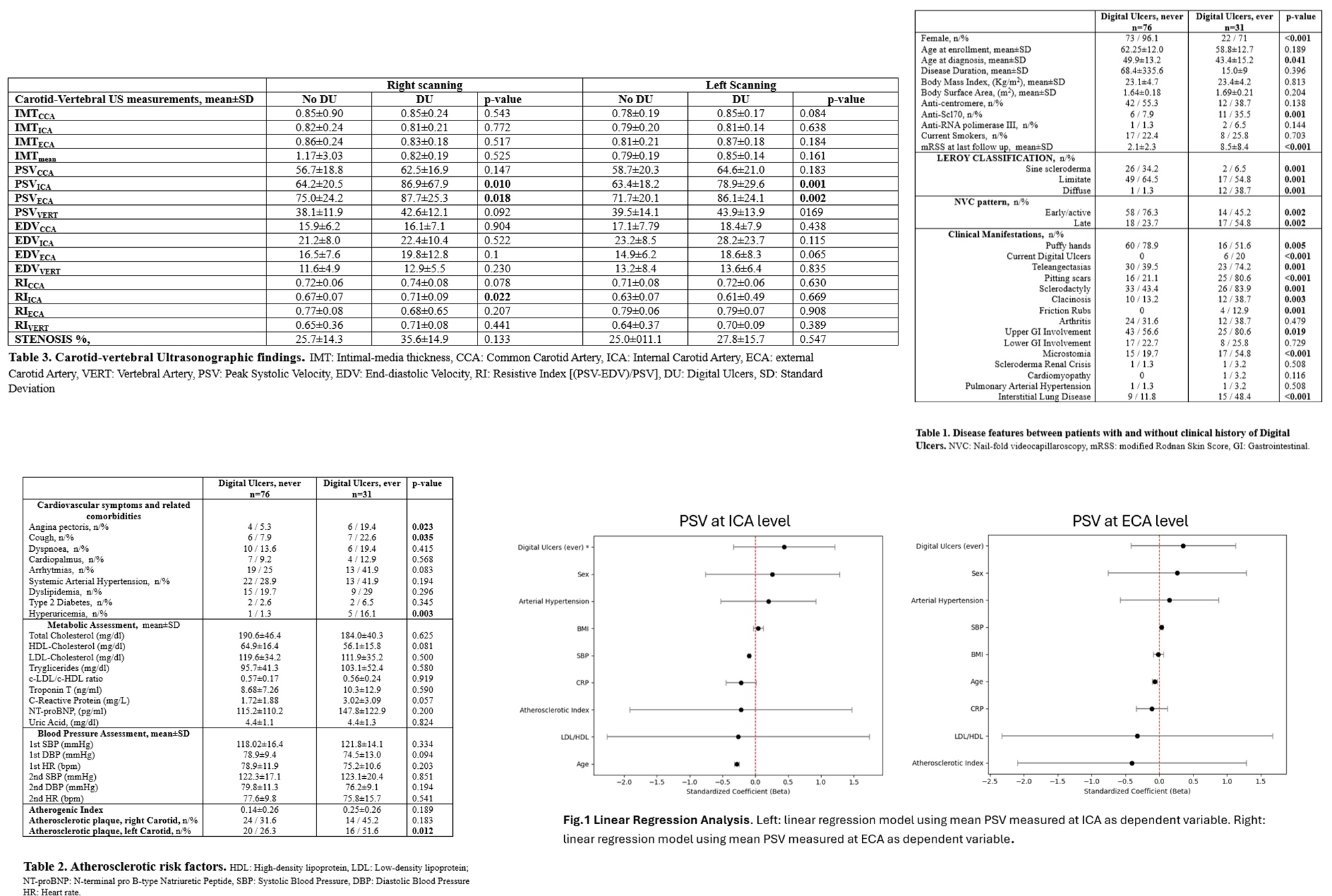
Results. Patients with a history of DUs were more frequently male (p<0.001), younger at diagnosis (p=0.041), and had higher modified Rodnan skin scores (p<0.001). The diffuse cutaneous subset was significantly more common in the DU group (p=0.001), as was the late capillaroscopic pattern (p=0.002). Serologically, anti-Scl70 positivity was more frequent in DU patients (p=0.001). Clinical features more prevalent among DU patients included pitting scars, sclerodactyly, calcinosis, upper gastrointestinal involvement, interstitial lung disease. (Table 1). As shown, in table 2, no differences in the most common risk factors for atherosclerosis were found between the two groups, who reported only an increased prevalence of hyperuricemia and angina pectoris, while exhibiting the same metabolic profile and blood pressure levels. From a vascular standpoint (Table 3), no differences were identified in EDV and IMT measures, while patients with DUs exhibited higher carotid blood flow velocities: PSV of the internal carotid artery (ICA) was significantly increased bilaterally (right: 86.9±67.9 vs 64.2±20.5 cm/s, p=0.01; left: 78.9±29.6 vs 63.4±18.2 cm/s, p=0.001), as was PSV in the external carotid artery (ECA) (right: 75.0±24.2 vs 87.7±25.3 cm/s, p=0.018; left: 71.7±20.1 vs 86.1±24.1 cm/s, p=0.002). The right ICA resistive index was also elevated (0.71±0.09 vs 0.67±0.07, p=0.022). Carotid plaque presence was significantly higher on the left side (51.6% vs 26.3%, p=0.012). The linear regression model reported that only digital ulcers were predictors of increased PSV at ICA level at both sides (p=0.035) , while no statistical significance was found for PSV at ECA level. (Fig.1).
Conclusions. These findings support the hypothesis of an increased vasculopathic burden at the carotid level in SSc patients with a history of DUs. The observed rise in PSV, particularly in distal carotid branches and in the absence of overt atherosclerosis, may reflect a functional macrovascular impairment in SSc.
Downloads
Download data is not yet available.
How to Cite
1.
di Reumatologia SI. PO:32:181 | Digital ulcers predict enhanced Peak Systolic Velocities at internal and external Carotid in Systemic Sclerosis Patients: Eugenio Capparelli1, Francesco Lapia2, Luca Clerici2, Eleonora Zaccara1, Giusy Cinzia Moltisanti2, Francesca Capelli2, Daniela Bompane1, Paola Faggioli1, Antonino Mazzone2 | 1UOC Reumatologia, ASST Ovest Milanese, Legnano, Milano, Italy; 2UOC Medicina Interna, ASST Ovest Milanese, Legnano, Milano, Italy. Reumatismo [Internet]. 2026 Mar. 18 [cited 2026 Oct. 24];77(s1). Available from: https://www.reumatismo.org/reuma/article/view/2371
Copyright (c) 2026 The Author(s)


This work is licensed under a Creative Commons Attribution-NonCommercial 4.0 International License.
PAGEPress has chosen to apply the Creative Commons Attribution NonCommercial 4.0 International License (CC BY-NC 4.0) to all manuscripts to be published.