
62nd National Congress of the Italian Society of Rheumatology
Vol. 77 No. s1 (2025): Abstract book of the 62th Conference of the Italian Society for...
 https://doi.org/10.4081/reumatismo.2025.2370
PO:32:178 | Effectiveness of oral anticoagulants in precapillary pulmonary hypertension associated with systemic sclerosis: a EUSTAR cohort study
Nicola Farina1, Silvia Bellando-Randone1, Hilde Jenssen-Bjørkekjær2, David Launay3, Patricia Carreira4, Paolo Airò5, Serena Guiducci1, Dilia Giuggioli6, Gabriela Riemekasten7, Carmen-Pilar Simeón Aznar8, Christina Bergmann9, Elise Siegart10, Ivan Castellví11, Lesley Ann Saketkoo12, Jeska De Vries-Bouwstra13, Philipp Klemm14, Ulf Müller-Ladner14, Alexandra Balbir-Gurman15, Vanessa Smith16, Florenzo Iannone17, Luca Idolazzi18, Christopher Denton19, Edoardo Rosato20, Britta Maurer1, Yannick Allanore1, Yoshiya Tanaka1, Elisabetta Zanatta1, Oliver Distler1, Marco Matucci-Cerinic1, Cosimo Bruni1 | 1Department of Experimental and Clinical Medicine, Scleroderma Unit, Division of Rheumatology, University of Florence, Az Firenze, Italy; 2Department of Rheumatology, Hospital of Southern Norway Kristiansand, Norway; 3National Reference Center for Pulmonary Arterial Hypertension Pulmotension Lille, France; 4Hospital Universitario 12 de Octubre, Rheumatology Department Madrid Spain; 5ASST Spedali Civili of Brescia, University of Brescia, Rheumatology and Clinical Immunology Unit Brescia, Italy; 6Scleroderma Unit, Rheumatology Unit, University Hospital of Modena and Reggio Emilia Modena, Italy; 7Universitätsklinikum Schleswig-Holstein, Klinik für Rheumatologie und klinische Immunologie Lübeck Germany; 8Hospital Universitario Vall d'Hebron, Department of Internal Medicine, Systemic Autoimmune Diseases Unit Barcelona Spain; 9University Hospital Erlangen, Department Internal Medicine 3 Erlangen Germany; 10Charité University Hospital, Department of Rheumatology Berlin Germany; 11Hospital de la Santa Creu i Sant Pau Baercelona Spain; 12New Orleans Scleroderma and Sarcoidosis Patient Care and Research Center New Orleans, USA; 13Leiden University Medical Center, Department of Rheumatology Leiden, The Netherlands; 14JLU Giessen, Campus Kerckhoff, Department of Rheumatology and Clinical Immunology Center Bad Nauheim Germany; 15Rambam Health Care Campus, Rheumatology Institute Haifa, Israel; 16University of Ghent, Department of Rheumatology Ghent, Belgium; 17Rheumatology DiMePReJ, University of Bari, School of Medicine Bari, Italy; 18University of Verona, Section of Rheumatology, Department of Medicine Verona, Italy; 19Royal Free London and University College London Medical School, Centre for Rheumatology London, United Kingdom; 20Sapienza University of Rome, Department of Translational and Precision Medicine Azienda Ospedaliero-Universitaria Policl Roma, Italy
Publisher's note
All claims expressed in this article are solely those of the authors and do not necessarily represent those of their affiliated organizations, or those of the publisher, the editors and the reviewers. Any product that may be evaluated in this article or claim that may be made by its manufacturer is not guaranteed or endorsed by the publisher.
All claims expressed in this article are solely those of the authors and do not necessarily represent those of their affiliated organizations, or those of the publisher, the editors and the reviewers. Any product that may be evaluated in this article or claim that may be made by its manufacturer is not guaranteed or endorsed by the publisher.
119
Views
Nicola Farina, Silvia Bellando-Randone, Hilde Jenssen-Bjørkekjær, David Launay, Patricia Carreira, Paolo Airò, Serena Guiducci, Dilia Giuggioli, Gabriela Riemekasten, Carmen-Pilar Simeón Aznar, Christina Bergmann, Elise Siegart, Ivan Castellví, Lesley Ann Saketkoo, Jeska De Vries-Bouwstra, Philipp Klemm, Ulf Müller-Ladner, Alexandra Balbir-Gurman, Vanessa Smith, Florenzo Iannone, Luca Idolazzi, Christopher Denton, Edoardo Rosato, Britta Maurer, Yannick Allanore, Yoshiya Tanaka, Elisabetta Zanatta, Oliver Distler, Marco Matucci-Cerinic, Cosimo Bruni
Methods. We conducted a cohort study using the EUSTAR database to investigate the impact of OAC exposure vs. non-exposure on the prognosis of SSc patients with pPH confirmed by right heart catheterization (RHC- mean PAP>20 mmHg, PVR>2 WU and PWP<15 mmHg). Exposure to OAC was defined when lasting for at least 3 months after the RHC diagnosis. The primary outcome was a combination of all-cause death or otherwise PH worsening, the latter defined as at least one of the following: decrease of 6MWD>15%, worsening of NYHA class, onset of right heart failure, additional PH medication, starting prostanoids, lung transplantation, or atrial septostomy. Mortality and PH worsening were also analyzed as secondary endpoints. Multivariable Cox regression was used to assess associations of exposure to OAC and the endpoints. Additionally, propensity score matching (PSM) was performed to balance confounding factors among patients treated with OAC and untreated. Time to endpoints was assessed using Kaplan Mayer estimates. Covariates for both Cox regression and PSM were chosen based on literature support and included risk factors for worse prognosis in SSc and PH.
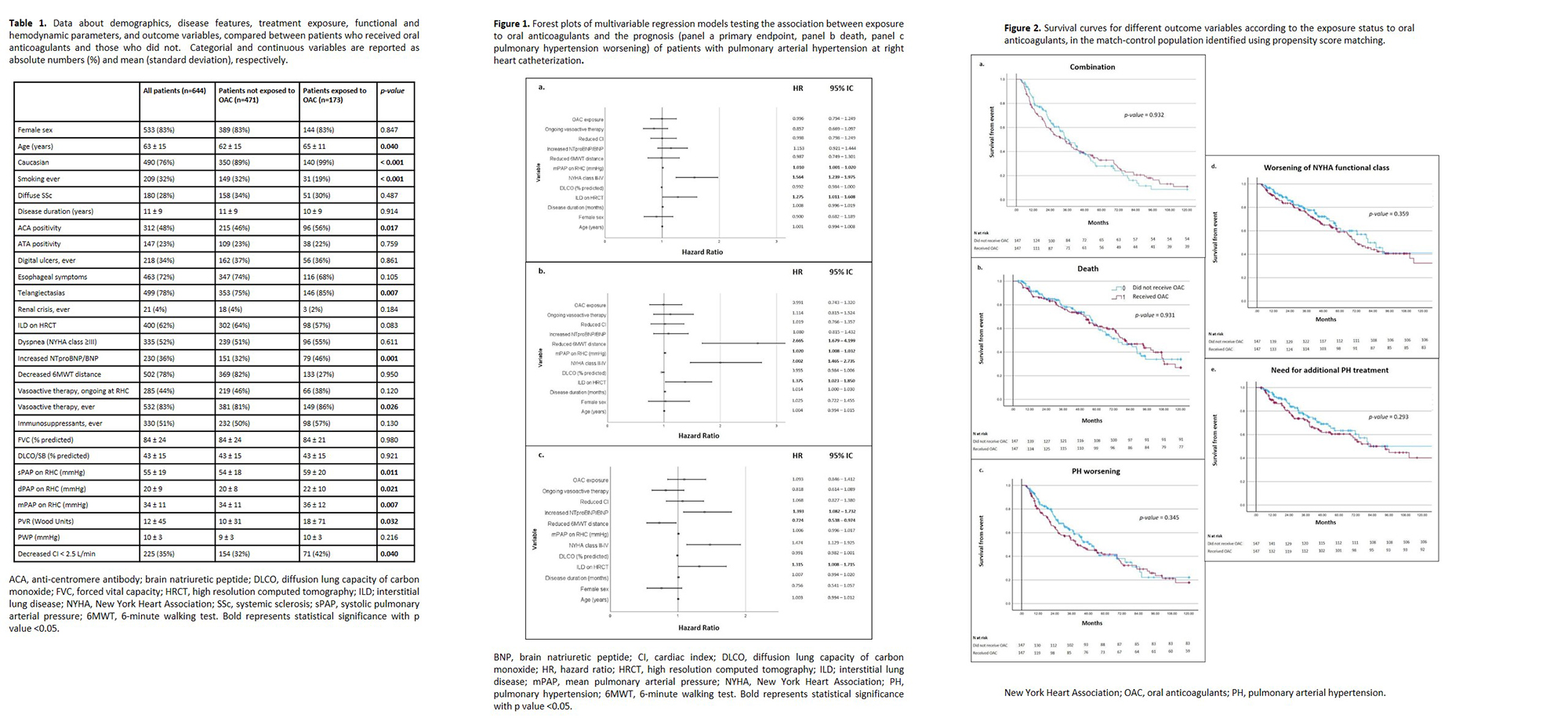
Results. Among 644 eligible patients, 173 (27%) received OAC at the time of RHC or afterwards. Patients treated with OAC were older and had more severe hemodynamic parameters (Table 1). During a median follow-up of 4 (2-6) years, 40% of patients died and 49% experienced PH worsening. Both events were recorded more frequently in the group treated with OAC, compared to non-treated patients (46% vs 37% and 59% vs 45%, respectively). Cox regression analysis did not show any significant association between OAC exposure and the combined endpoint (HR 0.996, 95%CI 0.794–1.249), mortality (HR 0.991, 95%CI 0.743–1.320) or PH worsening (HR 1.093, 95%CI 0.846–1.412) - Figure 1. PSM identified two balanced groups of 148 patients exposed and 148 not exposed to OAC. Kaplan Meier curves (Figure 2) confirmed the lack of association between OAC and prognostic outcomes.
Conclusions. In this large multicenter cohort of SSc patients with precapillary PH, OAC therapy did not impact survival or disease worsening. These findings argue against the routine use of anticoagulation in this population and highlight the importance of individualized treatment decisions. Prospective studies are needed to identify whether specific subgroups may benefit from OAC therapy.
Downloads
Download data is not yet available.
How to Cite
1.
PO:32:178 | Effectiveness of oral anticoagulants in precapillary pulmonary hypertension associated with systemic sclerosis: a EUSTAR cohort study : Nicola Farina1, Silvia Bellando-Randone1, Hilde Jenssen-Bjørkekjær2, David Launay3, Patricia Carreira4, Paolo Airò5, Serena Guiducci1, Dilia Giuggioli6, Gabriela Riemekasten7, Carmen-Pilar Simeón Aznar8, Christina Bergmann9, Elise Siegart10, Ivan Castellví11, Lesley Ann Saketkoo12, Jeska De Vries-Bouwstra13, Philipp Klemm14, Ulf Müller-Ladner14, Alexandra Balbir-Gurman15, Vanessa Smith16, Florenzo Iannone17, Luca Idolazzi18, Christopher Denton19, Edoardo Rosato20, Britta Maurer1, Yannick Allanore1, Yoshiya Tanaka1, Elisabetta Zanatta1, Oliver Distler1, Marco Matucci-Cerinic1, Cosimo Bruni1 | 1Department of Experimental and Clinical Medicine, Scleroderma Unit, Division of Rheumatology, University of Florence, Az Firenze, Italy; 2Department of Rheumatology, Hospital of Southern Norway Kristiansand, Norway; 3National Reference Center for Pulmonary Arterial Hypertension Pulmotension Lille, France; 4Hospital Universitario 12 de Octubre, Rheumatology Department Madrid Spain; 5ASST Spedali Civili of Brescia, University of Brescia, Rheumatology and Clinical Immunology Unit Brescia, Italy; 6Scleroderma Unit, Rheumatology Unit, University Hospital of Modena and Reggio Emilia Modena, Italy; 7Universitätsklinikum Schleswig-Holstein, Klinik für Rheumatologie und klinische Immunologie Lübeck Germany; 8Hospital Universitario Vall d’Hebron, Department of Internal Medicine, Systemic Autoimmune Diseases Unit Barcelona Spain; 9University Hospital Erlangen, Department Internal Medicine 3 Erlangen Germany; 10Charité University Hospital, Department of Rheumatology Berlin Germany; 11Hospital de la Santa Creu i Sant Pau Baercelona Spain; 12New Orleans Scleroderma and Sarcoidosis Patient Care and Research Center New Orleans, USA; 13Leiden University Medical Center, Department of Rheumatology Leiden, The Netherlands; 14JLU Giessen, Campus Kerckhoff, Department of Rheumatology and Clinical Immunology Center Bad Nauheim Germany; 15Rambam Health Care Campus, Rheumatology Institute Haifa, Israel; 16University of Ghent, Department of Rheumatology Ghent, Belgium; 17Rheumatology DiMePReJ, University of Bari, School of Medicine Bari, Italy; 18University of Verona, Section of Rheumatology, Department of Medicine Verona, Italy; 19Royal Free London and University College London Medical School, Centre for Rheumatology London, United Kingdom; 20Sapienza University of Rome, Department of Translational and Precision Medicine Azienda Ospedaliero-Universitaria Policl Roma, Italy. Reumatismo [Internet]. 2026 Mar. 18 [cited 2026 Oct. 19];77(s1). Available from: https://www.reumatismo.org/reuma/article/view/2370
Copyright (c) 2026 The Author(s)


This work is licensed under a Creative Commons Attribution-NonCommercial 4.0 International License.
PAGEPress has chosen to apply the Creative Commons Attribution NonCommercial 4.0 International License (CC BY-NC 4.0) to all manuscripts to be published.