
62nd National Congress of the Italian Society of Rheumatology
Vol. 77 No. s1 (2025): Abstract book of the 62th Conference of the Italian Society for...
 https://doi.org/10.4081/reumatismo.2025.2368
PO:31:169 | From Crisis to Chronicity: A Real-World Study of Renal Dysfunction in Systemic Sclerosis
Stefano Stano1, Fabio Cacciapaglia1|2, Giorgia Campanale1, Simone Perniola1, Maria Morrone1, Andrea Cito1, Vincenzo Venerito1, Maria Grazia Anelli1, Giuseppe Lopalco1, Florenzo Iannone1 | 1Rheumatology Unit - Department of Precision and Regenerative Medicine, Jonian Area DiPReMeJ, University of Bari Bari, Italy; 2Rheumatology Service, Internal Medicine Unit F. Miulli General Hospital, Department of Medicine and Surgery, LUM Casamassima, Italy
Publisher's note
All claims expressed in this article are solely those of the authors and do not necessarily represent those of their affiliated organizations, or those of the publisher, the editors and the reviewers. Any product that may be evaluated in this article or claim that may be made by its manufacturer is not guaranteed or endorsed by the publisher.
All claims expressed in this article are solely those of the authors and do not necessarily represent those of their affiliated organizations, or those of the publisher, the editors and the reviewers. Any product that may be evaluated in this article or claim that may be made by its manufacturer is not guaranteed or endorsed by the publisher.
90
Views
Objectives. This study aimed to explore clinical features of SSc patients with and without impaired renal function.
Methods. Patients fulfilling the 2013 ACR/EULAR classification criteria for SSc[3] and with at least two documented assessments of renal function were included. Estimated glomerular filtration rate (eGFR) was calculated using the Cockcroft-Gault equation, incorporating age, weight, and serum creatinine. Patients with eGFR <70 ml/min/1.73m² at the last follow-up were defined as having ‘impaired’ renal function, while those with higher values were classified as having ‘preserved’ function. Clinical data were retrospectively extracted from medical records and analyzed using appropriate statistical tests (GraphPad Prism v9).
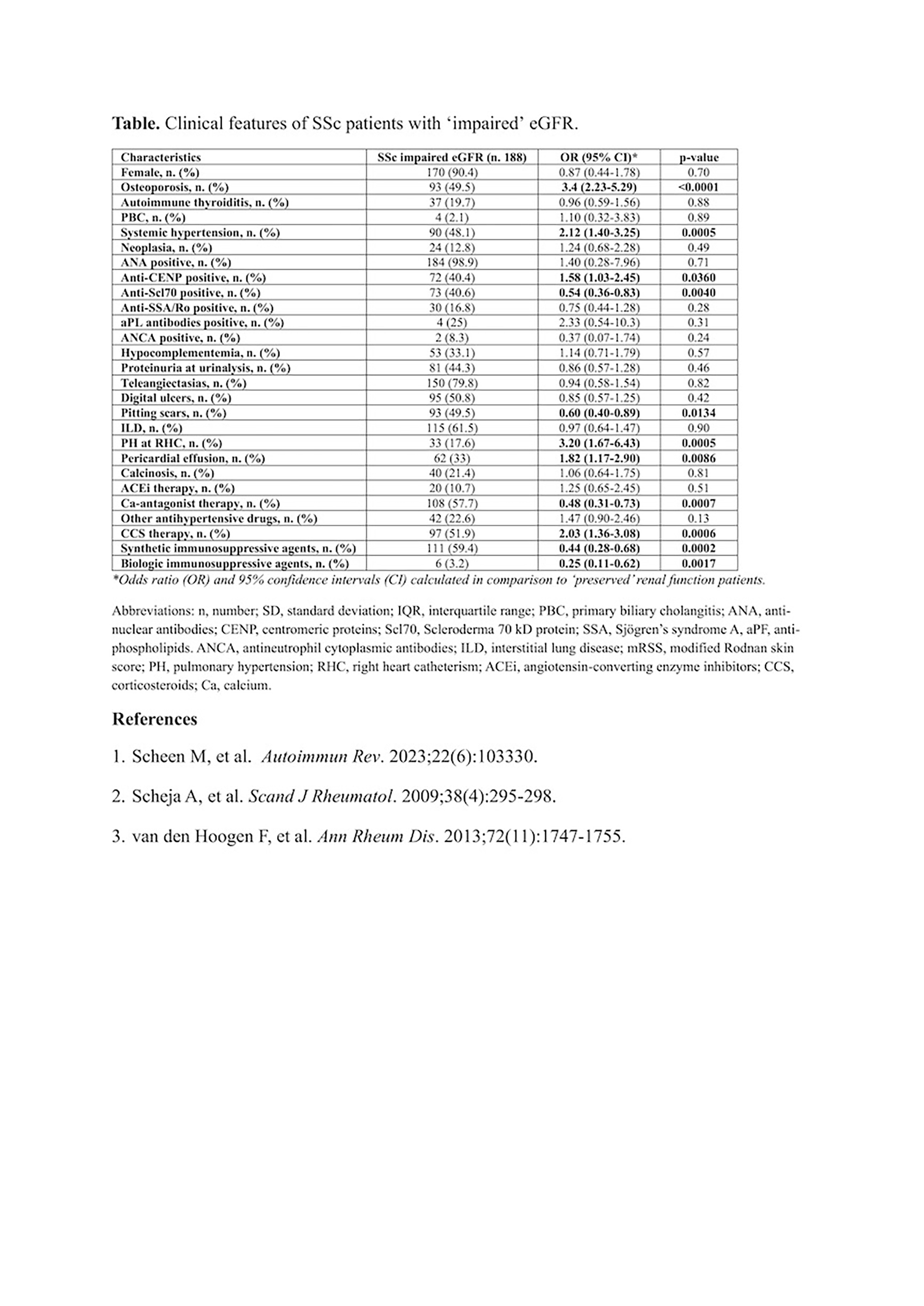
Results. A total of 395 patients were included (89.6% female; median age 65 years, IQR 54-74), and 188 (47.6%) had ‘impaired’ eGFR (Table). Three patients (0.8%) had a history of SRC. Those with ‘impaired’ renal function were significantly older, had longer disease duration, and were more frequently anti-centromere antibody (anti-CENP) positive (p<0.05), and surprisingly less often anti-TopoI positive (p<0.01). Nor were there any differences in other autoantibodies, hypocomplementemia, or proteinuria rates across groups, as well as modified Rodnan skin scores, telangiectasias, digital ulcers, calcinosis, and interstitial lung disease. Pulmonary hypertension (p<0.001) and pericardial effusion (p<0.01) were significantly more prevalent among patients with ‘impaired’ eGFR, suggesting possible cardiocirculatory hemodynamic or diuretic overload. Conversely, pitting scars were less frequent in this group (p=0.01). Systemic hypertension (p<0.001) and osteoporosis (p<0.0001) were also more commonly observed in patients with reduced eGFR. Therapeutic patterns differed between groups: calcium channel blockers, conventional synthetic and biologic immunosuppressive agents were more frequently used in patients with ‘preserved’ renal function (all p<0.001), whereas corticosteroid use was significantly higher in those with ‘impaired’ function (p<0.001). The prevalence of neoplasms and other autoimmune diseases, as thyroiditis and primary biliary cholangitis, did not differ significantly.
Conclusions. SSc patients with eGFR <70 ml/min/1.73m² more frequently exhibit systemic hypertension, pulmonary hypertension, and pericardial effusion, potentially reflecting underlying cardiocirculatory stress. Use of calcium channel blockers and immunosuppressive drugs appears associated with preserved renal function. These findings highlight the importance of regular renal monitoring and early intervention in SSc to mitigate renal and systemic complications.
Downloads
Download data is not yet available.
How to Cite
1.
PO:31:169 | From Crisis to Chronicity: A Real-World Study of Renal Dysfunction in Systemic Sclerosis: Stefano Stano1, Fabio Cacciapaglia1|2, Giorgia Campanale1, Simone Perniola1, Maria Morrone1, Andrea Cito1, Vincenzo Venerito1, Maria Grazia Anelli1, Giuseppe Lopalco1, Florenzo Iannone1 | 1Rheumatology Unit - Department of Precision and Regenerative Medicine, Jonian Area DiPReMeJ, University of Bari Bari, Italy; 2Rheumatology Service, Internal Medicine Unit F. Miulli General Hospital, Department of Medicine and Surgery, LUM Casamassima, Italy. Reumatismo [Internet]. 2026 Mar. 18 [cited 2026 Oct. 16];77(s1). Available from: https://www.reumatismo.org/reuma/article/view/2368
Copyright (c) 2026 The Author(s)


This work is licensed under a Creative Commons Attribution-NonCommercial 4.0 International License.
PAGEPress has chosen to apply the Creative Commons Attribution NonCommercial 4.0 International License (CC BY-NC 4.0) to all manuscripts to be published.