
62nd National Congress of the Italian Society of Rheumatology
Vol. 77 No. s1 (2025): Abstract book of the 62th Conference of the Italian Society for...
 https://doi.org/10.4081/reumatismo.2025.2361
PO:29:132 | Autonomic Dysfunction in Fibromyalgia: A Cross-Sectional Study and Cluster Analysis of Clinical Phenotypes
Sergio Del Vescovo1, Vincenzo Venerito1, Maria Giannotta1, Marco Fornaro1, Greta Giulia Dipietrangelo1, Andrea Cito1, Maria Morrone1, Giuseppe Lopalco1, Florenzo Iannone1 | 1UOC Reumatologia, Policlinico di Bari, DiMePre-J Bari, Italy
Publisher's note
All claims expressed in this article are solely those of the authors and do not necessarily represent those of their affiliated organizations, or those of the publisher, the editors and the reviewers. Any product that may be evaluated in this article or claim that may be made by its manufacturer is not guaranteed or endorsed by the publisher.
All claims expressed in this article are solely those of the authors and do not necessarily represent those of their affiliated organizations, or those of the publisher, the editors and the reviewers. Any product that may be evaluated in this article or claim that may be made by its manufacturer is not guaranteed or endorsed by the publisher.
219
Views
Methods. A cross-sectional study on 3.000 voluntary subjects was conducted. Participants completed questionnaires assessing 2016 ACR criteria and the Composite Autonomic Symptom Score (COMPASS-31). Demographic data, lifestyle factors and comorbidities were collected. Descriptive statistics, group comparisons, correlation and logistic regression were performed to examine factors related with fibromyalgia. FAMD was applied for both continuous and categorical variables followed by standardization and K-means clustering on fibromyalgia subject.
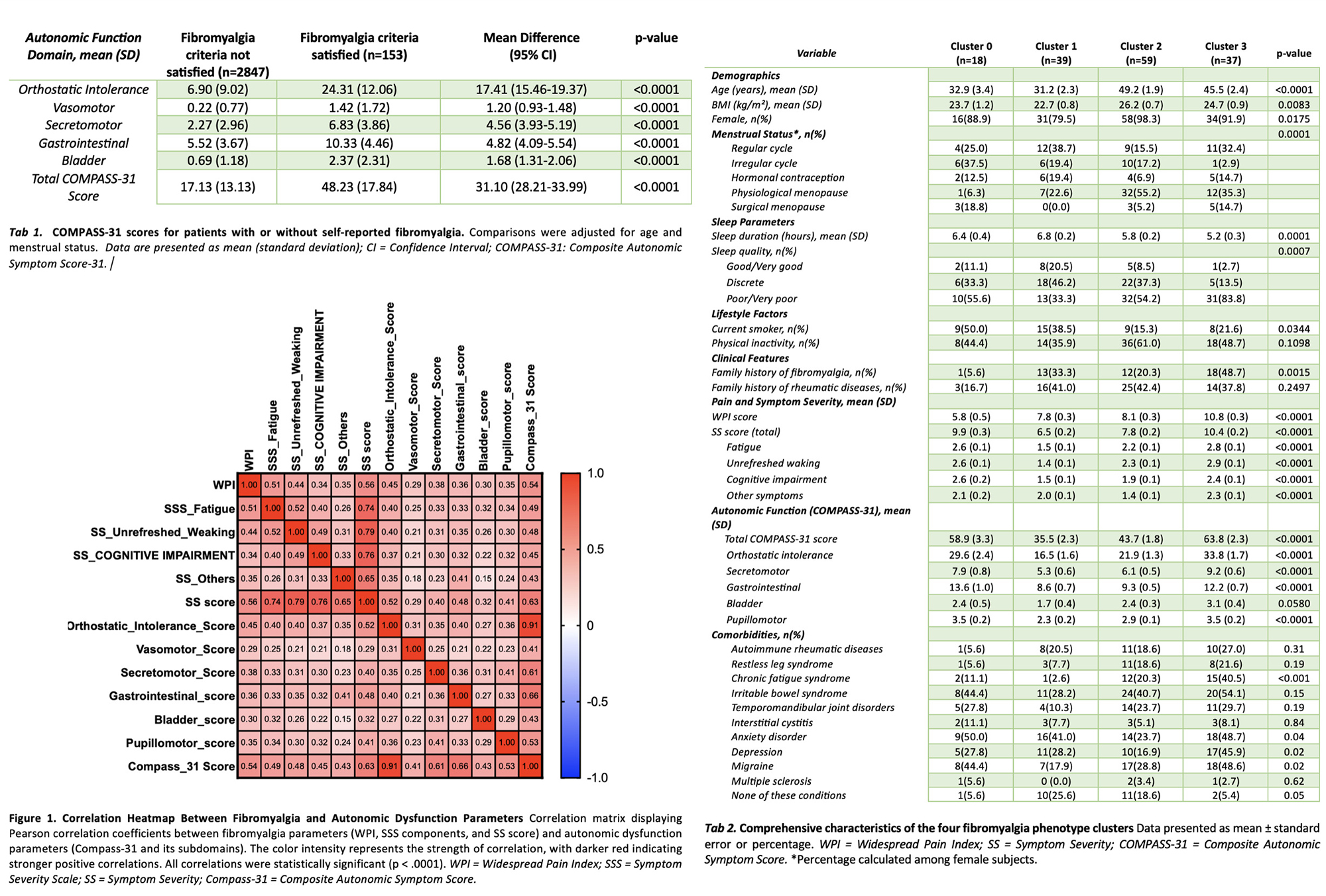
Results. Patients with fibromyalgia demonstrated markedly higher autonomic dysfunction compared to non-fibromyalgia subjects (COMPASS-31: 48.23±17.84 vs. 17.13±13.13, p<0.0001). All autonomic domains were significantly affected in fibromyalgia, with the greatest differences in orthostatic intolerance, gastrointestinal and secretomotor functions (Tab.1). Correlation analysis revealed positive associations between fibromyalgia parameters and autonomic dysfunction metrics (all p<0.0001, Fig.1): the SS showed strong correlation with COMPASS-31 score (r=0.63), with moderate associations between SS components and orthostatic intolerance (r=0.40). WPI demonstrated moderate correlation with overall autonomic dysfunction (r=0.54) and orthostatic intolerance (r=0.45). Sex-stratified multivariate logistic regression models showed that COMPASS-31 score was associated with fibromyalgia in females (OR=1.11, 95%CI 1.09-1.13, p<0.0001) and males (OR=1.14, 95%CI 1.08-1.21, p<0.0001), independently of age, BMI, smoking status, sleep duration, family history, and menstrual cycle status. Cluster analysis (Tab.2) revealed 4 clusters: Cluster 0, young patients with moderate WPI but high SS and significant autonomic dysfunction (58.9±3.3), characterized by high rates of smokers and poor sleep quality; Cluster 1, youngest group with lowest BMI, moderate WPI but the lowest SS and autonomic dysfunction (35.5±2.3), with the best sleep parameters; Cluster 2, oldest patients with the highest BMI and highest female predominance, moderate WPI levels, SS scores, and autonomic dysfunction (43.7±1.8), with high rates of menopause and physical inactivity; Cluster 3, middle-aged patients exhibiting the most severe phenotype with highest WPI, SS scores and autonomic dysfunction (63.8±2.3, with high orthostatic intolerance scores), poorest sleep quality and high family history of fibromyalgia.
Discussion. This study provides evidence of significant autonomic dysfunction in fibromyalgia, with higher COMPASS-31 scores across autonomic domains compared to non-fibromyalgia subjects. Our cluster analysis identified 4 distinct phenotypes: the most severe phenotype (Cluster 3) exhibited the highest autonomic dysfunction alongside worst pain, sleep quality, and symptom severity; this was associated with high rates of family history, suggesting genetic influence.
Downloads
Download data is not yet available.
How to Cite
1.
di Reumatologia SI. PO:29:132 | Autonomic Dysfunction in Fibromyalgia: A Cross-Sectional Study and Cluster Analysis of Clinical Phenotypes: Sergio Del Vescovo1, Vincenzo Venerito1, Maria Giannotta1, Marco Fornaro1, Greta Giulia Dipietrangelo1, Andrea Cito1, Maria Morrone1, Giuseppe Lopalco1, Florenzo Iannone1 | 1UOC Reumatologia, Policlinico di Bari, DiMePre-J Bari, Italy. Reumatismo [Internet]. 2026 Mar. 18 [cited 2026 Oct. 26];77(s1). Available from: https://www.reumatismo.org/reuma/article/view/2361
Copyright (c) 2026 The Author(s)


This work is licensed under a Creative Commons Attribution-NonCommercial 4.0 International License.
PAGEPress has chosen to apply the Creative Commons Attribution NonCommercial 4.0 International License (CC BY-NC 4.0) to all manuscripts to be published.