
62nd National Congress of the Italian Society of Rheumatology
Vol. 77 No. s1 (2025): Abstract book of the 62th Conference of the Italian Society for...
 https://doi.org/10.4081/reumatismo.2025.2360
PO:29:131 | Early effect of auricular acupuncture on pain modulation in patients with fibromyalgia: findings from a real-life experience
Benedetta Bianchi1, Edoardo Cipolletta1, Sonia Farah1, Fausto Salaffi1, Marco Di Carlo1 | 1Clinica Reumatologica, Università Politecnica delle Marche, ospedale Carlo Urbani Jesi, Ancona, Italy
Publisher's note
All claims expressed in this article are solely those of the authors and do not necessarily represent those of their affiliated organizations, or those of the publisher, the editors and the reviewers. Any product that may be evaluated in this article or claim that may be made by its manufacturer is not guaranteed or endorsed by the publisher.
All claims expressed in this article are solely those of the authors and do not necessarily represent those of their affiliated organizations, or those of the publisher, the editors and the reviewers. Any product that may be evaluated in this article or claim that may be made by its manufacturer is not guaranteed or endorsed by the publisher.
135
Views
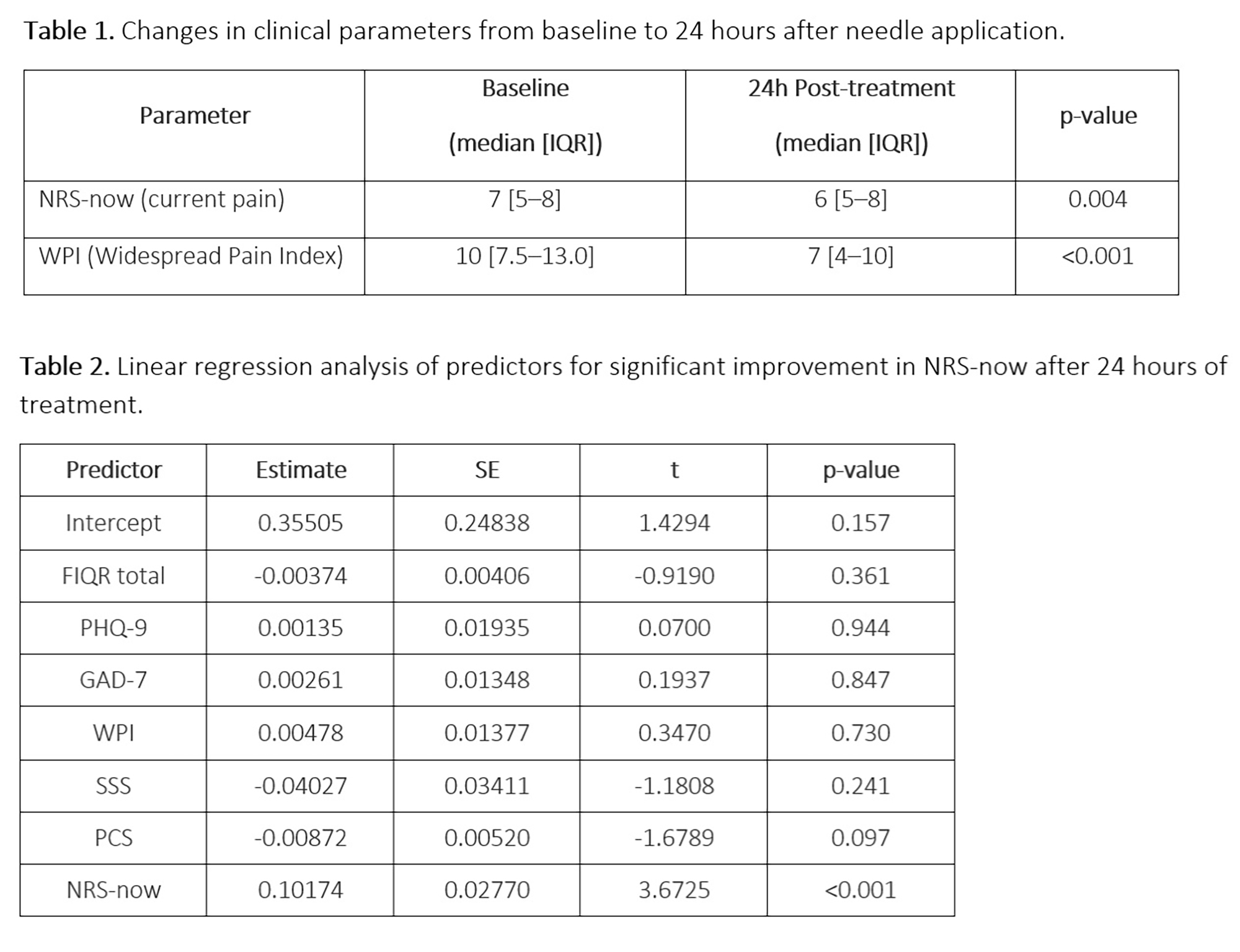
Methods. The acupuncture treatment cycle is offered to patients with moderate disease severity, defined as a revised Fibromyalgia Impact Questionnaire (FIQR) score >40, despite optimal pharmacological therapy. At baseline, a clinical and clinimetric evaluation was performed, investigating pain, disease severity, depression, anxiety, and catastrophizing. Pain symptoms were reassessed 24 hours after the first session of application of semi-permanent needles using the Numerical Rating Scale for current pain (NRS-now) and the Widespread Pain Index (WPI). A reduction of 2 points on the NRS-now was considered a significant improvement. The difference between baseline and 24-hour values for NRS-now and WPI was assessed using the Wilcoxon signed-rank test. In addition, a linear regression analysis was performed to identify predictors of early response.
Results. A total of 84 patients were enrolled (79 women and 5 men), with a median age of 57 years (IQR 49.8-64), a median baseline FIQR of 62.2 (IQR 50.2-78.7), a median baseline WPI of 10 (IQR 7.5-13.0) and a median baseline NRS-now of 7 (IQR 5-8). At 24 hours after needles application, a significant reduction in pain symptoms was observed, both in terms of current pain and widespread pain (NRS-now decreased to 6 [IQR 5-8], p = 0.004; WPI decreased to 7 [IQR 4-10], p <0.001) (Table 1). A significant improvement was recorded in 29 (34.5%) of the 84 patients studied. Linear regression analysis identified baseline NRS-now (p <0.001) as the only significant predictor of response, with higher baseline scores associated with greater improvements (Table 2).
Conclusions. Auricular acupuncture may represent a rapidly effective technique for managing pain in patients with FM. The presence of severe pain at the moment of needles application seems to be a predictive variable of early effectiveness. The therapeutic effect of a cycle of auricular acupuncture sessions rather than a single application and the persistance of treatment-related benefits remain subjects for further investigation. Reference: (1) Di Carlo M, Beci G, Salaffi F. Acupuncture for Fibromyalgia: An Open-Label Pragmatic Study on Effects on Disease Severity, Neuropathic Pain Features, and Pain Catastrophizing. Evid Based Complement Alternat Med. 2020 Feb 25;2020:9869250.
Downloads
Download data is not yet available.
How to Cite
1.
di Reumatologia SI. PO:29:131 | Early effect of auricular acupuncture on pain modulation in patients with fibromyalgia: findings from a real-life experience: Benedetta Bianchi1, Edoardo Cipolletta1, Sonia Farah1, Fausto Salaffi1, Marco Di Carlo1 | 1Clinica Reumatologica, Università Politecnica delle Marche, ospedale Carlo Urbani Jesi, Ancona, Italy. Reumatismo [Internet]. 2026 Mar. 18 [cited 2026 Oct. 24];77(s1). Available from: https://www.reumatismo.org/reuma/article/view/2360
Copyright (c) 2026 The Author(s)


This work is licensed under a Creative Commons Attribution-NonCommercial 4.0 International License.
PAGEPress has chosen to apply the Creative Commons Attribution NonCommercial 4.0 International License (CC BY-NC 4.0) to all manuscripts to be published.