
62nd National Congress of the Italian Society of Rheumatology
Vol. 77 No. s1 (2025): Abstract book of the 62th Conference of the Italian Society for...
 https://doi.org/10.4081/reumatismo.2025.2358
PO:27:106 | Role of histology in interstitial lung involvement of rheumatic diseases in real life scenario
Francesca Cozzini1|2, Francesco Falco1, Lucia Spaggiari1|3, Alberto Cavazza1, Adele Del Giudice1|2, Lucia Dardani1, Fabio Brandolino1, Emanuele Cocchiara1, Ilaria Chiapparoli1, Luca Magnani4, Gianluigi Bajocchi1, Carlo Salvarani1|2, Andreina Manfredi1|2 | 1IRCCS Arcispedale Santa Maria Nuova Reggio Emilia, Italy; 2Università degli Studi di Modena e Reggio Emilia Modena, Italy; 3AUSL area NORD Montecchio-Guastalla, Italy; 4UOC di Medicina Interna ad Indirizzo Reumatologico, Azienda USL Bologna, Ospedale Maggiore Bologna, Italy
Publisher's note
All claims expressed in this article are solely those of the authors and do not necessarily represent those of their affiliated organizations, or those of the publisher, the editors and the reviewers. Any product that may be evaluated in this article or claim that may be made by its manufacturer is not guaranteed or endorsed by the publisher.
All claims expressed in this article are solely those of the authors and do not necessarily represent those of their affiliated organizations, or those of the publisher, the editors and the reviewers. Any product that may be evaluated in this article or claim that may be made by its manufacturer is not guaranteed or endorsed by the publisher.
191
Views
Methods. Patients with autoimmune rheumatic diseases (ARDs)- ILD who underwent lung biopsy in the last ten years were identified by mean of clinical records. The indication for biopsy and the histological findings were analyzed. Moreover, histological patterns with the radiological patterns classifications derived from the concomitant HRCT were compared. Finally, we analyzed how histological findings weighted in final decision of multidisciplinary team.
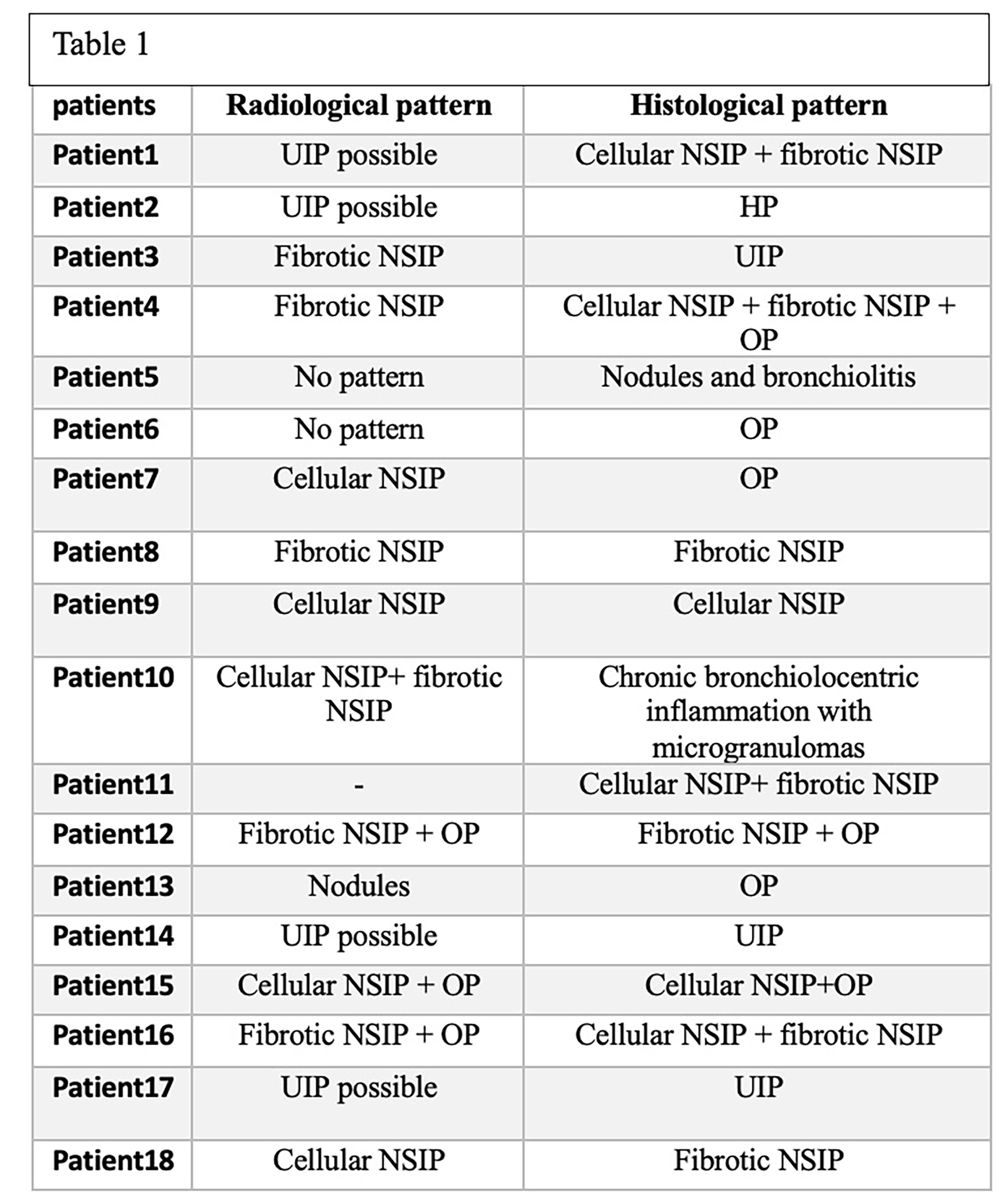
Results. Data from18 patients were available. The mean age at ILD onset was 58.1 ± 13 years, and in 88.9% of cases, ILD was the first clinical manifestation. The primary indication for biopsy was to differentiate among infection, neoplasia, and other pathologies causing ILD. In Table 1 details about the radiological and histological ILD patterns are reported. HRCT data was unavailable for one patient. We observed a certain concordance in detecting fibrosis between radiological and histological methods, with the exception of one case. Notably, biopsies more frequently identified the presence of organizing pneumonia, a significant indicator of inflammation, sometimes useful to support diagnosis of an ILD associated to autoimmune diseases. The final diagnoses among our patients were: Rheumatoid Arthritis (27.8%), Sjögren's Syndrome (22.2%), Interstitial Pneumonia with Autoimmune Features (22.2%) anti-synthetase syndrome (16.7%). Additionally, one patient was diagnosed with sarcoidosis, another with IgG4-related disease and one patient received a diagnosis of both carcinoma and ILD from the biopsy.
Conclusions. The ATS/ERS/ JRS/ALAT guidelines recommend HRCT and multidisciplinary discussion for diagnosing patients ARD-ILD, reserving biopsy for only the most complicated cases. In line with these guidelines, we proposed biopsy for only a few patients. For three of them, histology led directly to a diagnosis, while for the remaining cases, it helped clarify the diagnosis and guide appropriate therapy. Ultimately, the decision to perform a lung biopsy remains a key point requiring discussion within a multidisciplinary team. Further studies with larger patient cohorts will be needed to explore a possible correlation between radiological and histological patterns.
Downloads
Download data is not yet available.
How to Cite
1.
PO:27:106 | Role of histology in interstitial lung involvement of rheumatic diseases in real life scenario: Francesca Cozzini1|2, Francesco Falco1, Lucia Spaggiari1|3, Alberto Cavazza1, Adele Del Giudice1|2, Lucia Dardani1, Fabio Brandolino1, Emanuele Cocchiara1, Ilaria Chiapparoli1, Luca Magnani4, Gianluigi Bajocchi1, Carlo Salvarani1|2, Andreina Manfredi1|2 | 1IRCCS Arcispedale Santa Maria Nuova Reggio Emilia, Italy; 2Università degli Studi di Modena e Reggio Emilia Modena, Italy; 3AUSL area NORD Montecchio-Guastalla, Italy; 4UOC di Medicina Interna ad Indirizzo Reumatologico, Azienda USL Bologna, Ospedale Maggiore Bologna, Italy. Reumatismo [Internet]. 2026 Mar. 18 [cited 2026 Oct. 21];77(s1). Available from: https://www.reumatismo.org/reuma/article/view/2358
Copyright (c) 2026 The Author(s)


This work is licensed under a Creative Commons Attribution-NonCommercial 4.0 International License.
PAGEPress has chosen to apply the Creative Commons Attribution NonCommercial 4.0 International License (CC BY-NC 4.0) to all manuscripts to be published.