
62nd National Congress of the Italian Society of Rheumatology
Vol. 77 No. s1 (2025): Abstract book of the 62th Conference of the Italian Society for...
 https://doi.org/10.4081/reumatismo.2025.2357
PO:26:096 | From free text to diagnosis: a Natural Language Processing approach for identifying rheumatoid and psoriatic arthritis in the Emergency Department
Antonio Tonutti1|2, Pierandrea Morandini3, Cosimo Faeti3, Nicoletta Luciano1|2, Saverio D'Amico3, Antonio Voza1|4, Victor Savevski3, Carlo Selmi1|2 | 1Department of Biomedical Sciences, Humanitas University Pieve Emanuele, Milan, Italy; 2Rheumatology and Clinical Immunology, IRCCS Humanitas Research Hospital Rozzano, Milan, Italy; 3Artificial Intelligence Unit, IRCCS Humanitas Research Hospital Rozzano, Milan, Italy; 4Emergency Department, IRCCS Humanitas Research Hospital Rozzano, Milan, Italy
Publisher's note
All claims expressed in this article are solely those of the authors and do not necessarily represent those of their affiliated organizations, or those of the publisher, the editors and the reviewers. Any product that may be evaluated in this article or claim that may be made by its manufacturer is not guaranteed or endorsed by the publisher.
All claims expressed in this article are solely those of the authors and do not necessarily represent those of their affiliated organizations, or those of the publisher, the editors and the reviewers. Any product that may be evaluated in this article or claim that may be made by its manufacturer is not guaranteed or endorsed by the publisher.
181
Views
Materials and Methods. In this retrospective case-control study, we included patients diagnosed with RA or PsA at our center between Jan 2017 and Dec 2023. For each case, we retrieved ED visits occurring within the 12 months preceding the index rheumatology evaluation. Matched controls (1:10 ratio) were selected among ED patients seen on the same date, with no prior rheumatology evaluation, matched via propensity score on triage “color code.” A supervised machine learning pipeline was applied to ED clinical notes, using pre-trained language models and Bidirectional Encoder Representations from Transformers (BERT), fine-tuned over 5 epochs.
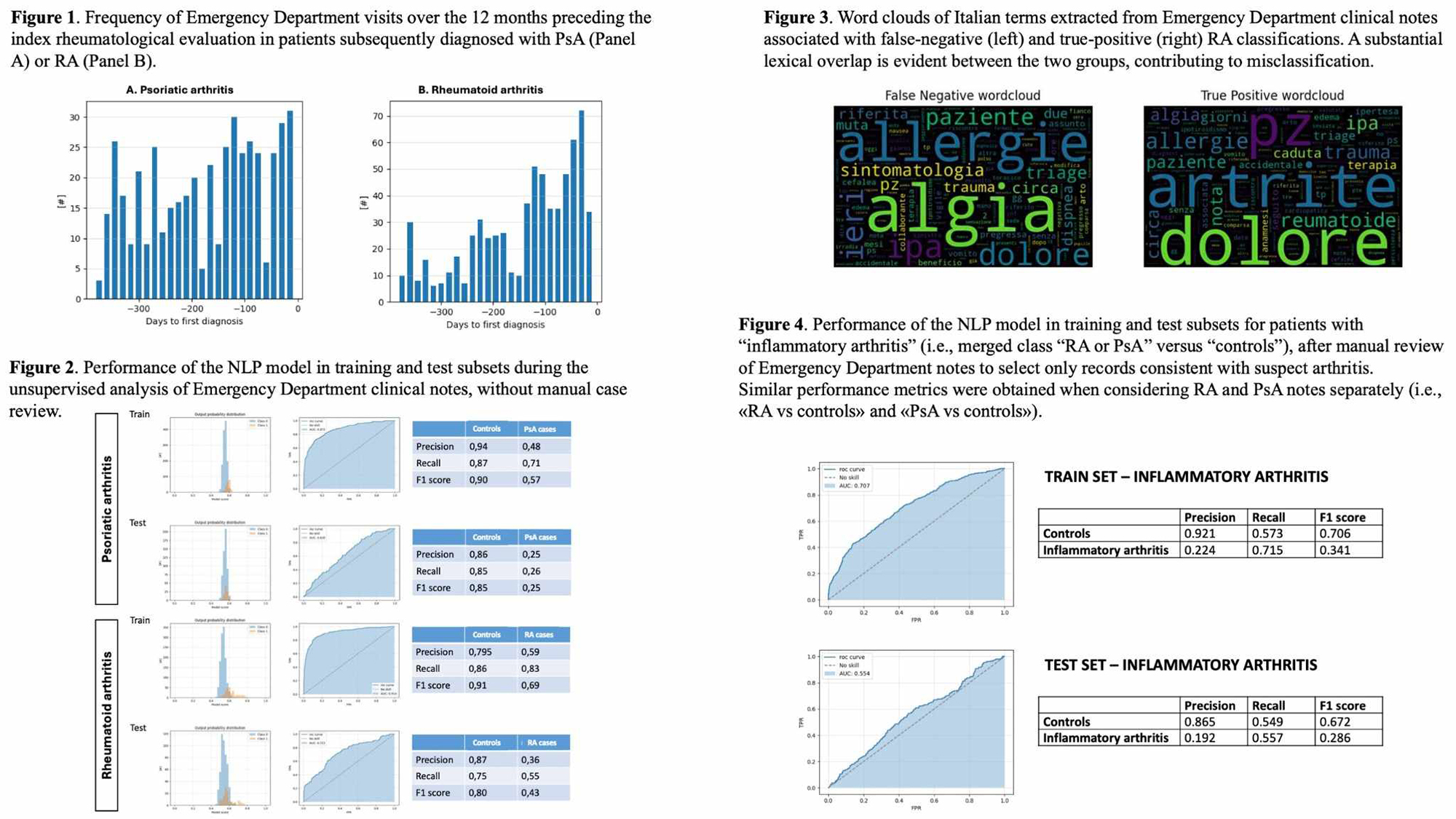
Results. A total of 650 patients accessed the ED in the year preceding RA or PsA diagnosis (58% female; mean age 63±15.6). Of these, 294 (45%) were diagnosed with PsA (7.5% of all new PsA cases diagnosed at our Center; 38% female; mean age 63±14.7), and 356 (55%) with RA (10.4% of all new RA cases; 75% female; mean age 63±16.4). ED visit frequency remained stable in PsA but increased in the three months before RA diagnosis (Figure 1). Musculoskeletal symptoms were the most common presenting complaint. NLP applied blindly to ED notes achieved good discrimination between cases and controls in the training set, but performance dropped on the test set (Figure 2). Word cloud analysis (Figure 3) revealed lexical overlap between true positives and false negatives. Manual review of ED notes was then performed to retain only records referring to suspected arthritis, identifying 151 PsA and 175 RA patients. After reapplying NLP, model performance again showed good discrimination in train set but declined in test set (Figure 4).
Conclusions. This is the first study using NLP to identify RA and PsA from ED notes before specialist referral. A meaningful proportion of patients had ED visits for potential rheumatologic symptoms up to one year prior to diagnosis. These patients were older than general RA/PsA incident cohorts, possibly reflecting greater symptom burden. While NLP demonstrated potential, it failed to consistently distinguish prodromal patients from matched controls, highlighting both the promise and current limitations of this approach in real-world settings.
Downloads
Download data is not yet available.
How to Cite
1.
PO:26:096 | From free text to diagnosis: a Natural Language Processing approach for identifying rheumatoid and psoriatic arthritis in the Emergency Department: Antonio Tonutti1|2, Pierandrea Morandini3, Cosimo Faeti3, Nicoletta Luciano1|2, Saverio D’Amico3, Antonio Voza1|4, Victor Savevski3, Carlo Selmi1|2 | 1Department of Biomedical Sciences, Humanitas University Pieve Emanuele, Milan, Italy; 2Rheumatology and Clinical Immunology, IRCCS Humanitas Research Hospital Rozzano, Milan, Italy; 3Artificial Intelligence Unit, IRCCS Humanitas Research Hospital Rozzano, Milan, Italy; 4Emergency Department, IRCCS Humanitas Research Hospital Rozzano, Milan, Italy. Reumatismo [Internet]. 2026 Mar. 18 [cited 2026 Oct. 21];77(s1). Available from: https://www.reumatismo.org/reuma/article/view/2357
Copyright (c) 2026 The Author(s)


This work is licensed under a Creative Commons Attribution-NonCommercial 4.0 International License.
PAGEPress has chosen to apply the Creative Commons Attribution NonCommercial 4.0 International License (CC BY-NC 4.0) to all manuscripts to be published.