
62nd National Congress of the Italian Society of Rheumatology
Vol. 77 No. s1 (2025): Abstract book of the 62th Conference of the Italian Society for...
 https://doi.org/10.4081/reumatismo.2025.2353
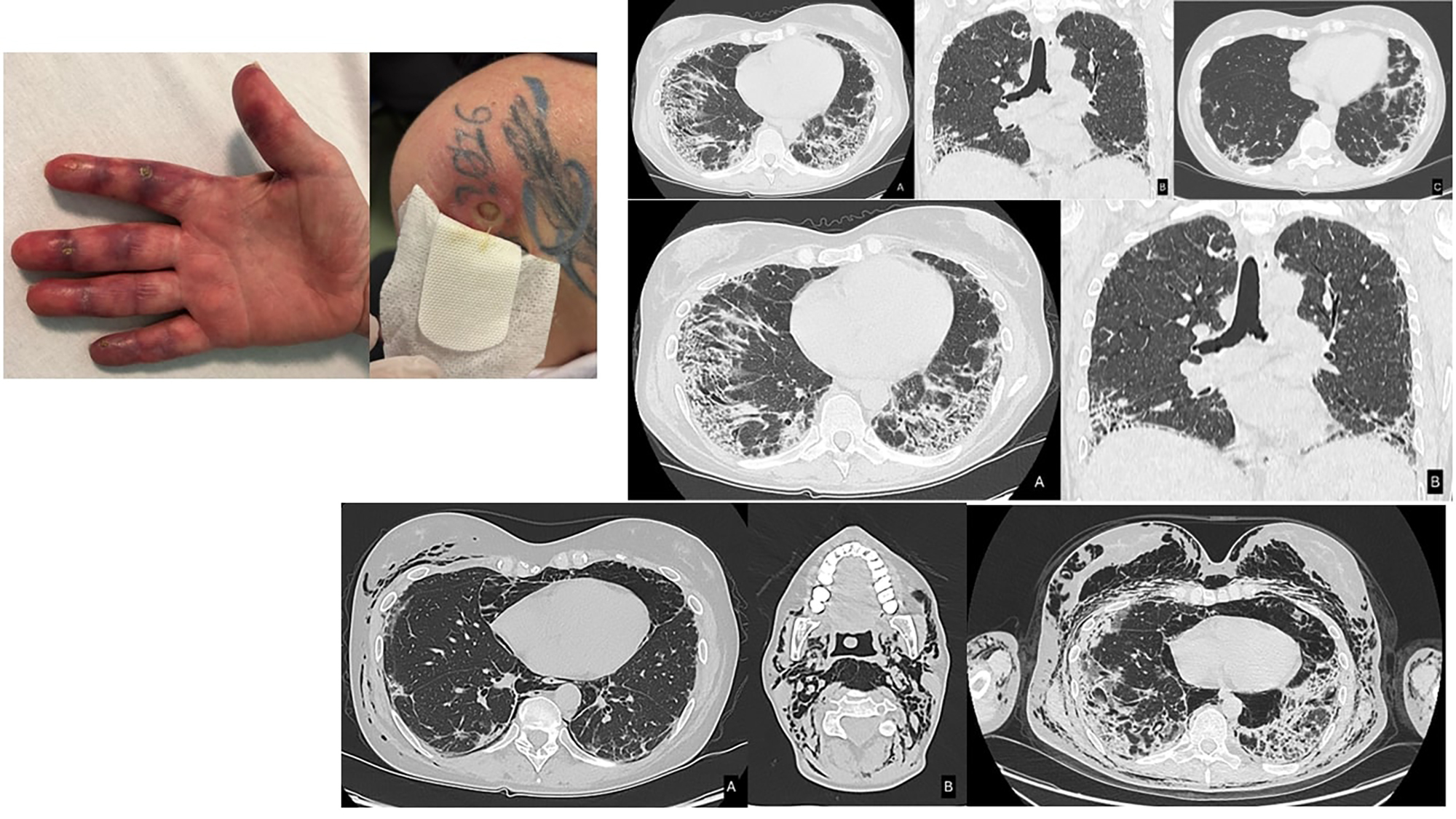
PO:24:068 | Case Report: ‘Spontaneous Pneumomediastinum in a Patient with MDA5-Positive Dermatomyositis and Severe Pulmonary Fibrosis’
Carlotta Braga1, Margherita Rizzo1, Marta Raschellà1, Beatrice Maranini1, Gioacchino Schifino2, Aldo Carnevale3, Marcello Govoni1, Andrea Lo Monaco1 | 1Rheumatology Unit, Department of Medical Sciences, University of Ferrara and Azienda Ospedaliero-Universitaria S. Anna Ferrara, Italy; 2Respiratory Medicine Unit, Department of Cardio-Thoracic-Vascular Pathologies, Arcispedale Sant'Anna, Ferrara, Italy; 3Radiology Unit, Department of Translational Medicine, University of Ferrara, Italy
Publisher's note
All claims expressed in this article are solely those of the authors and do not necessarily represent those of their affiliated organizations, or those of the publisher, the editors and the reviewers. Any product that may be evaluated in this article or claim that may be made by its manufacturer is not guaranteed or endorsed by the publisher.
All claims expressed in this article are solely those of the authors and do not necessarily represent those of their affiliated organizations, or those of the publisher, the editors and the reviewers. Any product that may be evaluated in this article or claim that may be made by its manufacturer is not guaranteed or endorsed by the publisher.
157
Views
Results. SPM is a rare but increasingly recognized complication of anti-MDA5-positive DM, often linked to RP-ILD and poor prognosis. It can occur without respiratory symptoms, complicating the diagnosis. Prognostic markers include cutaneous ulcers, anti-Ro52 antibodies, and persistent lymphopenia. In the present case the management was further complicated by the patient's oncologic and infectious complication. Nevertheless, a stepwise therapeutic approach, beginning with corticosteroids and IVIg, progressing to CyA, and ultimately to rituximab, achieved disease control. Rituximab, supported by growing observational data and emerging trials, appears effective in refractory DM, especially in cases with pulmonary involvement.
Conclusions. This case highlights the complexity of treating anti-MDA5-positive DM, especially in the setting of prior cancer and marked lymphopenia. The clinical severity required timely multidisciplinary management. It supports CyA and rituximab as effective options in refractory cases and underscores the need for greater awareness and further research into this high-risk DM subset.
Downloads
Download data is not yet available.
How to Cite
1.
PO:24:068 | Case Report: ‘Spontaneous Pneumomediastinum in a Patient with MDA5-Positive Dermatomyositis and Severe Pulmonary Fibrosis’: Carlotta Braga1, Margherita Rizzo1, Marta Raschellà1, Beatrice Maranini1, Gioacchino Schifino2, Aldo Carnevale3, Marcello Govoni1, Andrea Lo Monaco1 | 1Rheumatology Unit, Department of Medical Sciences, University of Ferrara and Azienda Ospedaliero-Universitaria S. Anna Ferrara, Italy; 2Respiratory Medicine Unit, Department of Cardio-Thoracic-Vascular Pathologies, Arcispedale Sant’Anna, Ferrara, Italy; 3Radiology Unit, Department of Translational Medicine, University of Ferrara, Italy. Reumatismo [Internet]. 2026 Mar. 18 [cited 2026 Oct. 16];77(s1). Available from: https://www.reumatismo.org/reuma/article/view/2353
Copyright (c) 2026 The Author(s)


This work is licensed under a Creative Commons Attribution-NonCommercial 4.0 International License.
PAGEPress has chosen to apply the Creative Commons Attribution NonCommercial 4.0 International License (CC BY-NC 4.0) to all manuscripts to be published.