
62nd National Congress of the Italian Society of Rheumatology
Vol. 77 No. s1 (2025): Abstract book of the 62th Conference of the Italian Society for...
 https://doi.org/10.4081/reumatismo.2025.2352
PO:24:065 | Nailfold capillaroscopic in primary Sjögren's syndrome, clinical and serological correlations; a preliminary report from a reference center
Caterina Vacchi1, Filippo Santoro1, Maria Grazia Malandra1, Giulia Cassone1, Alessandra Carobbio2, Martina Orlandi1, Dilia Giuggioli1 | 1Reumatologia Modena, Italy; 2Statistica Medica Modena, Italy
Publisher's note
All claims expressed in this article are solely those of the authors and do not necessarily represent those of their affiliated organizations, or those of the publisher, the editors and the reviewers. Any product that may be evaluated in this article or claim that may be made by its manufacturer is not guaranteed or endorsed by the publisher.
All claims expressed in this article are solely those of the authors and do not necessarily represent those of their affiliated organizations, or those of the publisher, the editors and the reviewers. Any product that may be evaluated in this article or claim that may be made by its manufacturer is not guaranteed or endorsed by the publisher.
89
Views
Objectives. To describe NC abnormalities in pSS patients vs pRP patients. - Among pSS patients, to correlate NC abnormalities with clinical-serologic features.
Materials and Methods. All the consecutive pSS patients (according 2016 ACR/EULAR classification criteria, positive MSGB, excluded overlap syndromes) and pRP controls were evaluated by NC in a 4-months period (Jan/01/2025–May/01/2025). Main clinical and serologic features in pSS patients were collected(table2). NC was performed according to EULAR study group on microcirculation in rheumatic diseases(1). A qualitative assessment (scleroderma pattern or not) and a quantitative assessment were performed. From the latter point of view, the following capillary characteristics were evaluated when assessing an image: capillary density, morphology (crossing/tortuous shape or neoangiogenic features), presence/absence of ectasias, giant capillaries and haemorrhages. The presence of multiple giant capillaries or the combination of abnormal shapes with a lowered number of capillaries points to a “scleroderma - SSc - pattern”.
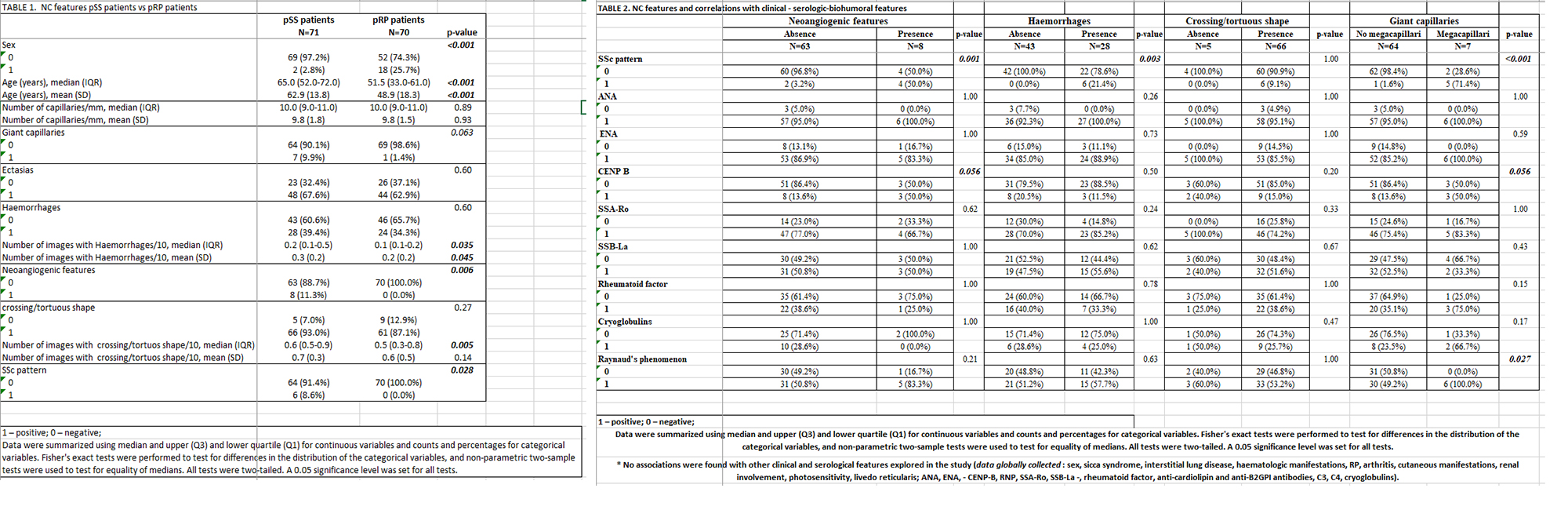
Results. NC was performed in 71 pSS patients (F/M 69/2; median age: 65.0 IQR:52.0-72.0) and 70 pRP controls (F/M 52/18; median age: 51.5 IQR:33.0-61.0). Comparing the groups, no differences were found in terms of capillary density, ectasias/giant capillaries. pSS patients presented more frequently haemorrhages, crossing shape capillaries and neoangiogenic features than pRP [Table 1]. RP was present in 53,7% of cases, 11 patients (16,9%) presented CENP-B, 51 SSA-Ro and 34 SSB-La. As shown in Table 2, in pSS subjects, giant capillaries was strongly associated to RP, with a trend toward significance for CENP-B antibodies. Also, neoangiogenic features were more likely to be present in CENP-B patients. Ssc pattern was present in 6 pSS patients, with statistical association, as expected (p=0,028). RP was reported by all subjects, one patient presented CENP-B, while 5 subjects presented SSA-Ro/SSB-La. As expected, RP was strongly associated with CENP -B (p< 0,001), with all CENP-B patients presenting RP, RP was also associated to SSc pattern, even in absence of statistical significance (p = 0,055). We failed in finding an association between SSc pattern and CENP-B.
Conclusions. The role of NC in pSS has been investigated in only a few studies. There is no evidence that patients with pSS have distinct NC characteristics compared to pRP(2). The prevalence of NC alterations may differ depending on the specific subset of pSS patients. Comparing NC features in pSS patients and overlap conditions could be a fascinating field of study in the future.
Downloads
Download data is not yet available.
How to Cite
1.
PO:24:065 | Nailfold capillaroscopic in primary Sjögren’s syndrome, clinical and serological correlations; a preliminary report from a reference center: Caterina Vacchi1, Filippo Santoro1, Maria Grazia Malandra1, Giulia Cassone1, Alessandra Carobbio2, Martina Orlandi1, Dilia Giuggioli1 | 1Reumatologia Modena, Italy; 2Statistica Medica Modena, Italy. Reumatismo [Internet]. 2026 Mar. 18 [cited 2026 Oct. 16];77(s1). Available from: https://www.reumatismo.org/reuma/article/view/2352
Copyright (c) 2026 The Author(s)


This work is licensed under a Creative Commons Attribution-NonCommercial 4.0 International License.
PAGEPress has chosen to apply the Creative Commons Attribution NonCommercial 4.0 International License (CC BY-NC 4.0) to all manuscripts to be published.