
62nd National Congress of the Italian Society of Rheumatology
Vol. 77 No. s1 (2025): Abstract book of the 62th Conference of the Italian Society for...
 https://doi.org/10.4081/reumatismo.2025.2343
PO:21:018 | The role of rheumatologists in the diagnosis and monitoring of Whipple's disease
Mariangela Salvato1, Alessandro Giollo1, Marco Cola2, Francesca Frizzera1, Kiren Khalid1, Lorenzo Di Luozzo1, Annamaria Cattelan2, Andrea Doria1 | 1UOC Reumatologia, AOUI Padova, Italy; 2UOC Malattie infettive, AOUI Padova, Italy
Publisher's note
All claims expressed in this article are solely those of the authors and do not necessarily represent those of their affiliated organizations, or those of the publisher, the editors and the reviewers. Any product that may be evaluated in this article or claim that may be made by its manufacturer is not guaranteed or endorsed by the publisher.
All claims expressed in this article are solely those of the authors and do not necessarily represent those of their affiliated organizations, or those of the publisher, the editors and the reviewers. Any product that may be evaluated in this article or claim that may be made by its manufacturer is not guaranteed or endorsed by the publisher.
174
Views
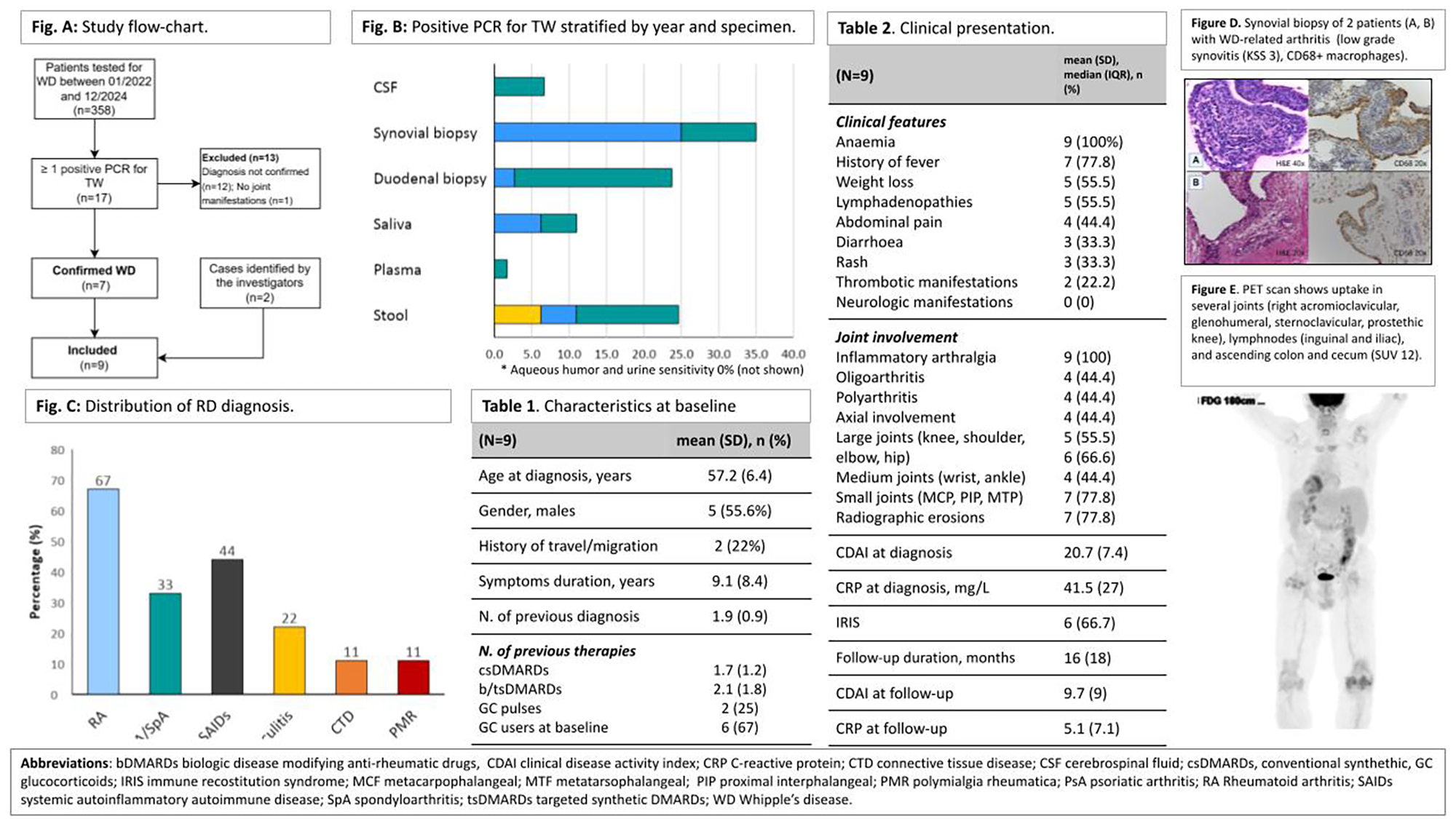
Materials and Methods. Retrospective cohort study in a tertiary-care centre. Cases were identified based on the positivity of at least one clinical sample tested for TW at the microbiology laboratory from 01/2022 to 12/2024 (FigA). Adult patients with confirmed WD and joint involvement were included in the study. Diagnosis was based on Periodic Acid–Schiff (PAS)-positive staining of duodenal biopsy tissue combined with confirmatory polymerase chain reaction (PCR) for TW or by a positive PCR for TW in sterile extra-digestive specimens such as synovial fluid, synovial membrane, or cerebrospinal fluid (CSF).
Results. Annual TW test volume increased from 110 in 2022 to 326 in 2024, with positivity rates rising from 0.9% to 6.7%. Among non-invasive specimens, stool samples had the highest positivity rate (6.3% to 13.7%). Positivity rates were 6.8% for duodenal biopsies (n=74), 0.2% for CSF (n=49), and 14% for synovial biopsies (n=14) (FigB). In 2024, rheumatology accounted for 23% of test requests but exhibited a higher positivity rate than other departments (16% vs. 5%). Nine patients had confirmed WD (mean age 57 years, males 56 %), all with prior diagnoses of RMD and treatment with DMARDs or glucocorticoids (GC). (Table 1, FigC). Systemic features included anaemia, fever, weight loss, and lymphadenopathy. All patients exhibited atypical oligo- or polyarthritis with axial involvement in 44% of cases (Table 2). Synovial fluid (n=6) was moderately inflammatory, while synovial biopsy (n=2) revealed low-grade synovitis (FigD). FDG19-PET/CT or MRI was performed in 78% for diagnostic purposes. Findings included persistent and multifocal areas of pathological uptake involving intestinal loops, stomach, abdominal lymph nodes, and axial spine (mean SUV 6.7) (FigE). Treatment included intravenous ceftriaxone followed by cotrimoxazole (n=6), doxycycline (n=1), or both (n=1); one patient received oral doxycycline plus hydroxychloroquine. At last follow-up (median (IQR) 16 (18) months), only one patient achieved complete remission of WD and RMD. Three patients had worsened arthritis confirmed by ultrasound, including one case of relapsed WD-arthritis confirmed by TW-PCR in synovial tissue. Another patient had relapsed TW infection without joint manifestations. GC use declined, though 33% of patients remained GC-dependent for pain control.
Conclusions. Increased awareness and targeted diagnostic efforts from rheumatologists may enhance WD detection. PET and synovial biopsy may be useful for diagnosis and monitoring. Long-term outcomes remain suboptimal, with frequent relapse and persistent symptoms despite treatment.
Downloads
Download data is not yet available.
How to Cite
1.
di Reumatologia SI. PO:21:018 | The role of rheumatologists in the diagnosis and monitoring of Whipple’s disease: Mariangela Salvato1, Alessandro Giollo1, Marco Cola2, Francesca Frizzera1, Kiren Khalid1, Lorenzo Di Luozzo1, Annamaria Cattelan2, Andrea Doria1 | 1UOC Reumatologia, AOUI Padova, Italy; 2UOC Malattie infettive, AOUI Padova, Italy. Reumatismo [Internet]. 2026 Mar. 18 [cited 2026 Oct. 23];77(s1). Available from: https://www.reumatismo.org/reuma/article/view/2343
Copyright (c) 2026 The Author(s)


This work is licensed under a Creative Commons Attribution-NonCommercial 4.0 International License.
PAGEPress has chosen to apply the Creative Commons Attribution NonCommercial 4.0 International License (CC BY-NC 4.0) to all manuscripts to be published.