
62nd National Congress of the Italian Society of Rheumatology
Vol. 77 No. s1 (2025): Abstract book of the 62th Conference of the Italian Society for...
 https://doi.org/10.4081/reumatismo.2025.2341
PO:20:006 | Efficacy of denosumab in glucocorticoid-induced osteoporosis patients with prior exposure to intravenous aminobisphosphonates
Kiren Khalid1, Alessandro Giollo1, Mariangela Salvato1, Francesca Frizzera1, Lorenzo Di Luozzo1, Bernd Raffeiner2, Andrea Doria1 | 1Rheumatology Unit, Department of Medicine - DIMED, University of Padova, Padova, Italy; 2Department of Rheumatology, Bolzano Central Hospital, Bolzano, Italy
Publisher's note
All claims expressed in this article are solely those of the authors and do not necessarily represent those of their affiliated organizations, or those of the publisher, the editors and the reviewers. Any product that may be evaluated in this article or claim that may be made by its manufacturer is not guaranteed or endorsed by the publisher.
All claims expressed in this article are solely those of the authors and do not necessarily represent those of their affiliated organizations, or those of the publisher, the editors and the reviewers. Any product that may be evaluated in this article or claim that may be made by its manufacturer is not guaranteed or endorsed by the publisher.
116
Views
Materials and Methods. In this retrospective cohort study, we included female, post-menopausal patients with rheumatic musculoskeletal diseases (RMDs) who initiated treatment with denosumab 60 mg every 6 months for GIOP between 06/2019 and 06/2023 in a single tertiary centre; patients underwent dual energy X-ray absorptiometry (DEXA) before starting treatment and after 24 months. We compared changes from baseline to follow-up of the T-score at the lumbar spine, femoral neck and total hip in patients who were DMAB/NBPs-experienced to those who were DMAB/NBPs-naive, adjusting for the cumulative prednisone dose.
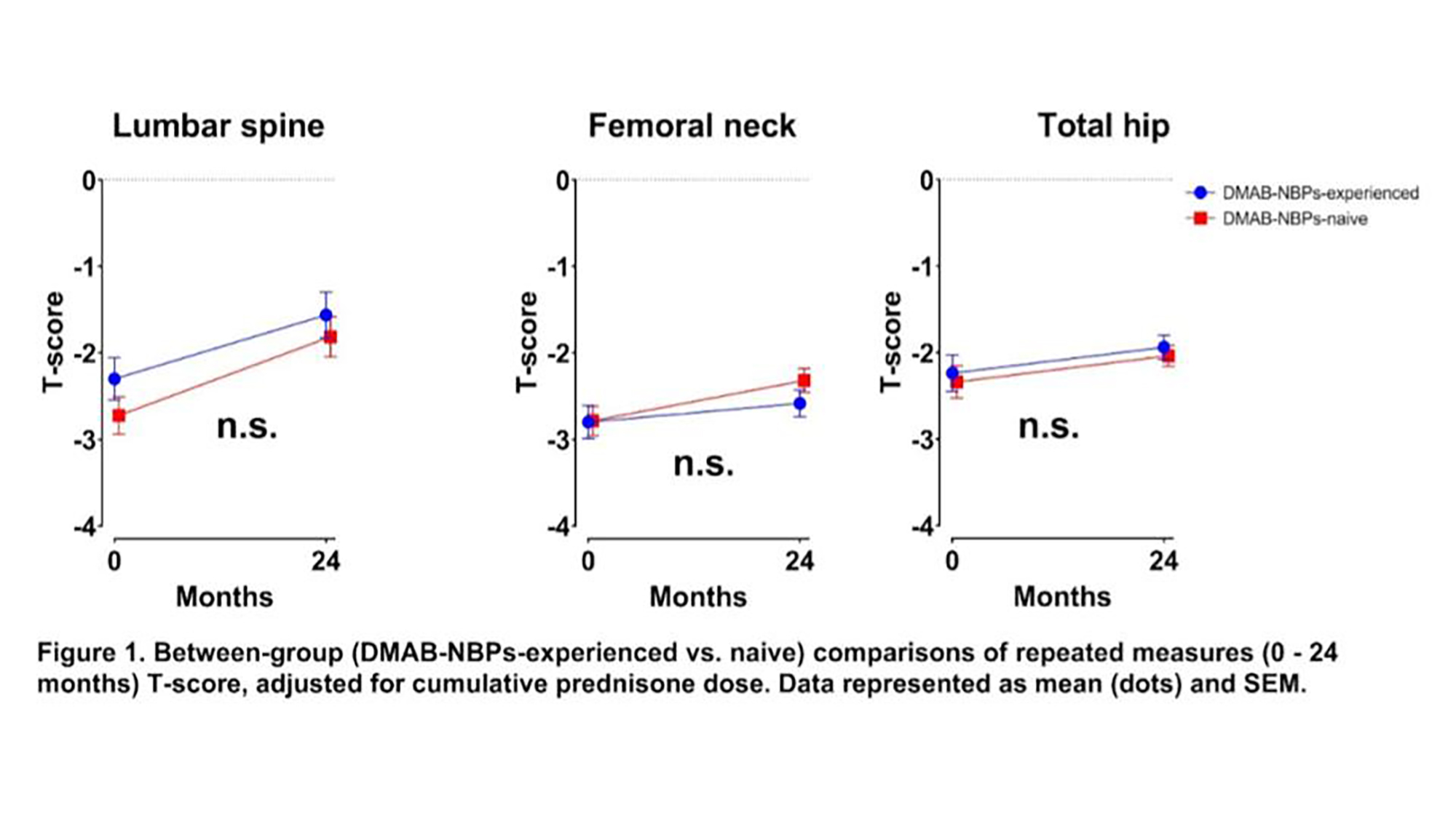
Results. Thirty-two patients with GIOP who initiated DMAB during the study period and had follow-up data were included (mean (SD) age 72 (12) years, FRAX 34 (22) %, 19/32 (59%) with prior fractures). The main RMD diagnoses were inflammatory arthritis (n=17, 53%) and CTD (n=15, 42%). There were no significant differences at baseline between DMAB/NBPs-experienced compared to DMAB/NBPs-naive patients, including the prevalence of CKD stage 3/4/5. In the DMAB/NBPs-experienced group, the median exposure to NBPs was 19 months. Mean (SD) T-scores at any site significantly increased at follow-up (+0.8 (0.7), +0.4 (0.6), +0.3 (0.6) for lumbar spine, femoral neck and total hip respectively; p<0.005 for all), without differences between treatment groups (Figure 1). During the study period, three new fractures occurred, two in the DMAB/NBPs-experienced group and one in the DMAB/NBPs-naive group. Bone turnover markers decreased with a similar magnitude between groups (mean (SD) CTX % change, DMAB/NBPs-naive vs. DMAB/NBPs-experienced: -48 (37) % vs. -61 (30) %, p=0.245; P1NP: -40 (10) % vs. -38 (21) %, p=0.691).
Conclusions. This small real-life study cohort of patients with GIOP provides evidence that DMAB is effective in increasing BMD, irrespective of prior use of potent intravenous NBPs.
Downloads
Download data is not yet available.
How to Cite
1.
PO:20:006 | Efficacy of denosumab in glucocorticoid-induced osteoporosis patients with prior exposure to intravenous aminobisphosphonates: Kiren Khalid1, Alessandro Giollo1, Mariangela Salvato1, Francesca Frizzera1, Lorenzo Di Luozzo1, Bernd Raffeiner2, Andrea Doria1 | 1Rheumatology Unit, Department of Medicine - DIMED, University of Padova, Padova, Italy; 2Department of Rheumatology, Bolzano Central Hospital, Bolzano, Italy. Reumatismo [Internet]. 2026 Mar. 18 [cited 2026 Oct. 16];77(s1). Available from: https://www.reumatismo.org/reuma/article/view/2341
Copyright (c) 2026 The Author(s)


This work is licensed under a Creative Commons Attribution-NonCommercial 4.0 International License.
PAGEPress has chosen to apply the Creative Commons Attribution NonCommercial 4.0 International License (CC BY-NC 4.0) to all manuscripts to be published.