
62nd National Congress of the Italian Society of Rheumatology
Vol. 77 No. s1 (2025): Abstract book of the 62th Conference of the Italian Society for...
 https://doi.org/10.4081/reumatismo.2025.2337
PO:18:264 | Anifrolumab in Systemic Lupus Erythematosus: Bridging Clinical Trial Data with Real-World Evidence
Giulia Cassone2, Filippo Santoro1, Caterina Vacchi2, Dilia Giuggioli2, Chiara Cabassi1 | 1UOC Reumatologia, AOU Policlinico di Modena, Università degli studi di Modena e Reggio Emilia Modena e Reggio Emilia, Italy; 2UOC Reumatologia, AOU Policlinico di Modena Modena, Italy
Publisher's note
All claims expressed in this article are solely those of the authors and do not necessarily represent those of their affiliated organizations, or those of the publisher, the editors and the reviewers. Any product that may be evaluated in this article or claim that may be made by its manufacturer is not guaranteed or endorsed by the publisher.
All claims expressed in this article are solely those of the authors and do not necessarily represent those of their affiliated organizations, or those of the publisher, the editors and the reviewers. Any product that may be evaluated in this article or claim that may be made by its manufacturer is not guaranteed or endorsed by the publisher.
217
Views
Materials and Methods. We included all patients undergoing ANI therapy for SLE. At baseline (T0), 3 months (T3), and 6 months (T6), overall and organ-specific disease activity, flares, daily glucocorticoid dose, and adverse events were recorded. Clinical manifestations, laboratory parameters, disease activity index, and therapeutic management were documented for each patient.
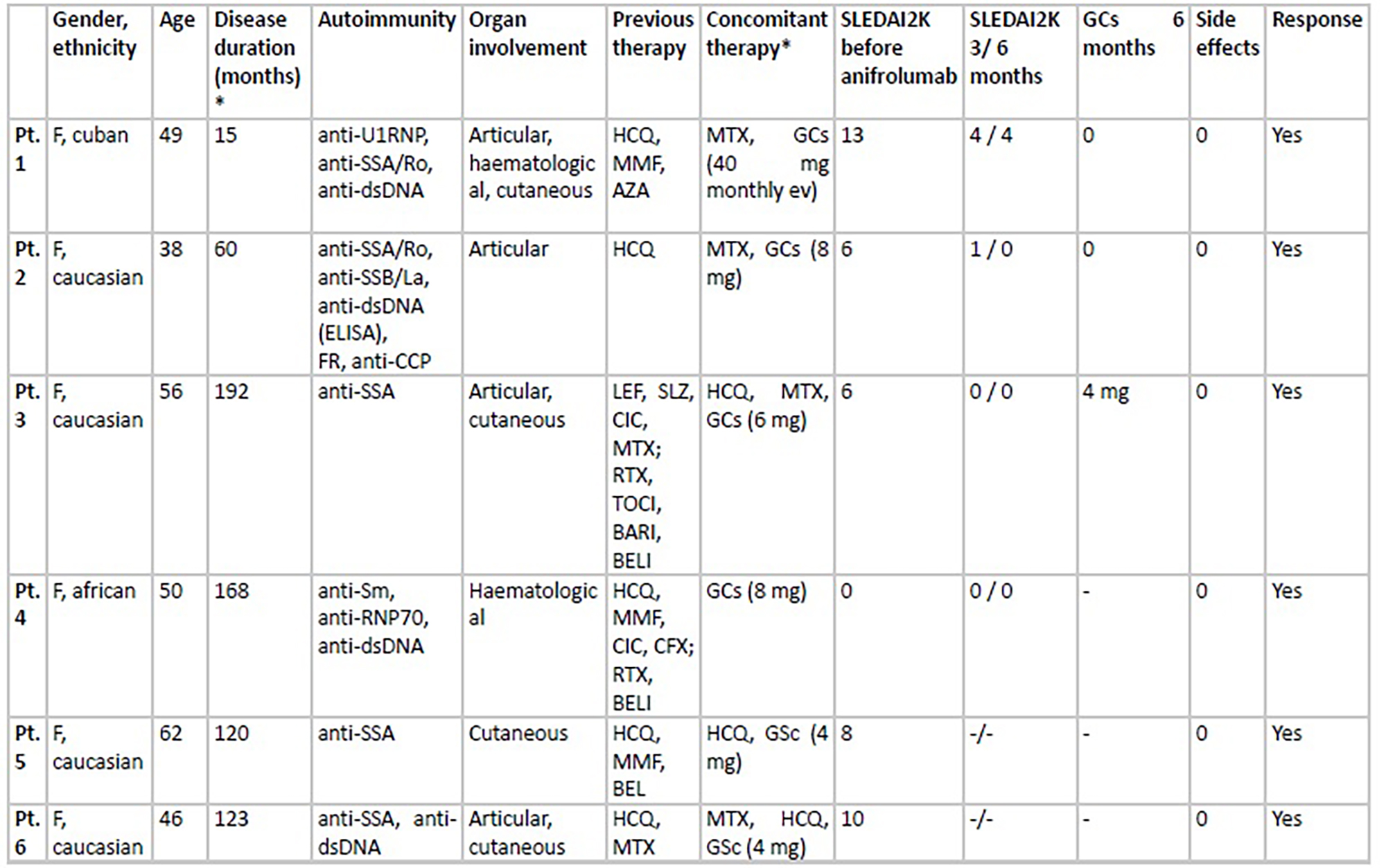
Results. Six patients undergoing ANI therapy for active SLE were enrolled, with a median age of 51 years and a median disease duration of 8 years. All patients had a history of mucocutaneous involvement; 83% had articular manifestations, 33% hematological involvement, 17% serositis, and one patient exhibited suspected neuropsychiatric manifestations. No cases of lupus nephritis were reported. All patients had previously received immunosuppressive therapy, with a median of 2.5 prior treatments. Specifically, treatment failure rates were as follows: methotrexate (66%), belimumab (50%), mycophenolate mofetil (50%), rituximab (33%), cyclosporine (33%), and cyclophosphamide (17%). At enrollment, the most frequent active disease manifestations were articular (4/6 patients), mucocutaneous (4/6), and hematological (2/6). Two patients exhibited active serology (anti-dsDNA positivity and/or hypocomplementemia). Regarding concomitant therapy, two patients were receiving methotrexate (MTX), antimalarial agents, and low-dose oral corticosteroids (OCS); two patients were on MTX plus OCS, one on antimalarial plus OCS, one on OCS monotherapy. The median daily OCS dose at baseline was 7 mg/day. Following ANI initiation, a significant reduction in disease activity was observed. At three months, mean SLEDAI-2K decreased from 6.25 at baseline to 1.25, with disease activity remaining stable at six months. All four patients with articular involvement achieved complete arthritis remission within four months. Dermatologic manifestations improved markedly after one month, with sustained resolution throughout follow-up. In one patient with hematological involvement, lymphopenia normalized completely. OCS tapering was successful in all patients: two discontinued corticosteroids entirely within two months, while the remaining four significantly reduced their doses. No patients experienced disease relapse or discontinued ANI therapy, and no severe adverse events were recorded.
Conclusions. ANI demonstrated rapid and effective control of cutaneous, articular, and hematological SLE manifestations. It also enabled corticosteroid sparing without significant adverse events, reinforcing its favorable safety profile. Our real-world data align with findings from clinical trials, confirming ANI’s efficacy and safety in routine clinical practice.
Downloads
Download data is not yet available.
How to Cite
1.
PO:18:264 | Anifrolumab in Systemic Lupus Erythematosus: Bridging Clinical Trial Data with Real-World Evidence: Giulia Cassone2, Filippo Santoro1, Caterina Vacchi2, Dilia Giuggioli2, Chiara Cabassi1 | 1UOC Reumatologia, AOU Policlinico di Modena, Università degli studi di Modena e Reggio Emilia Modena e Reggio Emilia, Italy; 2UOC Reumatologia, AOU Policlinico di Modena Modena, Italy. Reumatismo [Internet]. 2026 Mar. 18 [cited 2026 Oct. 14];77(s1). Available from: https://www.reumatismo.org/reuma/article/view/2337
Copyright (c) 2026 The Author(s)


This work is licensed under a Creative Commons Attribution-NonCommercial 4.0 International License.
PAGEPress has chosen to apply the Creative Commons Attribution NonCommercial 4.0 International License (CC BY-NC 4.0) to all manuscripts to be published.