
62nd National Congress of the Italian Society of Rheumatology
Vol. 77 No. s1 (2025): Abstract book of the 62th Conference of the Italian Society for...
 https://doi.org/10.4081/reumatismo.2025.2334
PO:16:234 | Differential efficacy of induction treatments for lupus nephritis at onset and relapses: an observational study
Giuseppe Alvise Ramirez1|2, Gabriele D Gallina1, Chiara Calabrese1|2, Serena Nannipieri1|2, Marta Calatroni3|4, Francesco Reggiani3|4, Giovanni Benanti1, Enrica Paola Bozzolo1, Raffaele Ceniccola2, Luca Moroni1|2, Marco Matucci-Cerinic1|2, Gabriella Moroni3|4, Lorenzo Dagna1|2 | 1IRCCS San Raffaele Hospital, Unit of Immunology, Rheumatology, Allergy and Rare Diseases Milan, Italy; 2Vita- Salute San Raffaele University Milan, Italy; 3IRCCS Humanitas Research Hospital, Nephrology and Dialysis Division Rozzano, Milan, Italy; 4Humanitas University, Department of Biomedical Sciences Rozzano, Milan, Italy
Publisher's note
All claims expressed in this article are solely those of the authors and do not necessarily represent those of their affiliated organizations, or those of the publisher, the editors and the reviewers. Any product that may be evaluated in this article or claim that may be made by its manufacturer is not guaranteed or endorsed by the publisher.
All claims expressed in this article are solely those of the authors and do not necessarily represent those of their affiliated organizations, or those of the publisher, the editors and the reviewers. Any product that may be evaluated in this article or claim that may be made by its manufacturer is not guaranteed or endorsed by the publisher.
159
Views
Methods. This retrospective, double-center observational study included LN patients from 1964 to 2024. Renal responses were categorized according to EULAR criteria as Complete Response (CR), Partial Response (PR), or Failure (FL). The best renal response for each flare was considered. Patients receiving a different induction regimen at relapse compared to onset were classified as “switchers.” Statistical analysis was performed using SPSS; categorical variables were analyzed with Chi-square test, with significance set at p: 0.05.
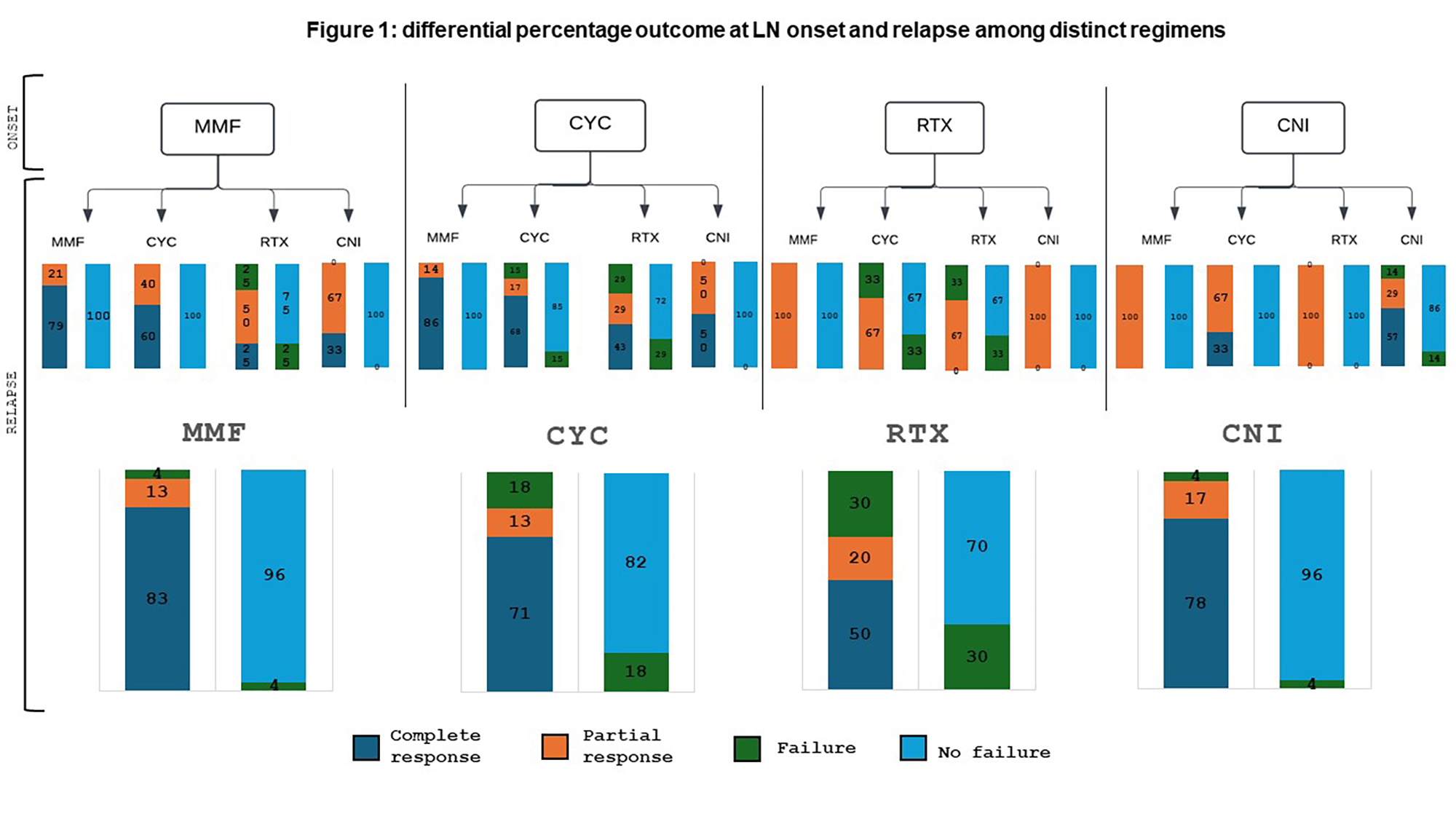
Results. Data from 286 patients and 474 LN episodes were analyzed, including 188 relapses. Median age at onset was 32 years (IQR 24–41). 111 patients (39%) experienced one or more relapse(s), occurring a median of 37 months (IQR 3–88) after onset. Median follow-up after relapse was 155 months (IQR 69–261). At onset, induction therapy included CYC (43%), MMF (20%), CNI (4%), and RTX (3%). For relapses, treatments included CYC (29%), MMF (25%), CNI (12%), and RTX (5%). Additional patients received azathioprine or corticosteroids only. Renal outcomes at onset vs relapse were: CR in 76% vs 79%, PR in 12% vs 10%, and FL in 11% vs 11%, respectively. CR rates were high with MMF (83%), CNI (78%), and CYC (71%), though CYC had a higher FL rate (18%) compared to others (4%). Among relapsing patients, 59% were switchers. Switchers had numerically higher CR rates than non-switchers (94% vs 76%, p=0.08). Among those who switched to MMF, patients previously treated with CYC had significantly higher CR rates compared to those previously treated with RTX (86% vs 0%, p=0.03), and also compared to MMF non-switchers (86% vs 79%, p=0.07). Switchers to CYC from MMF or CNI had no FL. CNI switchers and non-switchers had similar outcomes, with only 4% FL. No CR were observed in relapsing patients initially treated with RTX.
Conclusions. MMF and CYC are the most effective agents for inducing LN remission at both onset and relapse, with MMF associated with fewer failures. CNI are also effective at relapse, with low FL rates. RTX at onset may be associated with more severe relapses. Switching therapy after relapse may improve CR rates, without increasing PR or FL.
Downloads
Download data is not yet available.
How to Cite
1.
PO:16:234 | Differential efficacy of induction treatments for lupus nephritis at onset and relapses: an observational study: Giuseppe Alvise Ramirez1|2, Gabriele D Gallina1, Chiara Calabrese1|2, Serena Nannipieri1|2, Marta Calatroni3|4, Francesco Reggiani3|4, Giovanni Benanti1, Enrica Paola Bozzolo1, Raffaele Ceniccola2, Luca Moroni1|2, Marco Matucci-Cerinic1|2, Gabriella Moroni3|4, Lorenzo Dagna1|2 | 1IRCCS San Raffaele Hospital, Unit of Immunology, Rheumatology, Allergy and Rare Diseases Milan, Italy; 2Vita- Salute San Raffaele University Milan, Italy; 3IRCCS Humanitas Research Hospital, Nephrology and Dialysis Division Rozzano, Milan, Italy; 4Humanitas University, Department of Biomedical Sciences Rozzano, Milan, Italy. Reumatismo [Internet]. 2026 Mar. 18 [cited 2026 Oct. 17];77(s1). Available from: https://www.reumatismo.org/reuma/article/view/2334
Copyright (c) 2026 The Author(s)


This work is licensed under a Creative Commons Attribution-NonCommercial 4.0 International License.
PAGEPress has chosen to apply the Creative Commons Attribution NonCommercial 4.0 International License (CC BY-NC 4.0) to all manuscripts to be published.