
62nd National Congress of the Italian Society of Rheumatology
Vol. 77 No. s1 (2025): Abstract book of the 62th Conference of the Italian Society for...
 https://doi.org/10.4081/reumatismo.2025.2333
PO:16:227 | Anifrolumab for Systemic Lupus Erythematosus: Preliminary Safety and Efficacy Findings from the Italian Experience
Paola Bizioli1|2, Chiara Orlandi1|2, Claudia Barison1|2, Cesare Tomasi3, Alessia Caproli1, Silvia Piantoni1|2, Simona Signorini4, Emirena Garrafa4, Cecilia Nalli1, Micol Frassi1, Ilaria Cavazzana1|2, Micaela Fredi1|2, Franco Franceschini1|2 | 1Rheumatology and Clinical Immunology Unit - ERN ReCONNET, ASST Spedali Civili of Brescia, Italy; 2Department of Clinical and Experimental Sciences, University of Brescia, Italy; 3Department of Clinical and Experimental Sciences, University of Brescia, Italy; 4Laboratory of Clinical Chemistry, Department of Molecular and Translational Medicine, University of Brescia, Italy
Publisher's note
All claims expressed in this article are solely those of the authors and do not necessarily represent those of their affiliated organizations, or those of the publisher, the editors and the reviewers. Any product that may be evaluated in this article or claim that may be made by its manufacturer is not guaranteed or endorsed by the publisher.
All claims expressed in this article are solely those of the authors and do not necessarily represent those of their affiliated organizations, or those of the publisher, the editors and the reviewers. Any product that may be evaluated in this article or claim that may be made by its manufacturer is not guaranteed or endorsed by the publisher.
246
Views
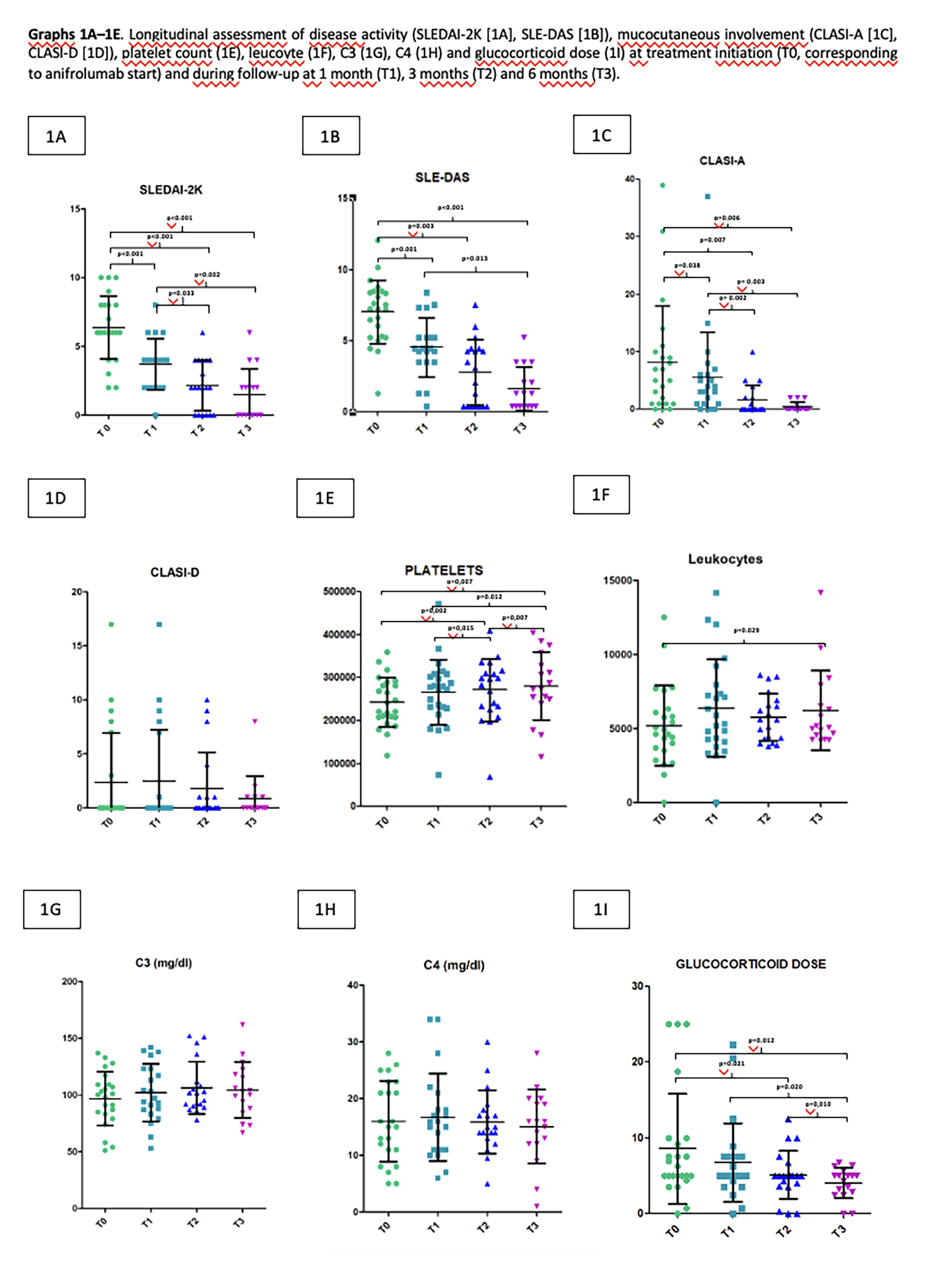
Methods. Patients starting anifrolumab by 30-Apr-2025 were included. Demographics, clinical data, disease activity scores (SLEDAI-2K, SLE-DAS), treatment, and adverse events were collected. Longitudinal data (SLEDAI-2K, SLE-DAS, complement, anti-dsDNA, corticosteroid (CSI) dose, haemoglobin, leukocyte, platelet) were assessed at predefined timepoints: T–3 (screening), T0 (treatment start), T1 (1 month), T2 (3 months), T3 (6 months), T4 (9 months) and T5 (1y ear). Statistical tests included paired t-test and GLM repeated measures.
Results. Twenty-four patients (F:M 5:1; 75% Caucasian) started anifrolumab at a mean age of 40.2 ± 14.5 years, with disease duration of 13.8 ± 12.3 years. Cumulative organ involvement included mucocutaneous (95.8%), articular (79.2%), haematological (54.2%) and renal (20.8%) manifestations. Treatment was mainly initiated for mucocutaneous (91.7%) and joint (58.3%) activity. Five patients (20.8%) were biologic-naïve; the mean number of prior conventional DMARDs was 2.67 ± 1.78. Baseline corticosteroid dose averaged 8.6 ± 7.3 mg/day. Mean SLEDAI-2K and SLE-DAS at T0 were 6.4 ± 2.3 and 7.0 ± 2.2, respectively. Thirteen patients (54.2%) developed infections (n=18), including 9 respiratory (4 pneumonias); 3 patients (12.5%) required hospitalization. No Herpes Zoster was observed; two patients developed labial herpes. There were 13 temporary and 3 permanent discontinuations (12.5%); temporary interruptions were not due to drug related adverse events but to infections or patient-related logistical issues. No specific corelation was observed between pneumonia and ongoing immunosuppressive therapy or CSI dosage. Baseline disease activity and serological markers were assessed in 22/24 patients. Disease activity at T0 was significantly higher than at T-3 (p<0.001), with progressive improvement and stabilization after T2. CLASI-A scores also improved (p=0.023). Complement, haemoglobin and leukocyte remained stable. Platelet counts increased significantly up to T2 (p=0.008), with a non-significant drop at T3. Anti-dsDNA positivity was less frequent at T3 vs T0, suggesting a trend toward seroreversion, though not statistically significant (p=0.063). CSI use declined significantly over time (p=0.009). Discussion In this small real-world cohort, anifrolumab was mainly used for mucocutaneous and articular SLE, showing rapid and significant disease activity reduction, followed by stabilization. CLASI-A improved significantly. CSI use decreased over time, supporting a steroid-sparing effect. Laboratory markers were mostly unchanged, except for a significant rise in platelet counts, with a later drop likely related to sample attrition at later timepoints. Infections were frequent but mostly mild. The main limitation is the small sample size (<30), which limits statistical power and generalizability.
Downloads
Download data is not yet available.
How to Cite
1.
PO:16:227 | Anifrolumab for Systemic Lupus Erythematosus: Preliminary Safety and Efficacy Findings from the Italian Experience: Paola Bizioli1|2, Chiara Orlandi1|2, Claudia Barison1|2, Cesare Tomasi3, Alessia Caproli1, Silvia Piantoni1|2, Simona Signorini4, Emirena Garrafa4, Cecilia Nalli1, Micol Frassi1, Ilaria Cavazzana1|2, Micaela Fredi1|2, Franco Franceschini1|2 | 1Rheumatology and Clinical Immunology Unit - ERN ReCONNET, ASST Spedali Civili of Brescia, Italy; 2Department of Clinical and Experimental Sciences, University of Brescia, Italy; 3Department of Clinical and Experimental Sciences, University of Brescia, Italy; 4Laboratory of Clinical Chemistry, Department of Molecular and Translational Medicine, University of Brescia, Italy. Reumatismo [Internet]. 2026 Mar. 18 [cited 2026 Oct. 16];77(s1). Available from: https://www.reumatismo.org/reuma/article/view/2333
Copyright (c) 2026 The Author(s)


This work is licensed under a Creative Commons Attribution-NonCommercial 4.0 International License.
PAGEPress has chosen to apply the Creative Commons Attribution NonCommercial 4.0 International License (CC BY-NC 4.0) to all manuscripts to be published.