
62nd National Congress of the Italian Society of Rheumatology
Vol. 77 No. s1 (2025): Abstract book of the 62th Conference of the Italian Society for...
 https://doi.org/10.4081/reumatismo.2025.2332
PO:16:226 | Clinical Phenotypes of Systemic Lupus Erythematosus: An Exploratory Cluster Analysis in a Monocentric Cohort
Richard Borrelli1, Stefania Nicola1, Federica Corradi1, Iuliana Badiu1, Luca Lo Sardo1, Marzia Boem1, Valentina Marmora1, Simone Negrini1, Luisa Brussino1 | 1SCDU Immunologia e Allergologia, AO Mauriziano, Dipartimento di Scienze Mediche, Università degli Studi di Torino, Italy
Publisher's note
All claims expressed in this article are solely those of the authors and do not necessarily represent those of their affiliated organizations, or those of the publisher, the editors and the reviewers. Any product that may be evaluated in this article or claim that may be made by its manufacturer is not guaranteed or endorsed by the publisher.
All claims expressed in this article are solely those of the authors and do not necessarily represent those of their affiliated organizations, or those of the publisher, the editors and the reviewers. Any product that may be evaluated in this article or claim that may be made by its manufacturer is not guaranteed or endorsed by the publisher.
90
Views
Materials and Methods. We retrospectively analyzed clinical data from a monocentric cohort of SLE patients followed at a tertiary care center, enrolled as per the 2019 EULAR/ACR classification criteria. Binary clinical variables were extracted, representing major organ/system involvement at diagnosis: cutaneous, articular, neuropsychiatric (NPSLE), renal, pulmonary, cardiac, and hematological (including AIHA, thrombocytopenia, and leukopenia). Only patients with complete data for all selected variables were included in the analysis. Hierarchical clustering was performed using Ward's method on standardized data. The optimal number of clusters was determined via visual inspection of a type-oriented dendrogram. Principal Component Analysis (PCA) was applied for two-dimensional visualization of the clusters.
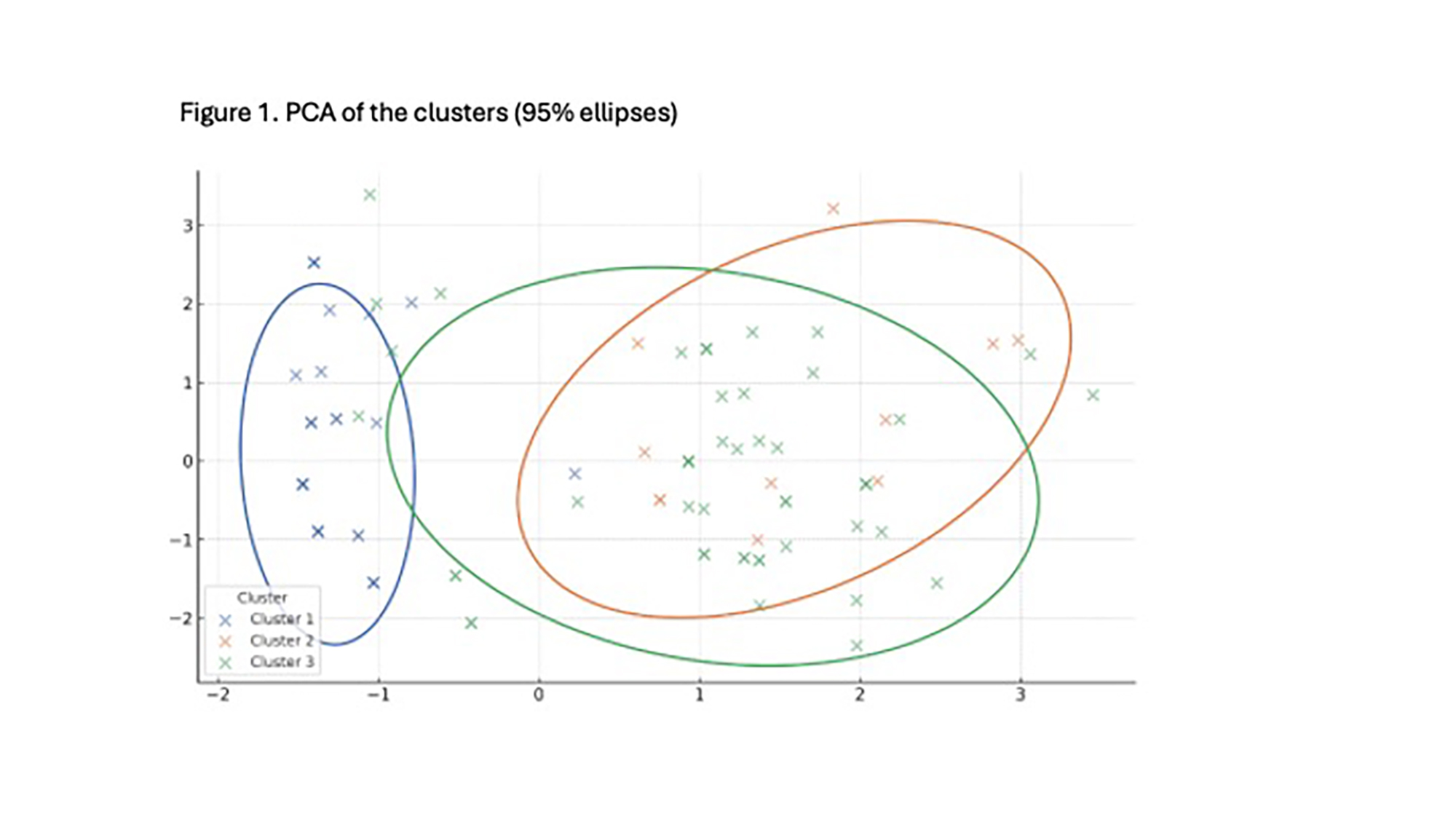
Results. A total of 119 SLE patients were included in the analysis. Three distinct clinical clusters were identified: - Cluster 1, Cutaneous-Articular (n = 62): included patients with high prevalence of articular (98%) and cutaneous (61%) involvement, with minimal major organ involvement. - Cluster 2, Renal- Hematologic (n = 22): was characterized by predominant hematologic manifestations (100% with autoimmune hemolytic anemia), frequently associated with renal (47%) and pulmonary involvement (10%). - Cluster 3, Neuro-Hematologic (n = 35): comprised patients with a combination of neuropsychiatric manifestations (21%), hematologic abnormalities (81%), and renal involvement (15%), suggesting a more complex and potentially severe disease profile. Specific results can be seen in the PCA biplot (figure 1). While Clusters 2 and 3 showed partial overlap in PCA visualization, they maintained distinct clinical features, particularly regarding the presence of NPSLE.
Conclusions. This exploratory cluster analysis identified three clinically distinct phenotypes of SLE based on organ involvement. While the cutaneous-articular cluster appeared less severe, the other two clusters showed broader systemic manifestations. These findings suggest that unsupervised learning techniques may aid in clinical classification of SLE and could inform future research on prognosis and therapy. Although limited by sample size and lack of formal validation, this study provides a rationale for further investigation in larger, multi-center cohorts.
Downloads
Download data is not yet available.
How to Cite
1.
PO:16:226 | Clinical Phenotypes of Systemic Lupus Erythematosus: An Exploratory Cluster Analysis in a Monocentric Cohort: Richard Borrelli1, Stefania Nicola1, Federica Corradi1, Iuliana Badiu1, Luca Lo Sardo1, Marzia Boem1, Valentina Marmora1, Simone Negrini1, Luisa Brussino1 | 1SCDU Immunologia e Allergologia, AO Mauriziano, Dipartimento di Scienze Mediche, Università degli Studi di Torino, Italy. Reumatismo [Internet]. 2026 Mar. 18 [cited 2026 Oct. 19];77(s1). Available from: https://www.reumatismo.org/reuma/article/view/2332
Copyright (c) 2026 The Author(s)


This work is licensed under a Creative Commons Attribution-NonCommercial 4.0 International License.
PAGEPress has chosen to apply the Creative Commons Attribution NonCommercial 4.0 International License (CC BY-NC 4.0) to all manuscripts to be published.