
62nd National Congress of the Italian Society of Rheumatology
Vol. 77 No. s1 (2025): Abstract book of the 62th Conference of the Italian Society for...
 https://doi.org/10.4081/reumatismo.2025.2331
PO:16:225 | Belimumab in refractory and/or non-criteria manifestations of antiphospholipid syndrome: ad interim analysis on Quality-of-Life changes from the BLAST trial
Alessio Conti1, Lois Ira Capulong1, Irene Cecchi1, Elena Rubini1, Chiara Bova1, Massimo Radin1, Alice Barinotti1, Beatrice Ala1, Silvia Grazietta Foddai1, Daniela Rossi1, Roberta Fenoglio1, Savino Sciascia1 | 1Centro di Eccellenza Universitario per le Malattie Nefrologiche, Reumatologiche e Rare, S.G.Bosco -ASL Città di Torino, Italy
Publisher's note
All claims expressed in this article are solely those of the authors and do not necessarily represent those of their affiliated organizations, or those of the publisher, the editors and the reviewers. Any product that may be evaluated in this article or claim that may be made by its manufacturer is not guaranteed or endorsed by the publisher.
All claims expressed in this article are solely those of the authors and do not necessarily represent those of their affiliated organizations, or those of the publisher, the editors and the reviewers. Any product that may be evaluated in this article or claim that may be made by its manufacturer is not guaranteed or endorsed by the publisher.
113
Views
Materials and Methods. In this ad interim analysis, we analyzed the first 14 patients who completed a set of structured questionnaires related to disease activity, fatigue, illness perception, and pain at baseline and after 20 weeks of treatment through Fatigue Severity Scale (FSS), Short Form-36 (SF-36), and Numeric Rating Scale (NRS). FSS included 9 statements rated on a 7-point Likert scale, with higher scores indicating greater fatigue. SF-36 questions were grouped into eight domains: physical functioning (10 items), role limitations due to physical health (4 items), bodily pain (2 items), general health (5 items), vitality (4 items), social functioning (2 items), role limitations due to emotional problems (3 items), emotional well-being (5 items), while the last item pertains to the overall health change. NRS assessed patients' subjective perceptions of their disease activity, pain, and general illness, on a scale from 0 (none) to 10 (worst imaginable).
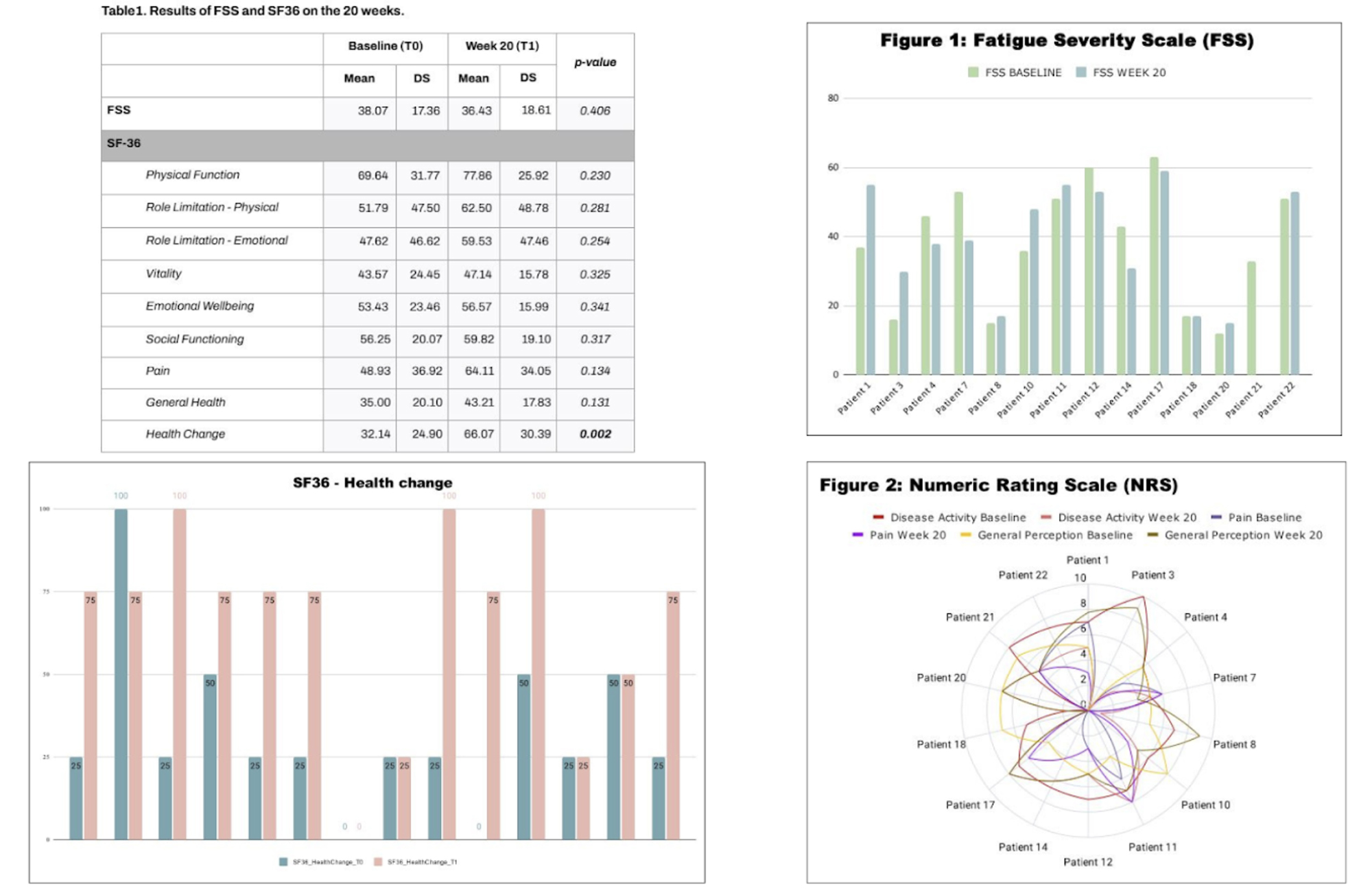
Results. At week 20, most patients reported a statistically significant improvement regarding their health change status, with scores more than doubling (an increase of 105.6%) compared to baseline. SF-36 scores generally reflected positive outcomes across most domains. Improvements were most frequently observed in general health (23.5%), pain (31%), and vitality (8.2%). Physical functioning (11.8%) and role limitations (both physical, 20.7% and emotional, 25%) showed modest improvements or remained stable. Emotional well-being (5.9%) and social functioning (6.4%) yielded mixed results Percentages reflect the degree of improvement relative to baseline. When referring to fatigue, the results were heterogeneous; seven patients reported increased fatigue, five reported decreased fatigue, one remained unchanged, and one questionnaire was incomplete (results are summarised in Table 1 and the graphs below). According to the NRS, regarding disease activity, the majority of patients (n= 8) reported improvement, while three reported worsening and one reported no change. Pain outcomes were mixed: two patients experienced less pain, three reported increased pain, and seven showed no change in their pain levels. Perceptions of general illness also varied: six patients reported worsening, four reported improvement, and two reported no change. Two patients were classified as non-responders.
Conclusions. Given the inherent limitations of interim analyses, these preliminary findings are encouraging. Ongoing long-term follow-up will be essential to confirm the positive trends observed and to gain a deeper understanding of belimumab’s impact on subjective APS-related outcomes.
Downloads
Download data is not yet available.
How to Cite
1.
PO:16:225 | Belimumab in refractory and/or non-criteria manifestations of antiphospholipid syndrome: ad interim analysis on Quality-of-Life changes from the BLAST trial: Alessio Conti1, Lois Ira Capulong1, Irene Cecchi1, Elena Rubini1, Chiara Bova1, Massimo Radin1, Alice Barinotti1, Beatrice Ala1, Silvia Grazietta Foddai1, Daniela Rossi1, Roberta Fenoglio1, Savino Sciascia1 | 1Centro di Eccellenza Universitario per le Malattie Nefrologiche, Reumatologiche e Rare, S.G.Bosco -ASL Città di Torino, Italy. Reumatismo [Internet]. 2026 Mar. 18 [cited 2026 Oct. 19];77(s1). Available from: https://www.reumatismo.org/reuma/article/view/2331
Copyright (c) 2026 The Author(s)


This work is licensed under a Creative Commons Attribution-NonCommercial 4.0 International License.
PAGEPress has chosen to apply the Creative Commons Attribution NonCommercial 4.0 International License (CC BY-NC 4.0) to all manuscripts to be published.