
62nd National Congress of the Italian Society of Rheumatology
Vol. 77 No. s1 (2025): Abstract book of the 62th Conference of the Italian Society for...
 https://doi.org/10.4081/reumatismo.2025.2330
PO:15:224 | Measuring disease activity in Systemic Lupus Erythematosus patients: SLE-DAS usefulness in real-life setting
Valeria Moretti, Fulvia Ceccarelli, Claudia Ciancarella, Cristina Garufi, Alessandra Ida Celia, Silvia Mancuso, Angelica Gattamelata, Simona Truglia, Francesca Romana Spinelli, Cristiano Alessandri, Fabrizio Conti | La sapienza Università di Roma, Italy
Publisher's note
All claims expressed in this article are solely those of the authors and do not necessarily represent those of their affiliated organizations, or those of the publisher, the editors and the reviewers. Any product that may be evaluated in this article or claim that may be made by its manufacturer is not guaranteed or endorsed by the publisher.
All claims expressed in this article are solely those of the authors and do not necessarily represent those of their affiliated organizations, or those of the publisher, the editors and the reviewers. Any product that may be evaluated in this article or claim that may be made by its manufacturer is not guaranteed or endorsed by the publisher.
80
Views
Methods. We evaluated consecutive patients. Disease activity was assessed by SLE-DAS, SLEDAI-2k and c-SLEDAI; then we evaluated the achievement of remission according to SLE-DAS definition (SLE-DAS <= 2.08 + PDN <= 5mg/daily) and to EULAR recommendations. Finally, we assessed chronic damage by applying the SLICC Damage Index (SDI). All the patients were prospectively evaluated after 12 months.
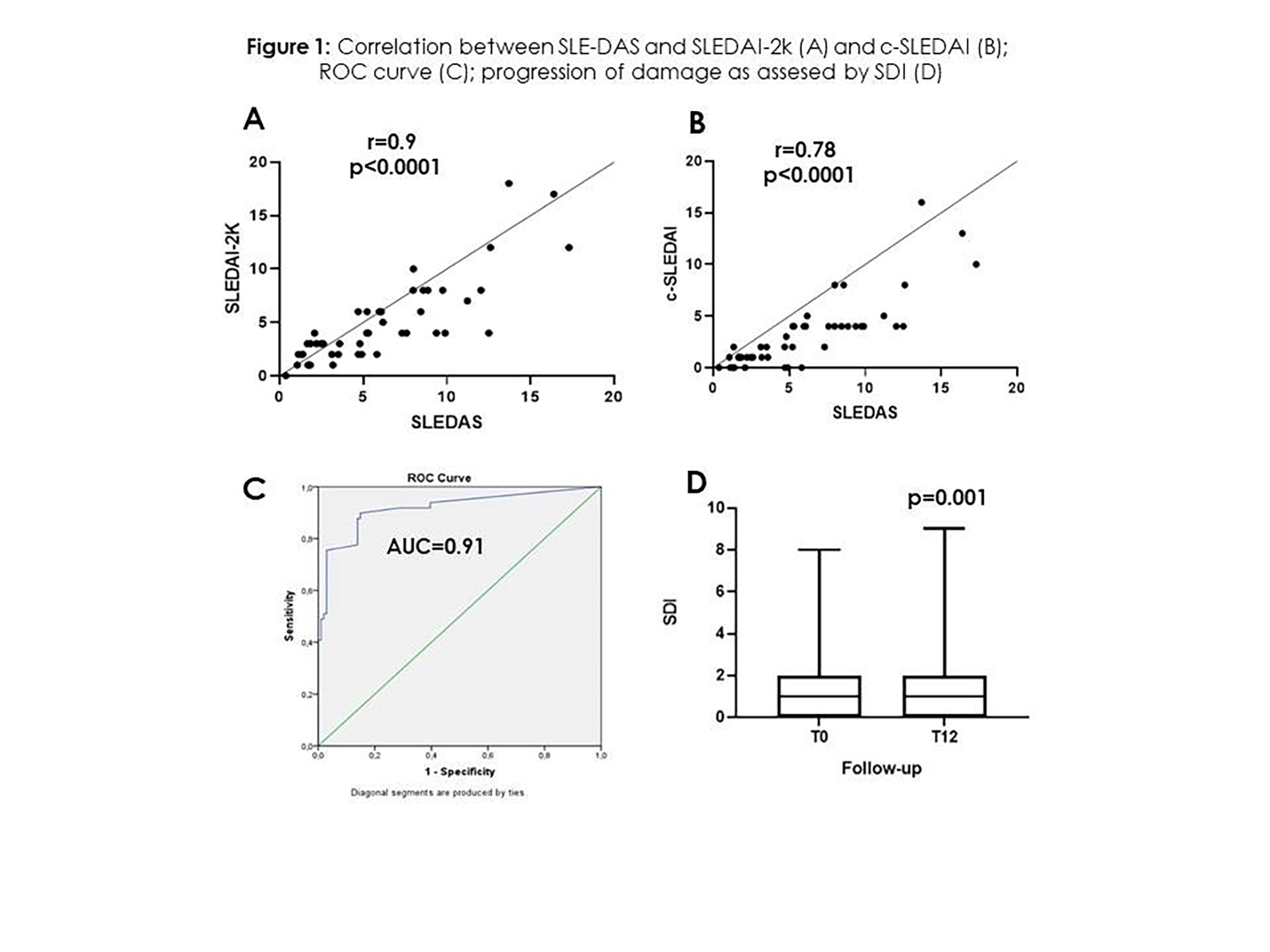
Results. We enrolled 150 patients [M/F 16/134, median age 50 years (IQR 16), median disease duration 191 months (IQR 213)]. At first evaluation, median val¬ues of SLE-DAS, SLEDAI-2k and c-SLEDAI were 1.12 (IQR 2,37), 2 (IQR 3,2), and 0 (IQR 1), respectively. A significant cor¬relation between SLE-DAS values and both SLEDAI-2k (r=0.9, p<0.0001, 95%CI 0.93-0.96,) and c-SLEDAI (r=0.78, p<0.0001, 95%CI 0.71-0.81) (figure 1A and 1B, respectively) was found. Then we assessed the prevalence of remission: 106 patients (70.6%) meet the SLE-DAS based definition, while 100 (66.6%) the one proposed by EULAR recommendations. Both definitions demonstrated an agreement of 94%, with a Cohen’s kappa equal to 0.6. Furthermore, by applying a ROC analysis we identified for SLE-DAS a cut-off value equal to 0.7 able to discriminate patients with EULAR-based remission (AUC 0.91; SE 0.028, 95%CI 0.86-0.97; figure 1C). Moving on damage assessment, 90 patients (60%) showed a SDI value >= 1 (mean±SD 1.2±1.46); after 12 month of follow-up we found a progression for chronic damage in 11 patients (7.3%), with a significant increase in SDI values (p=0.001; figure 1D). Finally, we compared patients with and without progression in SDI values: progressorsshowed higher median SLE-DAS values at baseline compared with non progressors [2.1 (IQR 4.8) versus 1.3 (IQR 2.1), p=ns).
Conclusions. Our analysis suggests the usefulness of SLE-DAS in a real-life context. This feasible index appears able to identify patients in remission according to EULAR-based remission and could provide information about the trajectory of chronic damage. Then, the use of SLE-DAS could facilitate disease activity assessment even in a routine setting.
Downloads
Download data is not yet available.
How to Cite
1.
PO:15:224 | Measuring disease activity in Systemic Lupus Erythematosus patients: SLE-DAS usefulness in real-life setting: Valeria Moretti, Fulvia Ceccarelli, Claudia Ciancarella, Cristina Garufi, Alessandra Ida Celia, Silvia Mancuso, Angelica Gattamelata, Simona Truglia, Francesca Romana Spinelli, Cristiano Alessandri, Fabrizio Conti | La sapienza Università di Roma, Italy. Reumatismo [Internet]. 2026 Mar. 18 [cited 2026 Oct. 16];77(s1). Available from: https://www.reumatismo.org/reuma/article/view/2330
Copyright (c) 2026 The Author(s)


This work is licensed under a Creative Commons Attribution-NonCommercial 4.0 International License.
PAGEPress has chosen to apply the Creative Commons Attribution NonCommercial 4.0 International License (CC BY-NC 4.0) to all manuscripts to be published.