
PO:15:216 | Safety and Efficacy of a single dose of Rituximab to manage Pregnancy-Related Severe Flare of Systemic Lupus Erythematosus: A Case Report
Eugenio Capparelli1, Daniela Bompane1, Eleonora Zaccara1, Laura Castelnovo1, Antonio Tamburello1, Antonino Mazzone2, Paola Faggioli1 | 1UOC Reumatologia, ASST Ovest Milanese, Legnano, Milano, Italy; 2UOC Medicina Interna, ASST Ovest Milanese, Legnano, Milano, Italy
Abstract
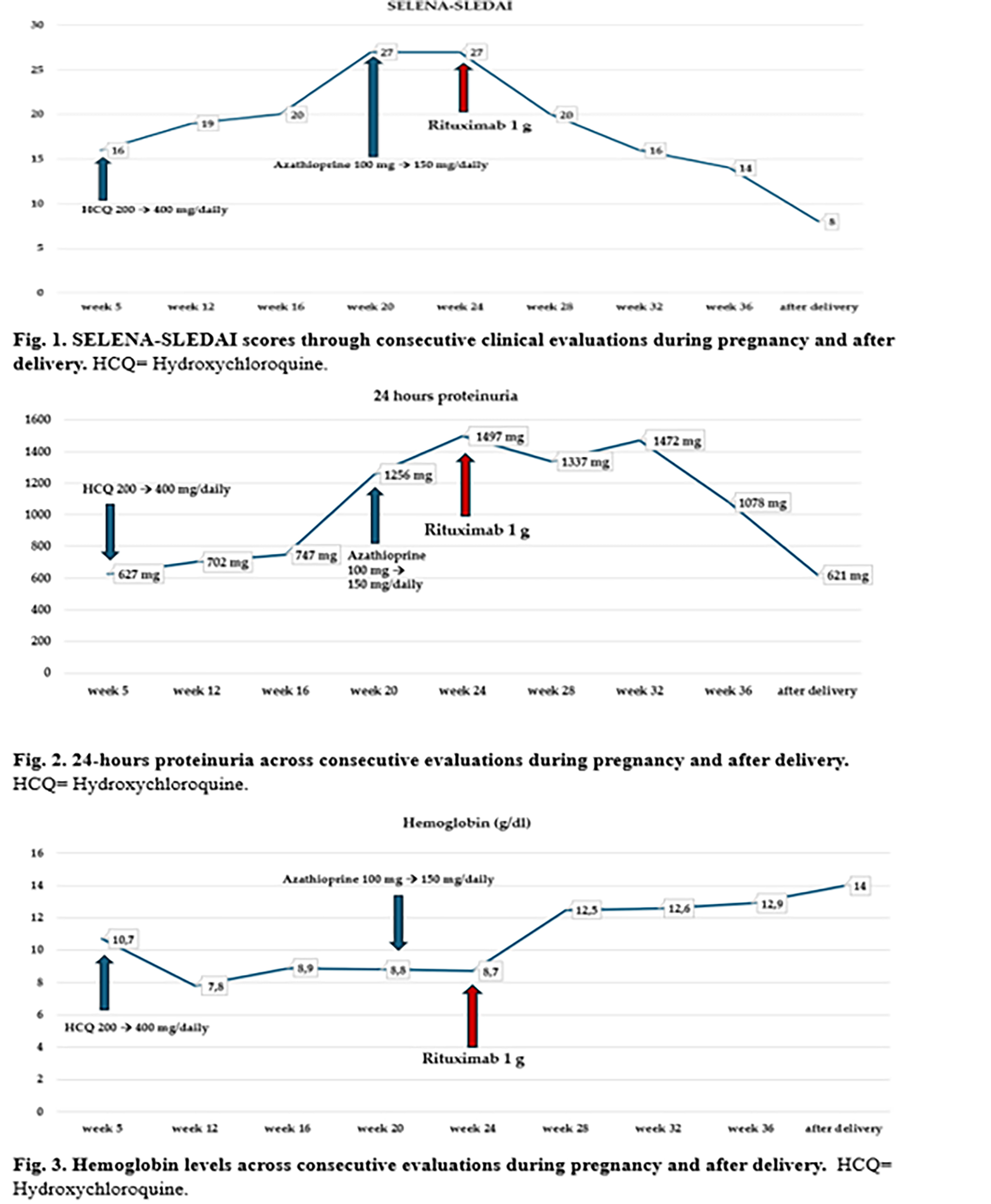
Background. This case report explores the safety and efficacy of a single dose of rituximab in a patient with SLE who developed significant disease flare along-with a new onset proteinuria during pregnancy. Case Presentation We present the case of a 34-year-old woman diagnosed with SLE at the age of 28, initially treated with hydroxychloroquine (200 mg/daily) and low dose of steroid. The autoimmune profile revealed positivity for double-stranded DNA (dsDNA), anti-Ro/SSA and anti-La/SSB and antiphospholipid antibodies. Relevantly, the patient had no prior history of pregnancy loss or thrombotic events. In July 2023, the patient presented with acute hemolytic anemia necessitating add on therapy with Azathioprine (100 mg/daily). In May 2024 the patient underwent to an unplanned pregnancy. During a clinical referral at 5 weeks of gestation, elevated disease activity was observed (SELENA-SLEDAI score of 16), accompanied by general malaise, fatigue, arthritis, mild anemia, and lymphopenia. Additionally, there were increased inflammatory markers and complement consumption, along with the new onset of proteinuria measured at 627 mg in a 24-hour collection. At week 12, the patient experienced further clinical worsening, marked by a significant decrease in hemoglobin levels (7.8 mg/dL), a notable increase in 24-hours proteinuria (1256 mg) and a rise in the SELENA-SLEDAI score to 20. This necessitated a rapid escalation of treatment, including full doses of glucocorticoids, azathioprine and hydroxychloroquine, along with iron supplementation therapy. However, only hemoglobin levels slightly improved to 8.9 mg/dL, while disease activity, inflammatory markers and proteinuria continued to rise until week 24. (Fig.1). This prompted the decision to initiate anti-CD20 rituximab (RTX) treatment, in a single dose of 1 g. The infusion was performed in week 23 and was well-tolerated, without significant complications or infectious processes. Following RTX infusion, at week 28, hemoglobin, complement and inflammatory markers levels showed rapid improvement, while proteinuria remained stable. The delivery occurred preterm at week 36 due to premature rupture of the membranes. A healthy male newborn weighed 3010 g with an APGAR score of 9. Throughout the pregnancy, the newborn was monitored with fetal echocardiography for potential atrioventricular block and no pathological congenital alterations were detected. The newborn underwent biohumoral and hematological analysis, which showed a normal white blood cell count. Maternal blood loss during delivery was 850 mL, with a post-delivery hemoglobin level of 8.5 mg/dL. Four weeks postpartum, maternal 24-hours proteinuria decreased up to 627 mg, hemoglobin increased to 14 mg/dL, while SELENA-SLEDAI score reduced to 8 points.
Conclusions. To our knowledge, this is the first reported case of a patient receiving rituximab for active lupus with new-onset renal involvement during pregnancy. Rituximab may represent a safe and effective therapeutic approach for managing SLE-related manifestations in this complex clinical scenario.
Conclusions. To our knowledge, this is the first reported case of a patient receiving rituximab for active lupus with new-onset renal involvement during pregnancy. Rituximab may represent a safe and effective therapeutic approach for managing SLE-related manifestations in this complex clinical scenario.
Keywords
Metrics
Citations and online attention from Dimensions, Altmetric and PlumX.
License
Copyright (c) 2026 The Author(s)

This work is licensed under a Creative Commons Attribution-NonCommercial 4.0 International License.
PAGEPress has chosen to apply the Creative Commons Attribution NonCommercial 4.0 International License (CC BY-NC 4.0) to all manuscripts to be published.