
62nd National Congress of the Italian Society of Rheumatology
Vol. 77 No. s1 (2025): Abstract book of the 62th Conference of the Italian Society for...
 https://doi.org/10.4081/reumatismo.2025.2326
PO:15:212 | Anifrolumab induces a rapid improvement in joint inflammation in Systemic Lupus Erythematosus patients: an ultrasonographic study
Valeria Moretti, Fulvia Ceccarelli, Claudia Ciancarella, Valerio Fiorilli, Francesca Romana Spinelli, Fabrizio Conti | Sapienza Università di Roma, Italy
Publisher's note
All claims expressed in this article are solely those of the authors and do not necessarily represent those of their affiliated organizations, or those of the publisher, the editors and the reviewers. Any product that may be evaluated in this article or claim that may be made by its manufacturer is not guaranteed or endorsed by the publisher.
All claims expressed in this article are solely those of the authors and do not necessarily represent those of their affiliated organizations, or those of the publisher, the editors and the reviewers. Any product that may be evaluated in this article or claim that may be made by its manufacturer is not guaranteed or endorsed by the publisher.
86
Views
Methods. We collected data about SLE patients treated by ANF for prevalent joint involvement. The drug was prescribed according to the current clinical practice. Treatment response was evaluated at baseline (T0) and after 1 month (T1) and three months (T2) by performing US assessment and by using clinimetric indices. Indeed, US, performed by using a MyLab Eight Exp (Esaote, Genoa, Italy) machine, was made at level of bilateral metacarpophalangeal and proximal interphalangeal of the hands. At each joint, according to the OMERACT definitions, we evaluated the presence of US inflammatory features (synovial effusion, synovial hypertrophy and Power Doppler - PD), each measured with a semiquantitative score (0–3), resulting in a total US inflammatory score (0–180). We also evaluated the total PD score (0-60). Furthermore, we evaluated disease activity (by using DAS28pcr, CDAI, SDAI and SLEDAI-2k) and glucocorticoids (GCs) dosage (PDN equivalent, mg/daily) during the follow-up.
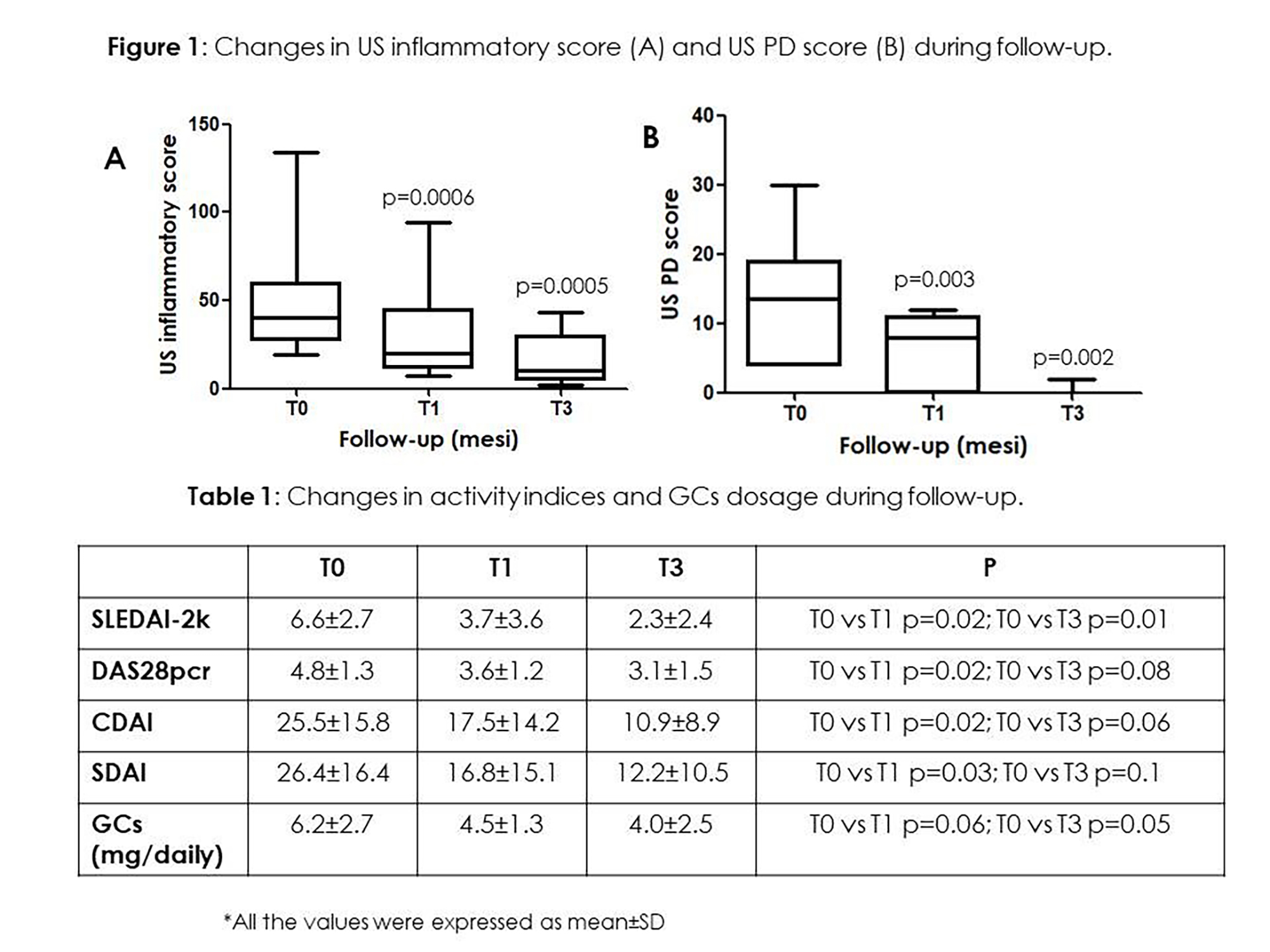
Results. We evaluated 10 female patients [mean age 49 years (IQR 20.5), mean disease duration 222 months (IQR 141)]. US evaluation allowed to identify a significant reduction of mean inflammatory score after 1 months of treatment (T0: 50.6±34.4; T1: 30.7±28.4, p=0.006), maintained after 3 months (T3: 15.4±15.2; p=0.0005). Interestingly, we found a similar results for US power Doppler score (T0: 13.5±8.5; T1: 6.4±5.1; T3: 0.3±0.7; To versus T1 p=0.003; T1 versus T3 p=0.002). These results were graphically represented in Figure 1A and 1B. Table 1 reported data about changes in activity indices and GCs dosage. We found a significant decrease in SLEDAI-2k values at T1 and T3, while for the other indices we found a significant reduction only at T1.
Conclusions. Our study, made in a real-life scenario, suggests that ANF may be able to intervene in joint synovitis as shown by the reduction in US scores in the early stages of treatment. In particular, the rapid effect on PD signal could suggest the ability of this drug to prevent the development of erosive damage. The dissociation between US response and joint activity indices could be related to the systemic nature of SLE and the possible presence of other symptoms, such as myalgia and asthenia, that may influence the patient's response to disease activity.
Downloads
Download data is not yet available.
How to Cite
1.
PO:15:212 | Anifrolumab induces a rapid improvement in joint inflammation in Systemic Lupus Erythematosus patients: an ultrasonographic study: Valeria Moretti, Fulvia Ceccarelli, Claudia Ciancarella, Valerio Fiorilli, Francesca Romana Spinelli, Fabrizio Conti | Sapienza Università di Roma, Italy. Reumatismo [Internet]. 2026 Mar. 18 [cited 2026 Oct. 16];77(s1). Available from: https://www.reumatismo.org/reuma/article/view/2326
Copyright (c) 2026 The Author(s)


This work is licensed under a Creative Commons Attribution-NonCommercial 4.0 International License.
PAGEPress has chosen to apply the Creative Commons Attribution NonCommercial 4.0 International License (CC BY-NC 4.0) to all manuscripts to be published.