
62nd National Congress of the Italian Society of Rheumatology
Vol. 77 No. s1 (2025): Abstract book of the 62th Conference of the Italian Society for...
 https://doi.org/10.4081/reumatismo.2025.2324
PO:14:201 | Olfactory Assessment in Patients with Systemic Lupus Erythematosus: Correlation with Clinical, Serological, and Imaging Markers
Lorenza Bruno1, Giacomo Cafaro1, Marta Di Berardino1, Roberto Dal Pozzolo1, Anna Colangelo1, Francesco Tromby1, Martina Nicchi1, Giulia Cruciani1, Biancamaria Pianese1, Roberto Gerli1, Elena Bartoloni Bocci1, Carlo Perricone1 | 1Università degli Studi di Perugia, Italy
Publisher's note
All claims expressed in this article are solely those of the authors and do not necessarily represent those of their affiliated organizations, or those of the publisher, the editors and the reviewers. Any product that may be evaluated in this article or claim that may be made by its manufacturer is not guaranteed or endorsed by the publisher.
All claims expressed in this article are solely those of the authors and do not necessarily represent those of their affiliated organizations, or those of the publisher, the editors and the reviewers. Any product that may be evaluated in this article or claim that may be made by its manufacturer is not guaranteed or endorsed by the publisher.
258
Views
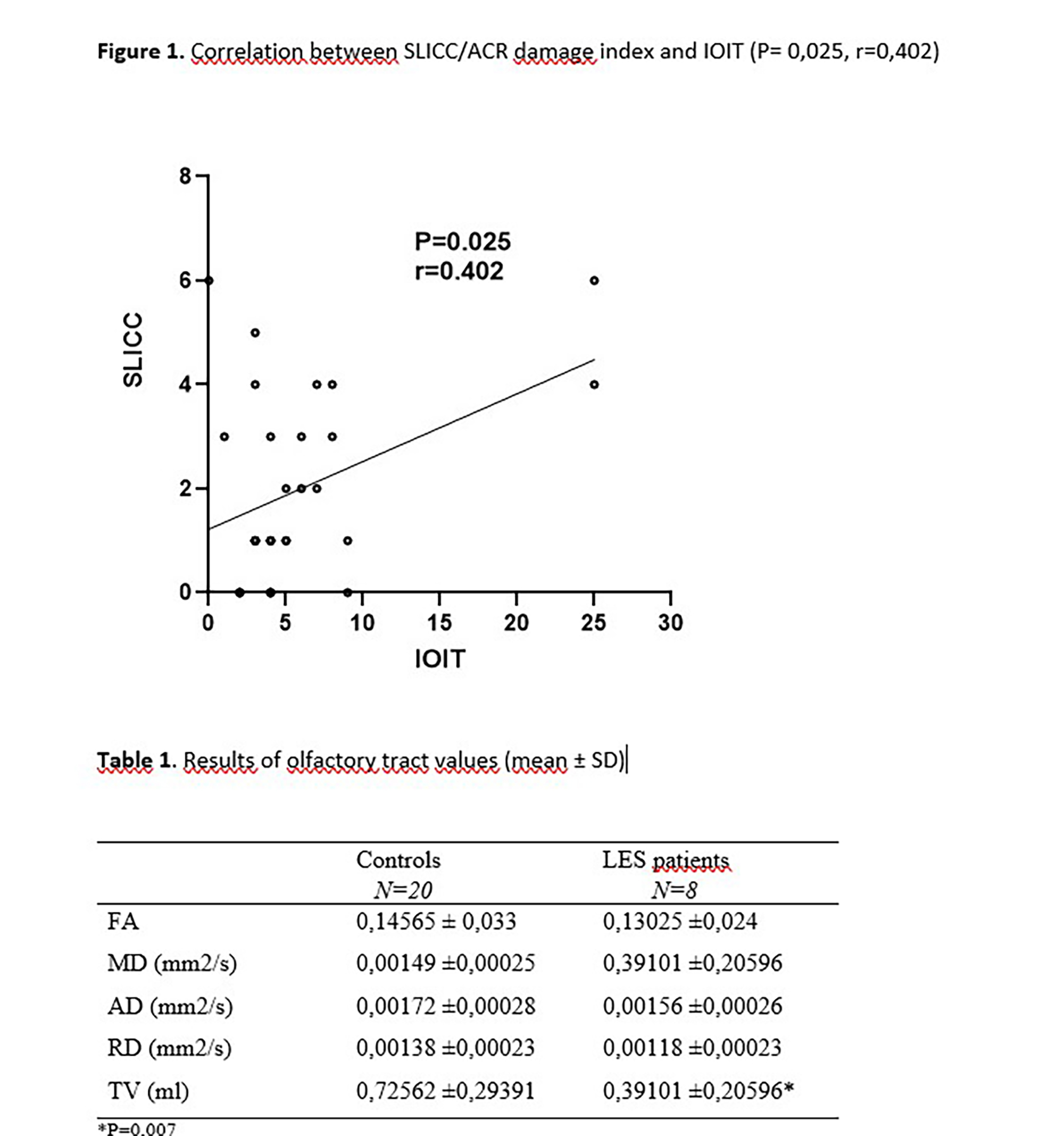
Results. Olfactory dysfunction (hyposmia) was observed in 40% of SLE patients. IOIT scores correlated significantly with cumulative damage (SLICC; p <0.01)(Fig.1). Trends, though not statistically significant, were observed between hyposmia and both antidepressant use and anti-beta-2 glycoprotein I (anti-B2GPI)antibodies. MRI analysis was feasible in 8 of the 20 MRI-scanned SLE patients. Compared with controls, SLE patients showed a significant reduction in olfactory tract volume (p = 0.007), along with increased FA, MD, RD, and AD values, consistent with microstructural alterations (Tab 1).
Conclusions. this study highlights a high prevalence of olfactory dysfunction in SLE and its association with cumulative organ damage, suggesting hyposmia as a potential clinical marker. Anti-B2GPI antibodies and antidepressant may represent contributing factors. DTI and tractography findings support a central, possibly ischemic or inflammatory, origin of olfactory impairment. These results underscore the relevance of olfactory assessment as a potential indicator of neuropsychiatric involvement and overall disease burden in SLE.
Downloads
Download data is not yet available.
How to Cite
1.
PO:14:201 | Olfactory Assessment in Patients with Systemic Lupus Erythematosus: Correlation with Clinical, Serological, and Imaging Markers: Lorenza Bruno1, Giacomo Cafaro1, Marta Di Berardino1, Roberto Dal Pozzolo1, Anna Colangelo1, Francesco Tromby1, Martina Nicchi1, Giulia Cruciani1, Biancamaria Pianese1, Roberto Gerli1, Elena Bartoloni Bocci1, Carlo Perricone1 | 1Università degli Studi di Perugia, Italy. Reumatismo [Internet]. 2026 Mar. 18 [cited 2026 Oct. 16];77(s1). Available from: https://www.reumatismo.org/reuma/article/view/2324
Copyright (c) 2026 The Author(s)


This work is licensed under a Creative Commons Attribution-NonCommercial 4.0 International License.
PAGEPress has chosen to apply the Creative Commons Attribution NonCommercial 4.0 International License (CC BY-NC 4.0) to all manuscripts to be published.