
62nd National Congress of the Italian Society of Rheumatology
Vol. 77 No. s1 (2025): Abstract book of the 62th Conference of the Italian Society for...
 https://doi.org/10.4081/reumatismo.2025.2320
PO:14:196 | Photosensitivity in Lupus Erythematosus: The Patients' Perspective in a National Survey
Marianna Salis1, Elisabetta Chessa2, Alessandra Oliva1, Marta Paola Pireddu1, Fabio Congiu1, Giulia Rizzo1, Elena Ragusa1, Alberto Cauli1|2, Laurent Arnaud3, Matteo Piga1|2 | 1Università degli Studi di Cagliari, Italy; 2Azienda Ospedaliera Universitaria di Cagliari, Unità Operativa Complessa di Reumatologia Cagliari, Italy; 3Strasbourg University and Academic Hospitals Strasbourg, France
Publisher's note
All claims expressed in this article are solely those of the authors and do not necessarily represent those of their affiliated organizations, or those of the publisher, the editors and the reviewers. Any product that may be evaluated in this article or claim that may be made by its manufacturer is not guaranteed or endorsed by the publisher.
All claims expressed in this article are solely those of the authors and do not necessarily represent those of their affiliated organizations, or those of the publisher, the editors and the reviewers. Any product that may be evaluated in this article or claim that may be made by its manufacturer is not guaranteed or endorsed by the publisher.
135
Views
Materials and Methods. The study was conducted involving adult patients affected by clinically confirmed Systemic LE (SLE) or Cutaneous LE (CLE). Patients voluntarily completed a 46-question questionnaire, in Italian, administered online, within the framework of the international PHOTOLUP study. Data were analyzed using descriptive statistics.
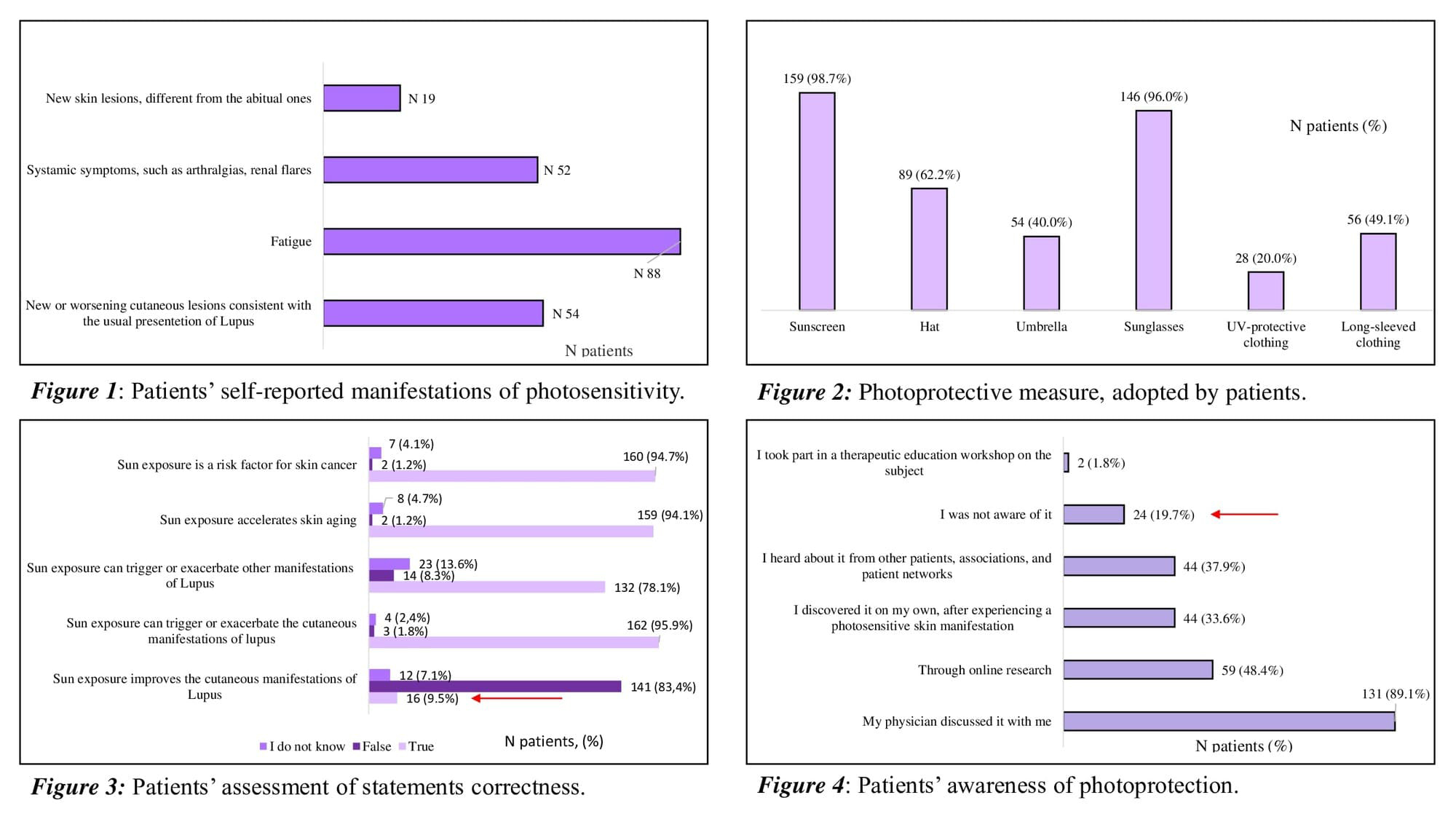
Results. A total of 170 patients completed the survey, of whom 157 (92.4%) had clinically confirmed SLE and 4 (2.4%) had isolated CLE. The study population was predominantly female (161, 94.7%) with a mean age of 41.1 years (SD±13.9). More than half of the cohort (97, 57.1%) exhibited Fitzpatrick skin phototype III. 116 (68.6%) patients reported having experienced photosensitivity symptoms during their lifetime, described as the onset or exacerbation of systemic symptoms or skin lesions following exposure to sunlight. The most frequent symptoms are reported in figure 1. Within the study population, 6.1% reported not using any form of photoprotective measures. The most commonly adopted photoprotective strategy was the use of sunscreen, as shown in figure 2. Figure 3 summarizes the level of awareness and knowledge of our population. Notably, 19.7% of participants stated they were not aware of the importance of photoprotection in the context of the disease (figure 4). Patients also reported feeling concerned about leaving their home (58, 43.3%) or avoided engaging in outdoor activities (58, 43.3%) due to the possibility that sun exposure might trigger a disease flare-up.
Conclusions. Despite PS being a common feature, patients are sometimes unaware of the potential harmful effects of Ultraviolet exposure and of the importance of adopting appropriate photoprotective strategies. These results suggest the need for implementing educational interventions during clinical consultations, given that photoprotection begins with patient education.
Downloads
Download data is not yet available.
How to Cite
1.
PO:14:196 | Photosensitivity in Lupus Erythematosus: The Patients’ Perspective in a National Survey: Marianna Salis1, Elisabetta Chessa2, Alessandra Oliva1, Marta Paola Pireddu1, Fabio Congiu1, Giulia Rizzo1, Elena Ragusa1, Alberto Cauli1|2, Laurent Arnaud3, Matteo Piga1|2 | 1Università degli Studi di Cagliari, Italy; 2Azienda Ospedaliera Universitaria di Cagliari, Unità Operativa Complessa di Reumatologia Cagliari, Italy; 3Strasbourg University and Academic Hospitals Strasbourg, France. Reumatismo [Internet]. 2026 Mar. 18 [cited 2026 Oct. 19];77(s1). Available from: https://www.reumatismo.org/reuma/article/view/2320
Copyright (c) 2026 The Author(s)


This work is licensed under a Creative Commons Attribution-NonCommercial 4.0 International License.
PAGEPress has chosen to apply the Creative Commons Attribution NonCommercial 4.0 International License (CC BY-NC 4.0) to all manuscripts to be published.